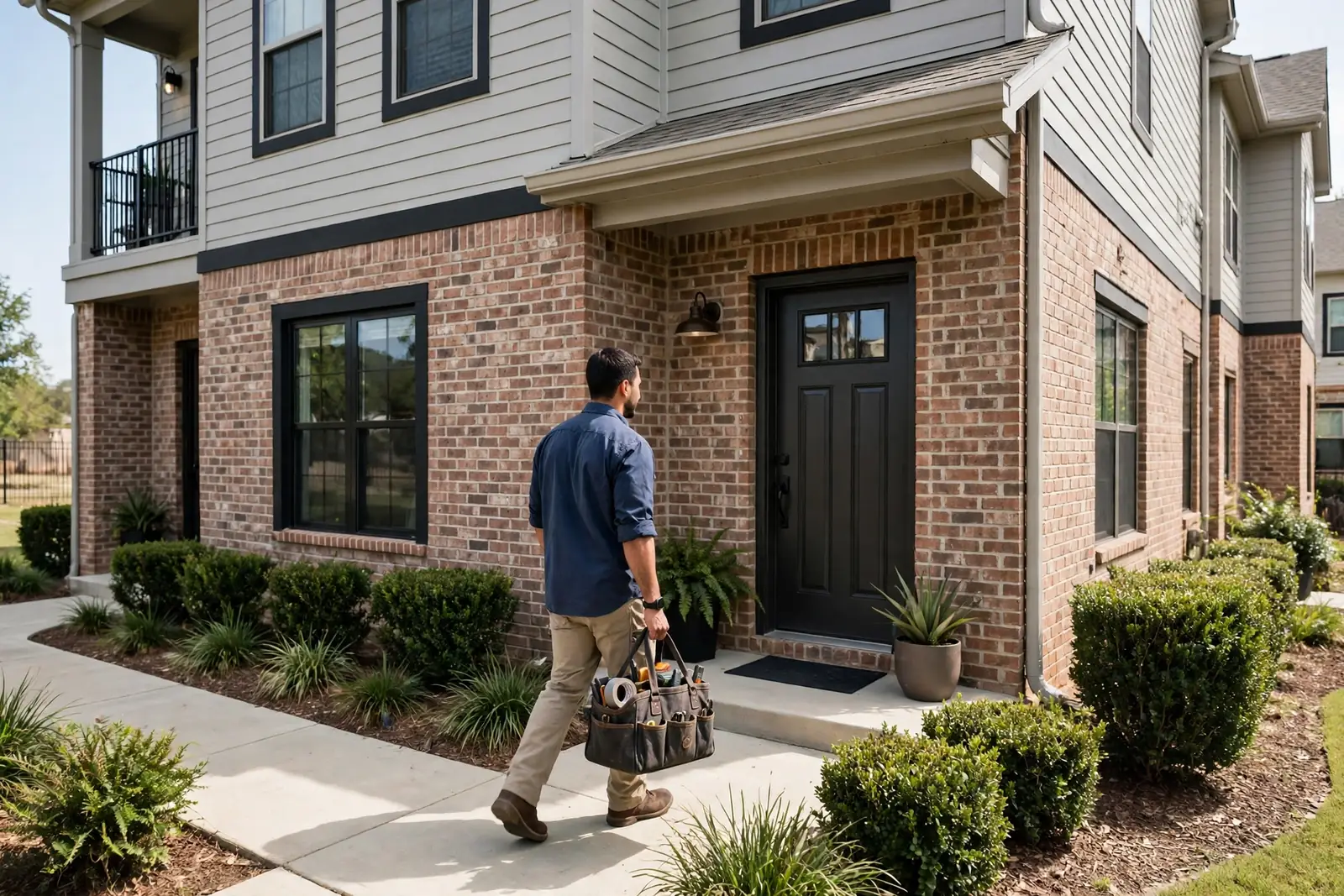
Tankless Water Heaters for Rental Properties in Sugar Land, TX
A leak or a cold shower in a rental has a tenant living with the problem, a landlord who owns the unit, and sometimes a manager in between. The first question is who calls — and the second is what to check first.
Need help with your tankless water heater?
Call Now to reach a local tankless water heater professional. Describe the unit, the symptoms, and any error code on the display.
Hours: Mon–Fri 7:00 AM–10:00 PM ET · Sat 8:00 AM–10:00 PM ET · Sun 7:00 AM–9:00 PM ET
Who calls, and what to say
A rental tankless problem has three parties: the tenant who lives with it, the landlord who owns the unit, and sometimes a property manager in between. The tenant is usually the first to know — the shower is cold, the unit is leaking, the display shows a code. The landlord or manager is usually the one who calls, because the unit is their asset and the repair is their decision. The call works smoothly when the tenant report travels with it: the symptoms, the error code, and when the problem started.
The information that matters is the same as for a family home: the make of the unit if it is known, the symptoms, any error code on the display, and whether the unit is leaking. A photo of the display and the label helps, and so does the age of the unit and when it was last descaled — if anyone knows. A rental unit that has never been descaled is a common finding, because the tenant does not own the maintenance and the landlord does not live with the symptoms.
The visit is arranged around access. The tenant holds the keys and the schedule, the landlord holds the decision, and the manager often holds both. The work itself is the same as any tankless visit — diagnosis at the unit, a plain explanation, then the repair or replacement — but the explanation goes to the party who decides, and the record goes to the party who keeps it.
The problems rentals meet most
No hot water is the rental emergency, because the tenant cannot shower, wash dishes or do laundry. The diagnosis is the same as any no-heat call: display, flow, supply, filter, scale, and then the parts. An error code names the fault. Flow and temperature are measured. The inlet filter is pulled and looked at. The heat exchanger is assessed. The most common rental fault is scale — a unit that has never been descaled in hard water, in a home where the tenant never knew it needed one.
Leaks are the second rental problem, and they matter more in a rental because the damage spreads to a property the tenant does not own. A connection leak, a relief valve leak, a condensate drain leak, or a heat exchanger leak — each one is traced to its source, and the water is shut off at the isolation valves where it is safe to do so. The tenant is told what to do while waiting: shut off the water, move valuables, mop up what can be reached.
The third rental problem is the one nobody reports: the slow decline. A unit that heats a little less every month, a shower that takes a little longer to warm up, a flow that drops a little at a time. The tenant adapts and does not call, and the landlord does not know, until the error codes start. The yearly maintenance visit is what catches that decline — and in a rental, the visit is the landlord responsibility, scheduled whether or not anyone has complained.
Maintenance and the descaling routine
A rental tankless unit needs the same yearly routine as any other unit in Sugar Land water: a descale and flush about once a year, with the inlet filter cleaned at the same time. The difference is ownership of the routine. The tenant lives with the unit but does not own it; the landlord owns it but does not live with it. The routine therefore needs scheduling, not waiting for a complaint — and the visit is the record that it happened.
The record matters in a rental for a second reason: the maker care guidance. Most unit makers state a descaling interval for hard-water areas, and damage caused by lime, scale or sediment is commonly excluded where the stated maintenance was skipped. A rental unit that has never been descaled and then fails on scale is a unit whose maker will not stand behind the heat exchanger — and the cost lands on the landlord, not the tenant.
The maintenance visit is also the moment the freeze question is asked. A unit on an outside wall or in an unheated space needs its freeze protection checked before winter, and the tenant needs to know the drain-down steps for a hard cold snap. The February 2021 freeze cracked units across the Houston area, and a rental unit that was never protected is a liability the landlord carries.
Repair or replace in a rental
The repair-or-replace decision in a rental turns on the same three things as anywhere else: what failed, how old the unit is, and what the heat exchanger looks like. A failed sensor or igniter is a repair. A leaking heat exchanger is usually a replacement. The difference is the decision-maker: the landlord decides, and the decision is about the asset, not about the inconvenience of the moment.
A replacement in a rental is also the chance to fix the sizing. A unit that was sized for the plan rather than the household will go lukewarm when two showers run, and the tenant will call about it — repeatedly. A replacement that sizes correctly ends those calls. A repair on an undersized unit leaves them in place, and the landlord pays for the visits.
Turnover is the moment to act. Between tenants, the unit can be descaled, inspected and tested without anyone living with the disruption, and a unit that is near the end of its life can be replaced before the next tenant moves in. The turnover visit is the simplest point on the curve, and it is the one landlords most often skip.
Documentation for the claim and the file
Every rental visit ends with a record: what was found, what was done, and what to watch next. The record goes to the landlord or the manager, and it serves three purposes — the maintenance file, the maker care record, and the evidence if a leak has caused damage and a claim follows. Photos of the display, the error code, the leak and the flush water are part of it.
A leak that has damaged the property needs the record most. The photos, the readings and the written note of what was found are what the insurer asks for, and they are also what the landlord needs to show the work was done properly. The visit produces that record as part of the job, not as an extra.
Turnover: the moment to act
Turnover between tenants is the moment to act on a rental tankless unit. The home is empty, the unit can be descaled, inspected and tested without anyone living with the disruption, and a unit that is near the end of its life can be replaced before the next tenant moves in. The turnover visit is the simplest point on the curve — the work happens once, on the landlord schedule, and the next tenant arrives to a unit that has been checked.
The turnover visit covers the same ground as any yearly visit, with one difference: it is the moment to decide. A unit that is declining — lukewarm water, slow flow, repeated error codes — can be replaced now, on the landlord schedule, rather than later, at midnight, with a tenant without hot water and water on the floor. A unit that is healthy is descaled, inspected and recorded, and the record goes to the file.
The record from a turnover visit serves the landlord three ways: the maintenance file, the maker care record, and the evidence if a leak has caused damage and a claim follows. Photos of the display, the error code, the leak and the flush water are part of it. A landlord who keeps that record has a unit whose history is known, and a history that is known is a history that protects the asset.
Services used most
Tankless Water Heater Repair · Emergency Tankless Water Heater Repair · Tankless Water Heater Maintenance · Tankless Water Heater Replacement
Where we work
Related guides
How Often to Flush a Tankless Unit · How Long Tankless Units Last · Freeze Protection for Texas Units
Related problems
Frequently asked questions
Questions people ask about tankless water heaters in rental properties, answered plainly.
Usually the landlord or the property manager, because the unit is their asset and the repair is their decision. The tenant report should travel with the call: the symptoms, the error code, and when the problem started.
Shut off the water at the isolation valves and the gas or power where it is safe to do so, move valuables, mop up what can be reached, and call the landlord or manager. Do not open the unit casing.
Usually the landlord, as the owner of the unit. The routine is about once a year in Sugar Land water, and it needs scheduling rather than waiting for a complaint — the tenant lives with the unit but does not own the maintenance.
About once a year: a descale and flush, an inlet-filter clean, a burner and vent check, and a freeze-protection check before winter. Turnover between tenants is the natural moment for the visit.
Call with the symptoms and the history. A unit cracked in that cold snap can leak months or years later, and freeze damage to a heat exchanger usually points toward replacement rather than repair.
The steps are published in most unit maker manuals, but the work involves the gas or electrical supply, the venting and the heat exchanger. In a rental the maintenance is normally arranged by the landlord or manager, not left to the tenant.
The maintenance record — what was done, when, and what was found — plus photos of any leak, error code or damage. The record serves the maintenance file, the maker care record, and any claim that follows a leak.
It is the simplest moment to do it. Between tenants the unit can be descaled, inspected and tested without disruption, and a unit near the end of its life can be replaced before the next tenant moves in.
Tankless water heater trouble at your property?
Call Now to reach a local tankless water heater professional. Describe the unit, the symptoms, and any error code on the display.
Call now for tankless water heater help
Tap Call Now to reach a local tankless water heater professional. Tell them the make of the unit if you know it, the symptoms, and any error code on the display.
Hours: Mon–Fri 7:00 AM–10:00 PM ET · Sat 8:00 AM–10:00 PM ET · Sun 7:00 AM–9:00 PM ET
Before you call
- Note the error code on the display, if one shows.
- Check whether other taps have hot water, and whether cold water runs normally.
- If the unit is leaking, shut off its water and gas or power where it is safe to do so.
- Take a photo of the display and the label on the unit.
- Note when the problem started and what changed just before it.