Tankless Water Heater Maintenance in Sugar Land, TX
Tankless maintenance is a yearly routine, not an optional extra. In Sugar Land hard water, a descale and flush once a year is what keeps the unit heating the way it did on installation day.
Need help with your tankless water heater?
Call Now to reach a local tankless water heater professional. Describe the unit, the symptoms, and any error code on the display.
Hours: Mon–Fri 7:00 AM–10:00 PM ET · Sat 8:00 AM–10:00 PM ET · Sun 7:00 AM–9:00 PM ET
What this service does
A tankless water heater is a machine that heats water by passing it through a narrow, very hot heat exchanger, and in Sugar Land that design meets the hardest water in the Houston metro. The City of Houston water averaged about 8 grains per gallon in the city 2025 water quality report, a level the USGS classifies as hard, and some supplies in the wider area test higher. Every firing lays down a little more mineral scale inside the heat exchanger. Maintenance is the routine that takes it back off — before it thickens enough to matter.
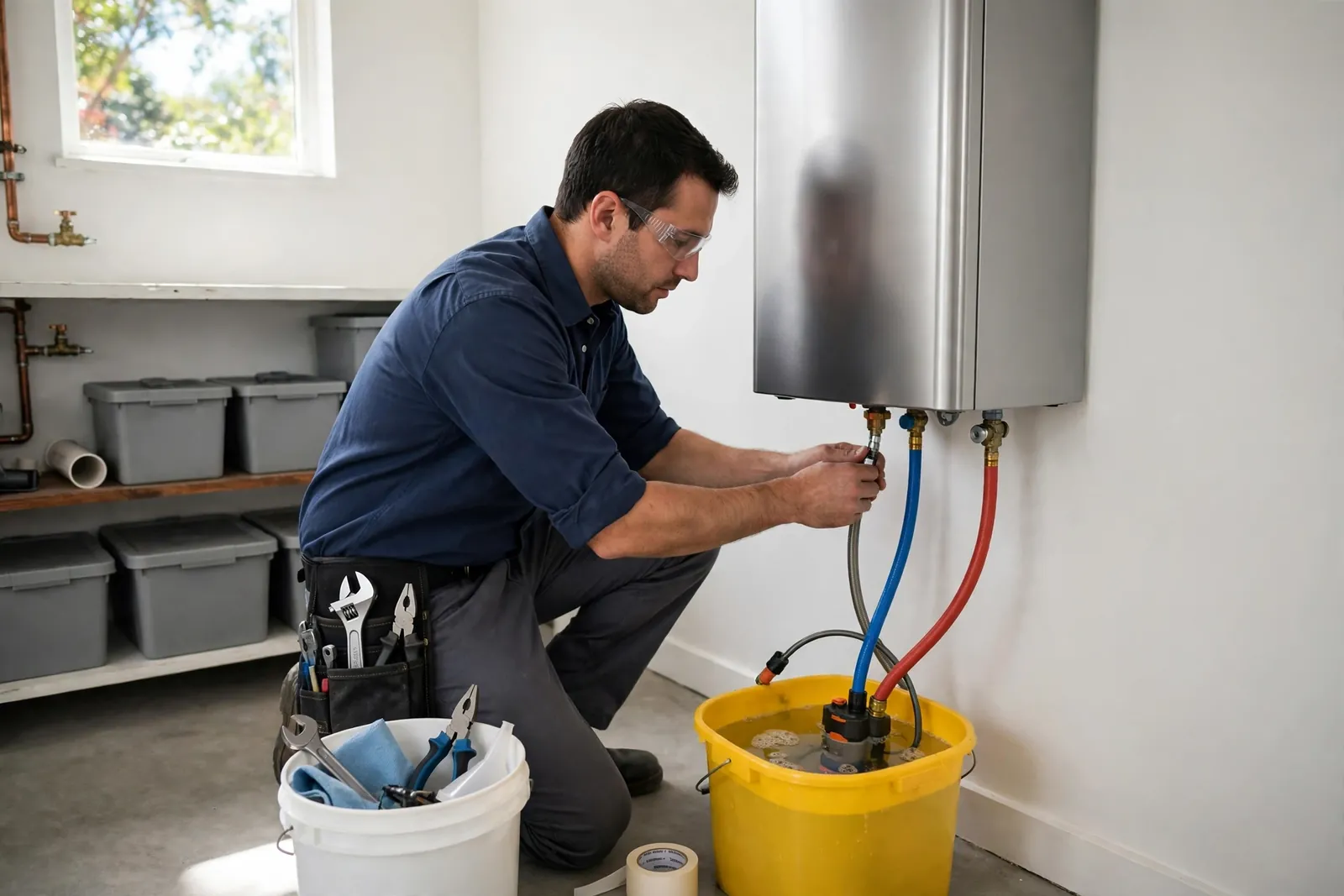
The core of the routine is the descale and flush. A circulation pump runs a descaling solution through the heat exchanger for the better part of an hour, dissolving the calcium and magnesium layer that hard water leaves behind, and the solution is monitored until it stops changing — which is how you know the scale is gone. The inlet filter screen is cleaned at the same time, because it catches the grit and the scale flakes that would otherwise travel into the unit. The burner is checked for a clean, steady flame, the vent path is inspected, and the condensate drain on a condensing unit is checked for blockage.
The interval that matters is about once a year, which is the interval most unit makers state for hard-water areas in their care guidance. Some makers state it as a condition of their care coverage: damage caused by lime, scale or sediment is not covered where the stated maintenance was skipped. That is a practical point, not a legal one — a unit that has never been descaled and then fails on scale is a unit whose maker will not stand behind the heat exchanger. The yearly visit is the record that the routine happened.
Homes with a water softener can stretch the interval, because the softener removes the calcium and magnesium before they reach the unit. Homes without one should not — in Sugar Land water, a year without a flush is a year of scale, and two years without one is often the point where the symptoms begin: lukewarm showers, falling flow, error codes on cold mornings. The maintenance visit is also the moment the unit is looked at as a whole: the gas or electrical supply, the venting, the condensate drain, the relief valve, and the freeze protection for the next cold snap.
There is one more reason the yearly routine matters, and it is about the heat exchanger itself. Scale acts like insulation inside the heat exchanger: the metal underneath runs hotter than it was made to, because the heat cannot get through the scale layer into the water. Over time that thermal stress warps and damages the metal, and a heat exchanger damaged by scale cannot be flushed back to health. Maintenance prevents that damage. Repair after it is a replacement conversation.
Before you call
- Note the error code on the display, if one shows.
- Check whether other taps have hot water, and whether cold water runs normally.
- If the unit is leaking, shut off its water and gas or power where it is safe to do so.
- Take a photo of the display and the label on the unit.
- Note when the problem started and what changed just before it.
What the yearly maintenance visit actually covers
A maintenance visit is a checklist, and it is worth knowing what is on it before you book one. The descale and flush is first: the unit is isolated from the house water, a pump circulates descaling solution through the heat exchanger, and the solution is monitored until it stops changing. The inlet filter screen is removed, cleaned and refitted. The burner is inspected for a clean, steady flame and the flame sensor is checked. The vent path is inspected for blockage, corrosion and correct sizing. The condensate drain on a condensing unit is checked for blockage and proper drainage.
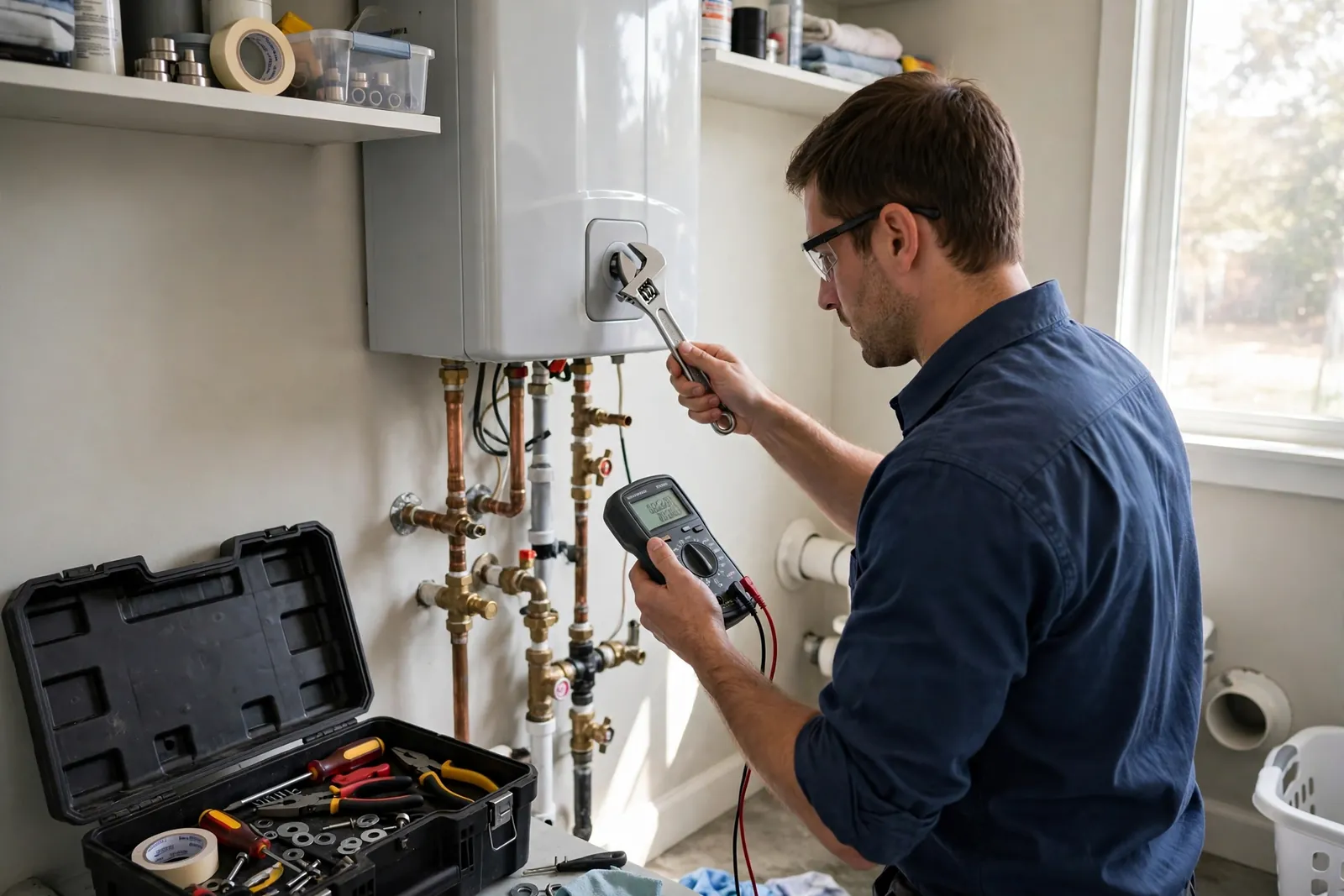
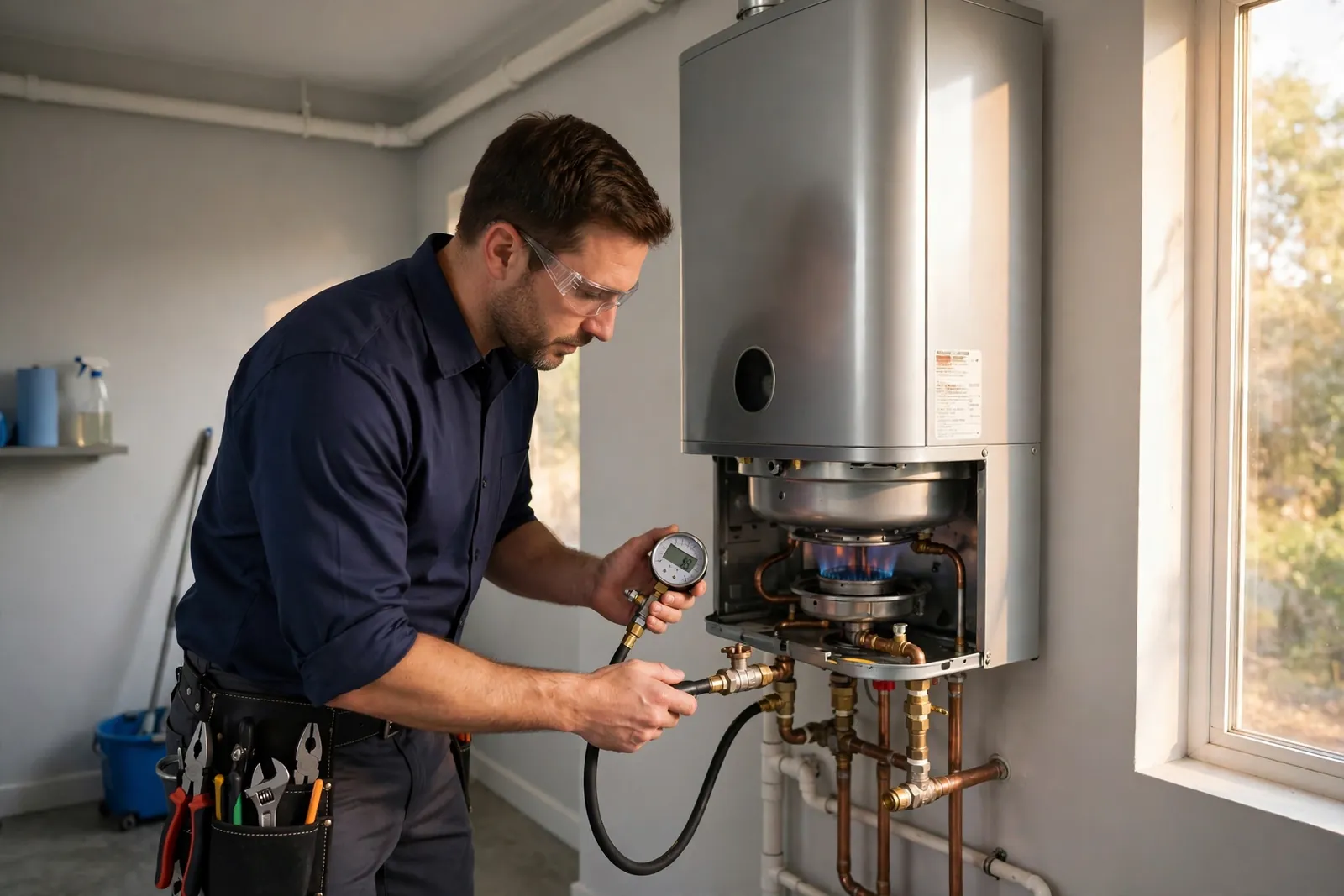
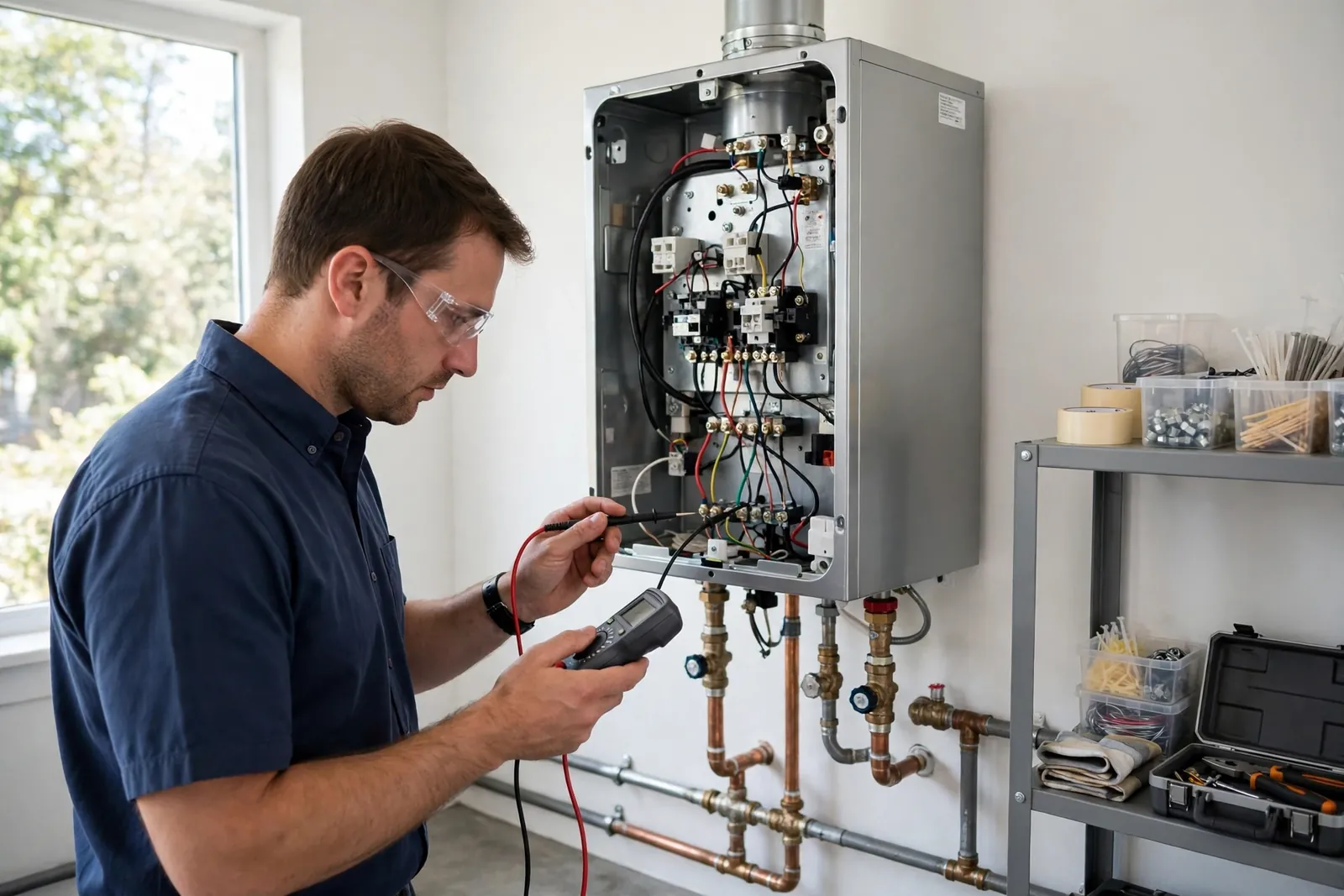
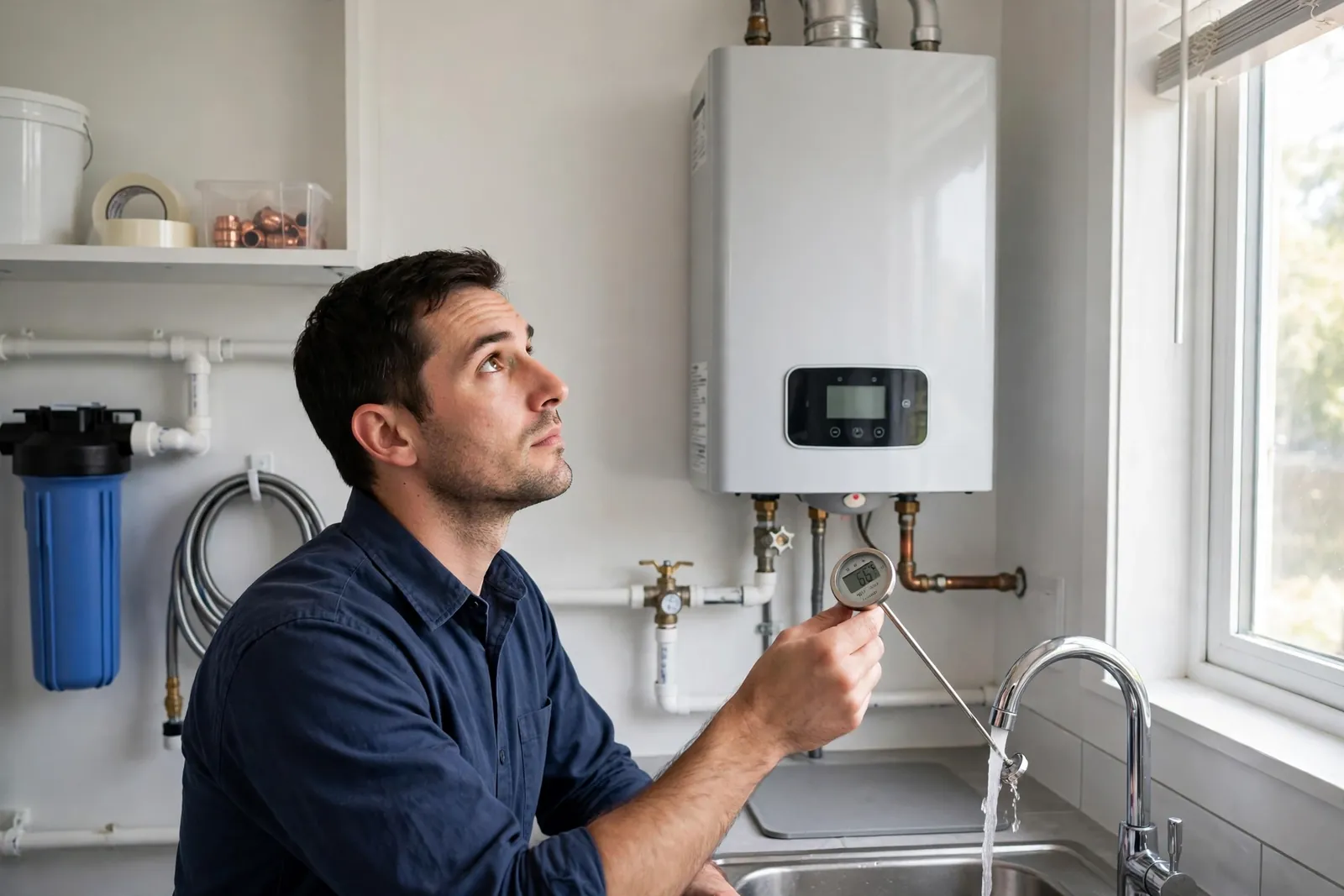
The electrical and gas sides get their own checks. On a gas unit the gas pressure is measured and the ignition system is checked. On an electric unit the elements, breakers and sensors are checked. The pressure relief valve is tested where the maker guidance allows it, and the water connections are checked for weeps. The temperature setting is checked against what the taps deliver, and the flow rate is measured to confirm the unit is heating what it should.
The visit ends with a record: what was done, what was found, and what to watch. The flush water tells its own story — the amount of scale that came out, and its colour and texture, say how hard the water has been on the unit. A unit that produces a heavy scale load every year is a unit whose owner should think about a water softener. A unit that produces almost nothing is a unit whose interval can stretch. The record is the basis for the next visit, not a formality.
Maintenance is also the moment the freeze question is asked. A unit on an outside wall or in an unheated space needs its freeze protection checked before winter: the internal heater, the drain-down steps, and the insulation on the water lines. The February 2021 freeze cracked units across the Houston area, and the maintenance visit in autumn is the natural moment to make sure the unit is ready for the next cold snap.
What the service includes
Descale and flush
A circulation pump runs descaling solution through the heat exchanger, monitored until it stops changing — which is how you know the scale is gone.
Inlet filter cleaning
The inlet filter screen is removed, cleaned of grit and scale flakes, and refitted.
Burner and flame check
The burner is checked for a clean, steady flame, and the flame sensor is checked.
Vent and condensate check
The vent path is inspected for blockage and corrosion, and the condensate drain on a condensing unit is checked.
Gas and electrical checks
Gas pressure measured on gas units; elements, breakers and sensors checked on electric units.
Freeze protection check
The internal heater, drain-down steps and line insulation checked before winter, so the unit is ready for the next cold snap.
How the work runs
Call and describe the unit
The make if you know it, the age of the unit, and when it was last descaled — if it ever was.
Descale and flush
The unit is isolated, a pump circulates descaling solution through the heat exchanger, monitored until it stops changing.
Filter and burner checks
The inlet filter screen is cleaned, the burner is checked for a clean flame, and the flame sensor is checked.
Vent, drain and supply checks
The vent path, the condensate drain, the gas pressure or the electrical supply — all checked in order.
Flow and temperature test
Flow rate and temperature rise measured at the taps, before and after, proving the improvement.
Record and next interval
What was done, what was found, and when the next visit falls — with the freeze steps for winter.
Tools and methods used
Circulation pump and descaling solution
The pump runs the solution through the heat exchanger at a consistent flow, dissolving the mineral layer hard water leaves behind.
pH monitoring
The solution is monitored until it stops changing, which is the sign the scale is gone and the flush is complete.
Flow and temperature meters
Flow rate and temperature rise are measured at the taps before and after the flush, proving the improvement.
Gas pressure gauge
Gas pressure is measured at the unit, so a starved burner is found rather than assumed.
Electrical meter
Voltage, current and continuity are checked on electric units, so a failing element is found early.
Inspection of vent and drain
The vent path and the condensate drain are inspected by eye and by hand, because blockage there shuts the unit down.
Hard water, scale, and the heat exchanger
Scale is calcium carbonate, and it forms where hot water meets metal. In a tankless heat exchanger the water is at its hottest and the passages are at their narrowest, so scale forms there first and fastest. The layer starts as a thin film and thickens with every firing. A thin film costs a little efficiency. A thick layer costs heat transfer, flow, and eventually the heat exchanger itself — because the metal underneath, insulated by scale, runs hotter than it was made to, and warps under the thermal stress.
The symptoms of scale arrive in order, and they are worth recognising early. First the shower is a little less hot than it was, or the tap takes a little longer to warm up. Then the temperature swings during a shower. Then flow drops, and the unit starts tripping its overheat protection on cold mornings when demand is highest. By the time flow has dropped noticeably, the scale layer is thick enough to matter, and the flush that would have prevented it becomes a rescue that may not fully restore the unit.
The descale itself is straightforward but it is not a quick rinse. A circulation pump runs the solution through the heat exchanger for 45 to 60 minutes, at a consistent flow, and the solution is monitored until it stops changing — which is how you know the scale is gone. Rushing the step leaves deposits behind, which defeats the purpose. The inlet filter is cleaned at the same time, and the flow is checked afterwards to confirm the unit is heating what it should.
What happens when maintenance is skipped
Skipping maintenance does not cause a sudden failure. It causes a slow one, which is worse, because the household adapts to each small loss — a slightly cooler shower, a slightly weaker flow — and does not notice how far the unit has fallen until the error codes start. By then the scale layer is thick, the heat exchanger has been running hot under its insulation, and the flush may not restore the unit fully.
The costs of skipped maintenance arrive in the same slow order. First the efficiency falls, because the unit burns more gas or draws more power to push the same heat through the scale layer. Then the parts start failing — sensors, igniters and fans working harder than they were made to. Then the heat exchanger itself is damaged, and the conversation becomes a replacement. The yearly visit is the simplest point on that curve, and every year skipped moves the household further along it.
There is also the matter of the maker care guidance. Most unit makers state a descaling interval for hard-water areas, and damage caused by lime, scale or sediment is commonly excluded from their care coverage where the stated maintenance was skipped. A unit that has never been descaled and then fails on scale is a unit whose maker will not stand behind the heat exchanger. The yearly visit is the record that the routine happened — and the record is what the maker asks for.
A unit that has not been descaled in over a year, heating unevenly and losing flow
A tankless unit that cannot heat, or heats unevenly, leaves the house without reliable hot water — and the cause is rarely visible from the outside.
A unit flushed, checked, and heating the way it did on installation day
The diagnosis names the cause — scale, flow, gas, venting or a failed part — before any work starts, and the fix is tested at the taps.
Problems this service solves
- Scale building up inside the heat exchanger from hard water.
- Lukewarm showers that get a little worse every few months.
- Flow dropping at the taps as the heat exchanger narrows.
- Error codes appearing on cold mornings when demand peaks.
- A clogged inlet filter screen starving the unit of water.
- A blocked condensate drain shutting a condensing unit down.
- A burner that is not burning cleanly, or a flame sensor that is fouled.
- Freeze protection that has never been checked before winter.
Signs your tankless unit needs maintenance
- It has been more than a year since the last descale and flush.
- Showers are a little less hot than they were, or take longer to warm up.
- The temperature swings during a shower without anyone touching a tap.
- Flow at the taps has dropped, or a shower has gone weak.
- An error code appears on cold mornings and clears later in the day.
- The unit has never been serviced since installation.
- The flush water at the last service carried a heavy scale load.
- Winter is coming and the freeze protection has never been checked.

Related problems
Industries that use this service
Single-Family Homes · Restaurants and Hospitality · Commercial Offices · All industries →
Frequently asked questions
Questions people ask about tankless water heater maintenance, answered plainly.
About once a year is the usual interval here. Houston-area water is hard — about 8 grains per gallon in the City of Houston 2025 water quality report, a level the USGS classifies as hard — and that mineral load coats the heat exchanger a little more every time the unit fires. Homes with a water softener can stretch the interval.
A descale and flush, an inlet-filter clean, a burner and flame check, a vent and condensate-drain check, gas pressure or electrical checks, and a freeze-protection check before winter. The visit ends with a record of what was done, what was found, and when the next visit falls.
Scale builds inside the heat exchanger, and the symptoms arrive in order: lukewarm showers, temperature swings, falling flow, then error codes on cold mornings. The heat exchanger runs hotter under its scale insulation, and over time the metal is damaged beyond what flushing can restore. At that point the conversation becomes a replacement.
The signs are lukewarm water, temperature swings, falling flow, and error codes on cold mornings — or simply that it has been more than a year since the last flush. The flush water tells its own story: the amount of scale that comes out says how hard the water has been on the unit.
The steps are published in most unit maker manuals — isolate the unit, circulate descaling solution with a pump, monitor it, clean the filter — but the work involves the gas or electrical supply, the venting, and the heat exchanger, and a mistake can leave scale behind or damage the unit. Many homeowners leave the yearly flush to a professional and keep the filter check for themselves.
Yes. A softener removes the calcium and magnesium before they reach the unit, so scale forms far more slowly and the descaling interval stretches. It is the one addition that changes the maintenance curve for a tankless unit in hard-water country.
Maintenance keeps the heat exchanger clean, and a clean heat exchanger is what the unit was designed around. A unit descaled on schedule holds its temperature and flow; a unit that is never descaled loses both, a little at a time, until the symptoms are impossible to ignore.
The inlet filter screen sits on the cold-water inlet and catches grit and debris before they reach the inside of the unit. When it clogs with grit and scale flakes, flow to the unit falls and the unit cannot heat properly. It is cleaned at every maintenance visit.
Yes — autumn is the natural moment. The maintenance visit checks the freeze protection: the internal heater, the drain-down steps, and the insulation on the water lines. The February 2021 freeze cracked units across the Houston area, and the check before winter is what prevents a repeat.
Most unit makers state a descaling interval for hard-water areas in their care guidance, and damage caused by lime, scale or sediment is commonly excluded where the stated maintenance was skipped. The yearly visit is the record that the routine happened.
No hot water in your Sugar Land home?
Call Now to reach a local tankless water heater professional. Describe the unit, the symptoms, and any error code on the display.
Call now for tankless water heater help
Tap Call Now to reach a local tankless water heater professional. Tell them the make of the unit if you know it, the symptoms, and any error code on the display.
Hours: Mon–Fri 7:00 AM–10:00 PM ET · Sat 8:00 AM–10:00 PM ET · Sun 7:00 AM–9:00 PM ET
Before you call
- Note the error code on the display, if one shows.
- Check whether other taps have hot water, and whether cold water runs normally.
- If the unit is leaking, shut off its water and gas or power where it is safe to do so.
- Take a photo of the display and the label on the unit.
- Note when the problem started and what changed just before it.