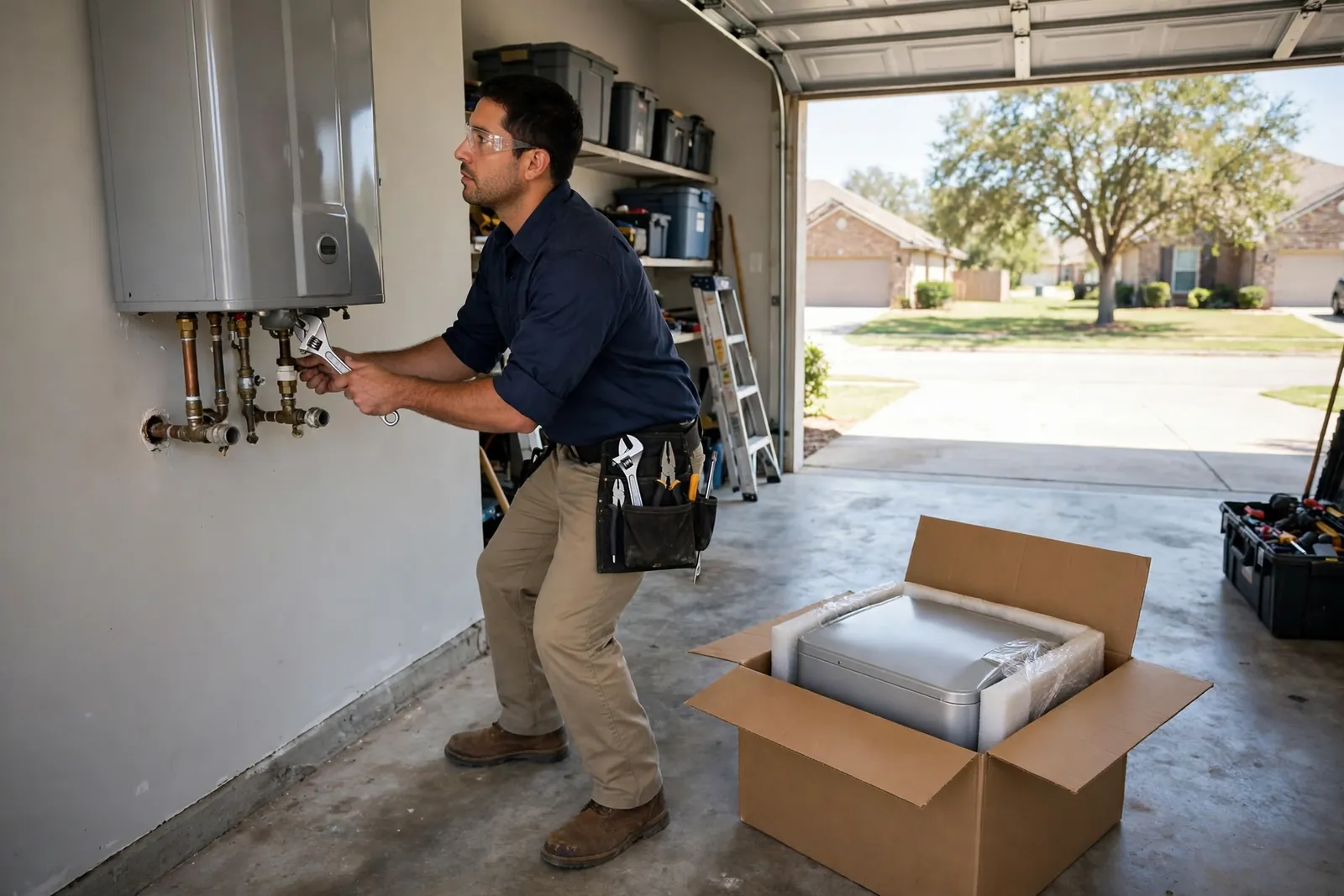
Tankless Water Heater Replacement in Sugar Land, TX
A tankless unit reaches replacement when the heat exchanger leaks, the scale has done damage that flushing cannot undo, or the part it needs costs more sense than the unit has left in it.
Need help with your tankless water heater?
Call Now to reach a local tankless water heater professional. Describe the unit, the symptoms, and any error code on the display.
Hours: Mon–Fri 7:00 AM–10:00 PM ET · Sat 8:00 AM–10:00 PM ET · Sun 7:00 AM–9:00 PM ET
What this service does
Every tankless water heater reaches a point where the question stops being what is wrong with it and starts being whether it is worth fixing. The unit has a heat exchanger at its heart, and that part is both the most expensive and the least forgiving: once it leaks, or once scale has damaged it beyond flushing, the repair is effectively a rebuild. The replacement conversation starts there — not with a sales pitch, but with what the diagnosis found and what the unit has left in it.
The clearest replacement sign is a leaking heat exchanger. The heat exchanger is a coil of copper or stainless steel that carries water through the burner flame, and it lives a hard life: high temperatures, hard water, and constant expansion and contraction. A leak there shows up as water under or around the unit, or as damp on the wall behind it. The part itself is the bulk of the unit cost, and fitting a new one into an old unit leaves every other worn part in place. In most cases the right call is a new unit, not a new heart in an old body.
Scale is the second replacement driver, and it is the Sugar Land story. A unit that has never been descaled in hard water builds a mineral layer inside the heat exchanger that flushing can no longer remove once it has hardened and the metal underneath has been damaged by heat. The symptoms are the same as a unit that needs a flush — lukewarm water, falling flow, error codes — but the flush water runs clear and the unit still will not heat properly. That is the point where the heat exchanger is damaged, not dirty, and replacement is the answer.
Age and history shape the call as well. A unit that is a few years old and has been descaled on schedule is worth repairing even for a major part, because the rest of the unit has years left. A unit well past a decade, never flushed, and now needing a control board or a fan is a different calculation: the next failure is usually close behind, and the money spent on the repair buys a short extension rather than a fix. The label on the unit gives its age; the descaling history and the inspection give the rest.
The February 2021 freeze is the fourth factor, and it is specific to this area. Units that cracked in that cold snap were often repaired at the time, but freeze damage can leave a heat exchanger weakened in ways that show up later as a slow leak. If a unit was freeze-damaged and now leaks, replacement is usually the right call, because the crack is rarely the only weak point the cold left behind. A technician who asks about the 2021 freeze is not making conversation — the answer changes the recommendation.
Before you call
- Note the error code on the display, if one shows.
- Check whether other taps have hot water, and whether cold water runs normally.
- If the unit is leaking, shut off its water and gas or power where it is safe to do so.
- Take a photo of the display and the label on the unit.
- Note when the problem started and what changed just before it.
How the replacement decision is made — step by step
The replacement decision follows the diagnosis, and it follows it in order. First the fault is named: what failed, and where. A failed sensor, igniter, element or valve is a repair in almost every case. A leaking heat exchanger, a scaled-out heat exchanger, or a cracked one is a replacement conversation. The fault decides the category; everything after that is about the numbers around it.
Second, the age of the unit is read from the label, and the descaling history is asked about. A young unit with a clean heat exchanger and one failed part is a repair whatever the part costs, because the unit has years left. An old unit with no descaling history and a major part failure is a replacement, because the repair buys a short extension on a unit that is already at the end of its life. The middle ground — a mid-life unit with a major part failure and a mixed history — is where the inspection matters most, and where a straight answer is worth more than a quick one.
Third, the sizing is re-checked. The old unit may have been undersized for the home from the start — a common finding in Sugar Land, where a unit sized for one shower at a time meets a household that runs two showers and a washing machine together. A replacement is the chance to size correctly: peak flow rate and temperature rise worked out from the fixtures and the household, and the coldest incoming water temperature. Replacing an undersized unit with the same size repeats the problem; replacing it with the right size ends it.
Fourth, the supply is re-checked. The gas line, meter and regulator for a gas unit, the panel and circuits for an electric unit, the vent route and the condensate path. A replacement is not a swap — the new unit may need a bigger gas line, a different vent, or a condensate drain the old unit never had. The supply checks happen before the new unit is ordered, so the installation day has no surprises.
What the service includes
Diagnosis that names the fault
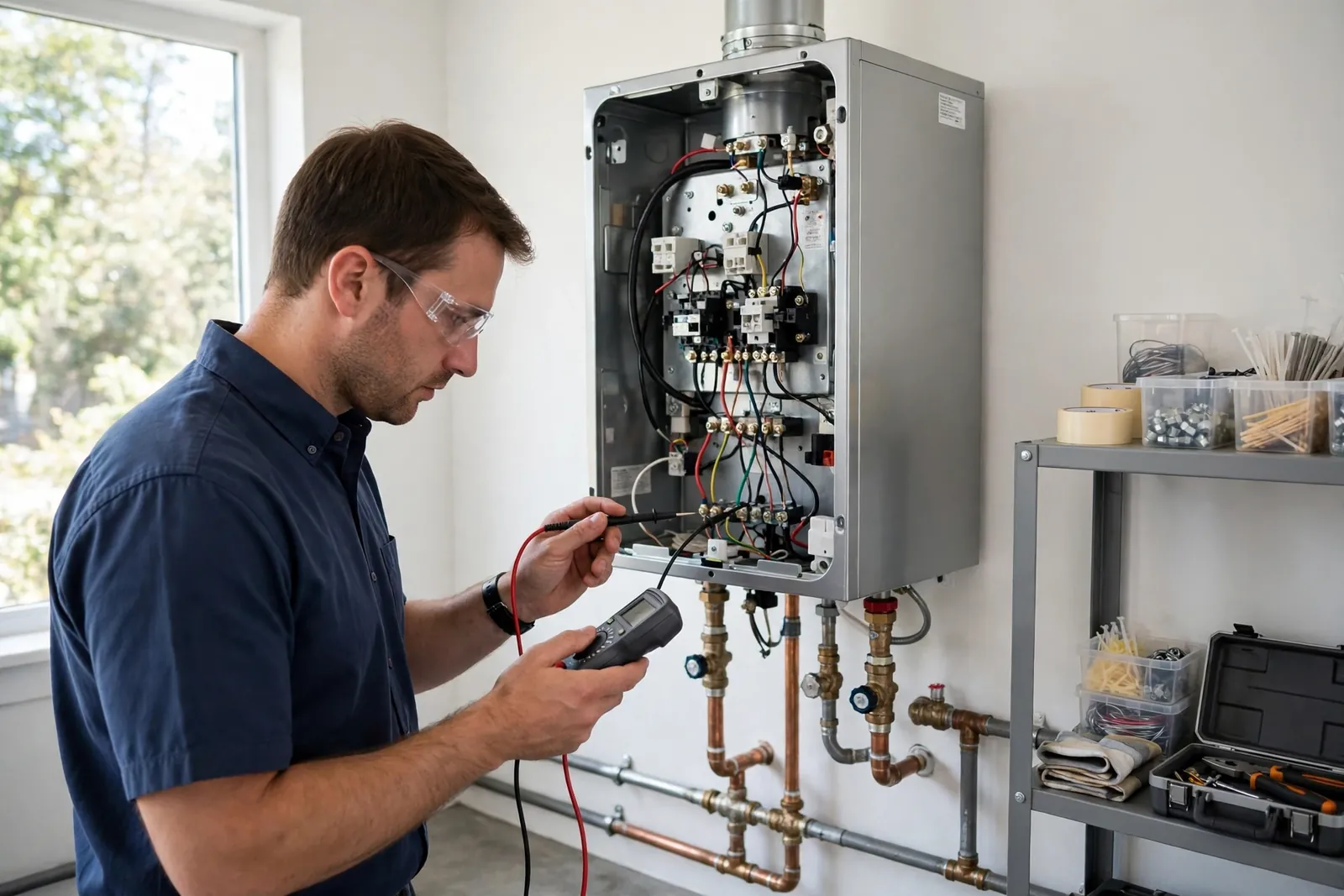
Error code read, flow and temperature checks, gas or electrical supply check, venting check, and a look at the heat exchanger.
Plain repair-or-replace explanation
What failed, what the unit has left, and whether repair or replacement fits — in plain words, before any work starts.
Sizing for the home
Peak flow rate and temperature rise re-checked from the fixtures and the household, so the new unit fits the home rather than the old one.
Supply checks
Gas line, meter and regulator for a gas unit; panel and circuits for an electric unit; vent route and condensate path.
Old unit removal
The old unit drained, disconnected and taken away as part of the job.
Testing and handover
Hot water run at the taps, temperature and flow checked, filter location shown, descaling interval and freeze steps explained.
How the work runs
Call and describe the unit
The make if you know it, the symptoms, any error code, and whether the unit is leaking.
Diagnosis at the unit
Error codes, flow and temperature checks, gas or electrical supply, venting, and the heat exchanger.
Repair-or-replace explanation
What failed, what the unit has left, and which way the numbers point — in plain words.
Sizing and supply checks
Peak flow and temperature rise re-checked; gas line, panel, vent route and condensate path checked.
Old unit out, new unit in
The old unit drained, disconnected and taken away; the new unit mounted and connected.
Test and handover
Hot water run at the taps, temperature and flow checked, filter location shown, descaling interval and freeze steps explained.
Tools and methods used
Error-code reading
The display code is read first, because it names the fault the unit detected and sets the order of the checks.
Flow and temperature meters
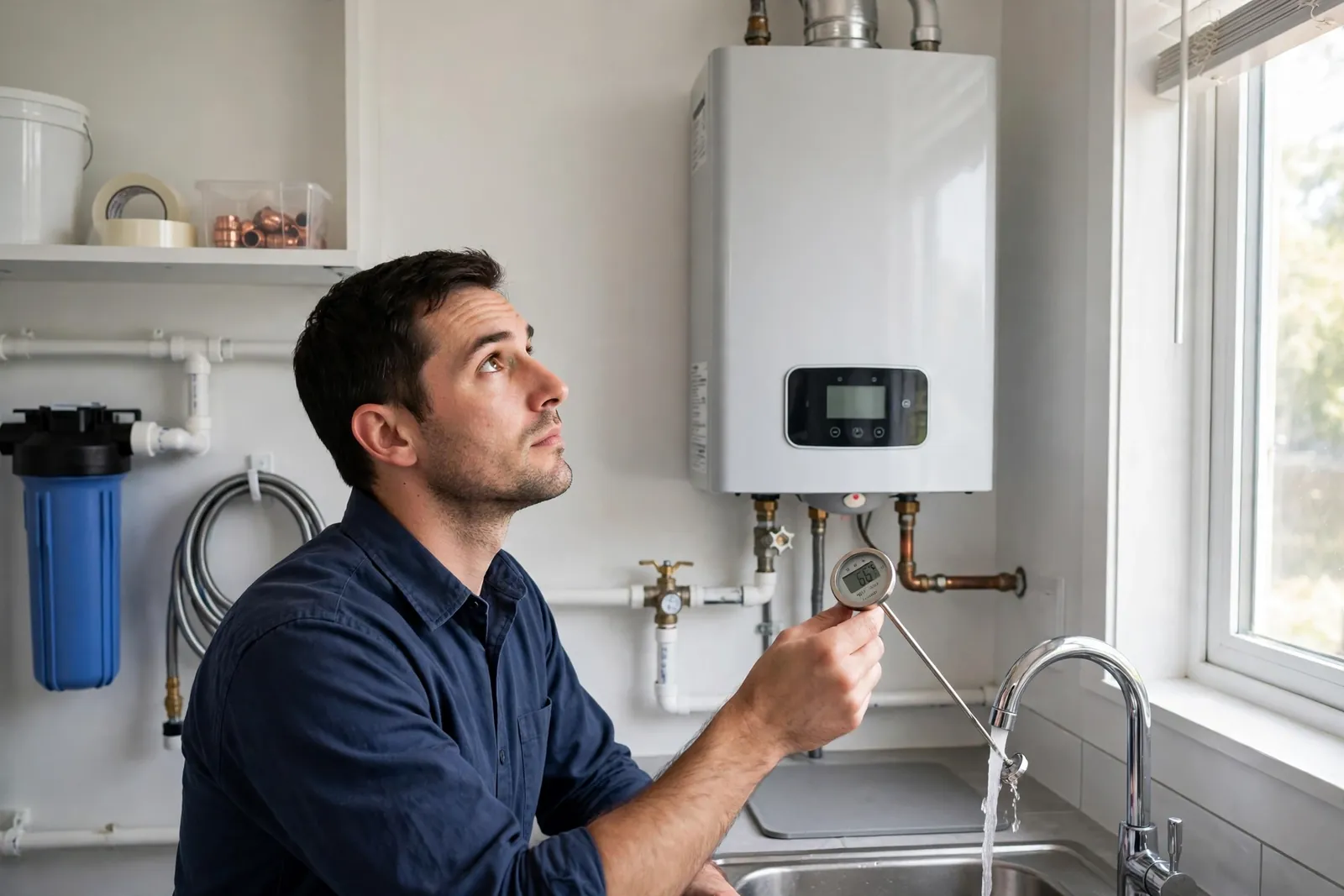
Flow rate and temperature rise are measured at the taps, so the sizing and the diagnosis rest on numbers.
Heat exchanger inspection
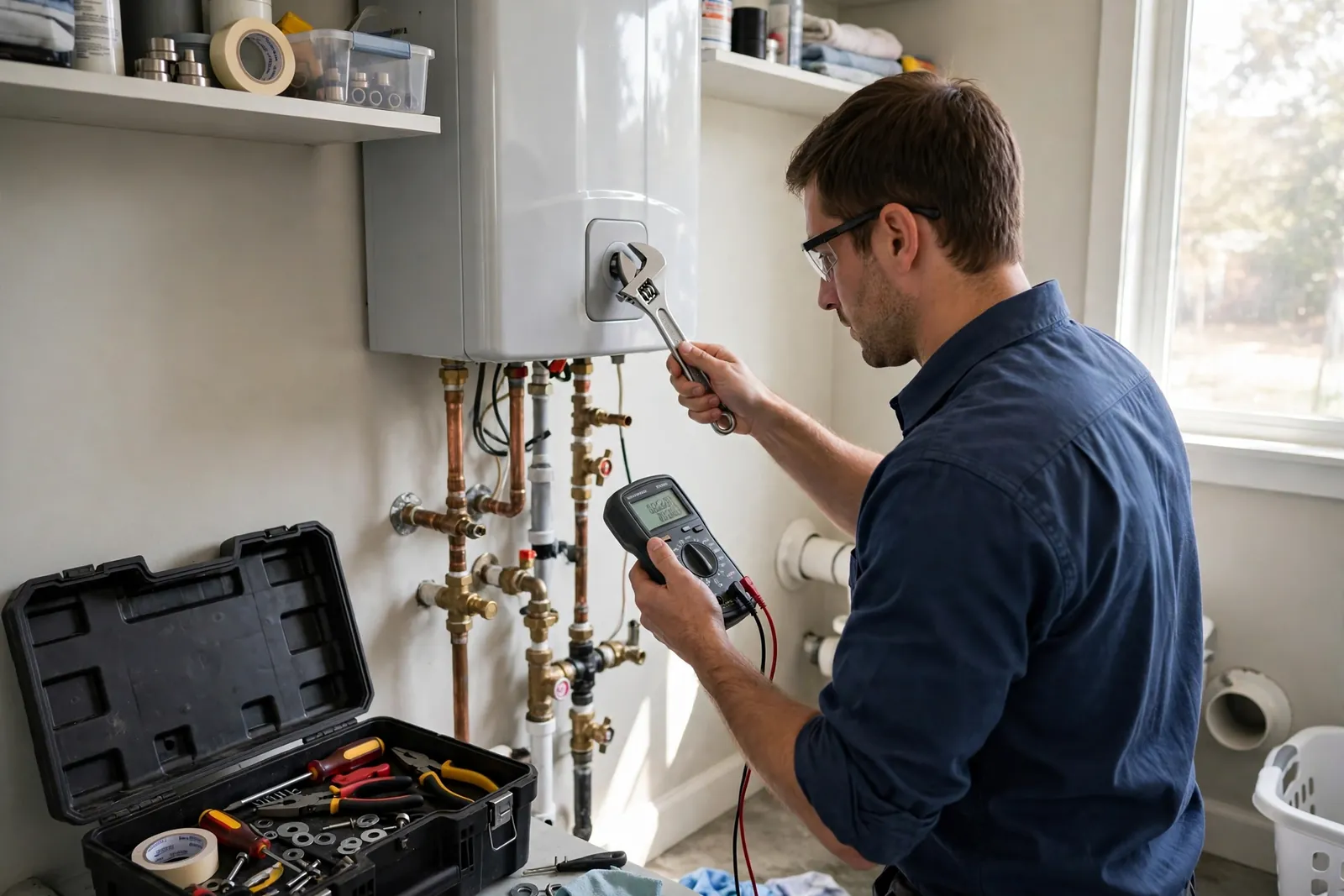
The heat exchanger is inspected for leaks, scale damage and freeze damage, because that is the part that decides repair or replace.
Gas and electrical checks
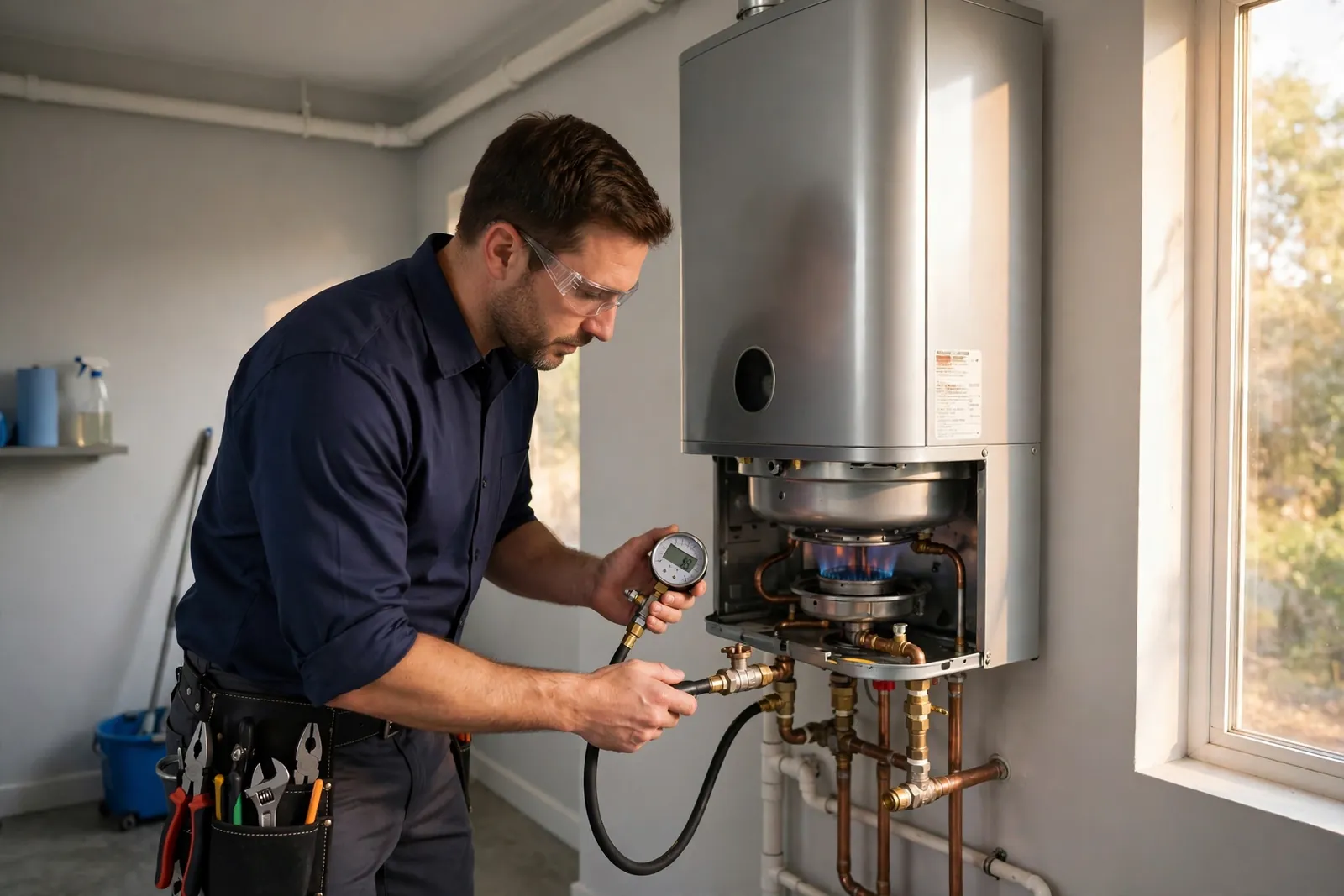
Gas pressure and electrical supply are checked, so the new unit is fed properly from its first firing.
Venting layout
The vent path is planned to the unit maker instructions and local code, with the right slope, terminations and clearances.
Leak and combustion checks
Water and gas connections checked for leaks, and the burner checked for a clean, steady flame.
What a replacement visit looks like
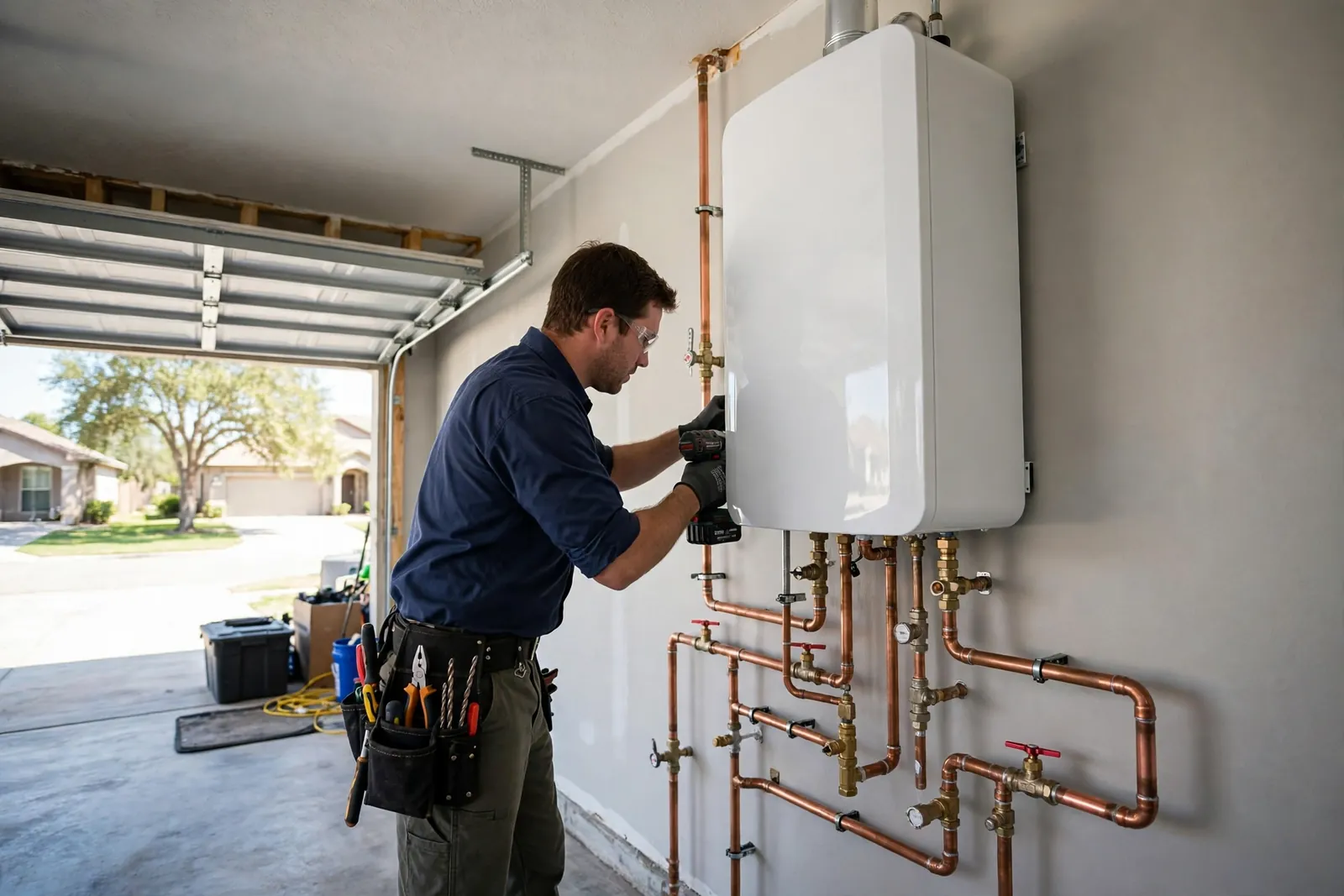
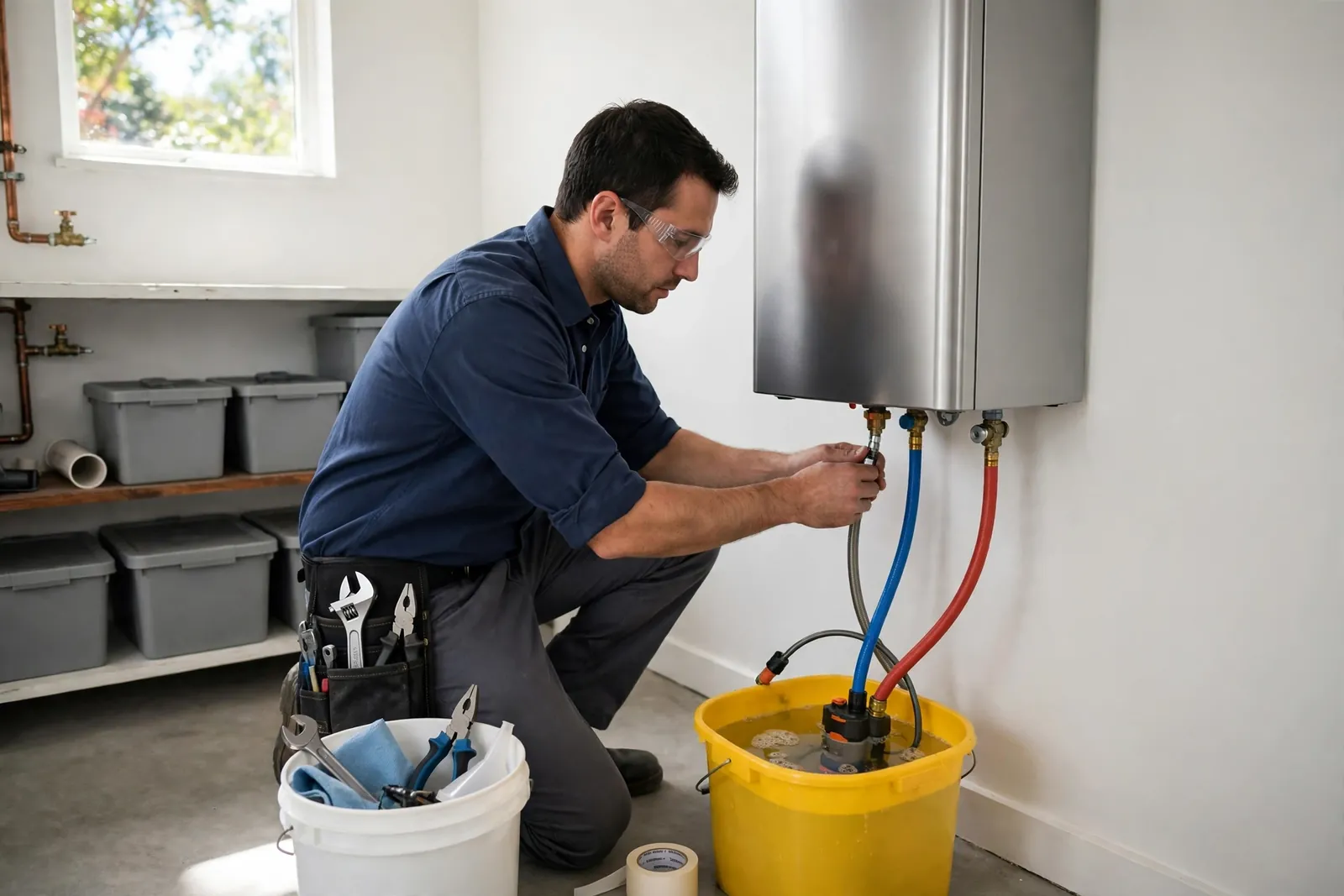
A replacement starts with the diagnosis that named the fault, and the sizing that follows it. The new unit is chosen for the home peak demand and the coldest incoming water temperature, and the supply checks — gas line, electrical panel, vent route, condensate path — are done before the unit is ordered. The old unit is drained, disconnected and taken away, and the new unit is mounted, connected, and fitted with isolation valves and service valves so it can be flushed and serviced without draining the house.
The installation itself follows the same steps as any tankless installation: water and gas or electrical connected, venting fitted to the unit type, condensate drain routed safely, connections checked for leaks, and the burner checked for a clean, steady flame. The difference from a first installation is that the house already has the water lines, the gas or electrical supply, and the vent route — the work is adapting them to the new unit, not building them from nothing.
The visit ends the way every tankless visit should end: hot water run at the taps, temperature and flow checked, the filter location shown, and the descaling interval and the freeze steps explained. A new unit in Sugar Land water begins scaling from its first firing, and the yearly flush is what keeps it heating the way it did on installation day. The handover matters as much as the fitting.
Repair or replace: the honest comparison
Repair and replacement are not rivals; they answer different questions. Repair answers the question of what is wrong with this unit, right now. Replacement answers the question of what this home needs for the years ahead. A repair is right when the fault is a part and the rest of the unit has life left. A replacement is right when the fault is the heat exchanger, when scale has damaged the unit beyond flushing, or when the unit was never sized for the home in the first place.
The comparison that matters is not the cost of the part against the cost of the unit. It is the cost of the repair against the life it buys, set against the cost of the replacement against the life it buys. A repair that buys a year on a unit that is already failing elsewhere is expensive; a replacement that buys a properly sized unit with a clean heat exchanger and a fresh descaling routine is not. The diagnosis gives the numbers for that comparison, and the recommendation follows from them.
One more comparison is worth making, and it is the one households forget: the replacement is the chance to fix the sizing and the supply. An undersized unit, a gas line that starves the burner at peak, a vent route that was never right — all of these can be corrected at replacement time, and none of them can be corrected by a repair. A replacement that fixes the sizing ends the lukewarm showers; a repair on an undersized unit leaves them in place.
A unit with a leaking or scaled-out heat exchanger, or one that was never sized for the home
A tankless unit that cannot heat, or heats unevenly, leaves the house without reliable hot water — and the cause is rarely visible from the outside.
A new unit sized for the home, fitted, and tested at the taps
The diagnosis names the cause — scale, flow, gas, venting or a failed part — before any work starts, and the fix is tested at the taps.
Problems this service solves
- A heat exchanger that is leaking and cannot be repaired sensibly.
- A unit so scaled that flushing no longer restores its heating.
- A unit cracked by the February 2021 freeze that now leaks.
- A unit well past its serviceable life that needs a major part.
- A unit that was never sized for the home and goes lukewarm at peak times.
- A unit whose control board or fan has failed on an old, unmaintained machine.
- A household that wants to switch from a tank unit to tankless at replacement time.
- A second unit for a large home whose single unit cannot keep up.
Signs your tankless unit needs replacing, not repairing
- Water is leaking from the unit itself, not from a connection.
- A flush was done and the unit still will not heat properly.
- The unit is well past a decade old and has never been descaled.
- The unit was cracked in the 2021 freeze and now leaks.
- The unit needs a major part and the rest of it is worn out.
- The unit was never sized for the home and goes lukewarm at peak times.
- Error codes keep returning after repairs, one after another.
- The heat exchanger shows scale damage or corrosion on inspection.
Related problems
Industries that use this service
Single-Family Homes · Rental Properties · Commercial Offices · All industries →
Frequently asked questions
Questions people ask about tankless water heater replacement, answered plainly.
The clearest signs are a leaking heat exchanger, a unit so scaled that flushing no longer restores its heating, or freeze damage from the February 2021 cold snap. Age and descaling history shape the call as well — a unit well past a decade that has never been descaled and now needs a major part is often better replaced.
Usually not sensibly. The heat exchanger is the most expensive part of the unit, and fitting a new one into an old unit leaves every other worn part in place. A leaking heat exchanger usually means the unit has reached the end of its serviceable life, and replacement is the right call.
Diagnosis first, then sizing for the home, supply checks for gas or electric, venting and condensate, removal of the old unit, fitting of the new one with isolation and service valves, and testing at the taps. The visit ends with the filter location shown and the descaling interval explained.
Not necessarily. The old unit may have been undersized for the home from the start — a common finding where a unit sized for one shower meets a household that runs two showers and a washing machine together. A replacement is the chance to size correctly, and replacing an undersized unit with the same size repeats the problem.
If it leaks now, usually yes. Freeze damage can leave a heat exchanger weakened in ways that show up later as a slow leak, and the crack is rarely the only weak point the cold left behind. A technician who asks about the 2021 freeze is asking because the answer changes the recommendation.
It depends on the supply work: a straightforward swap in the same spot is faster than a replacement that needs a bigger gas line, a new vent route, or water lines rerouted. The sizing and supply checks happen first, and the visit is planned around what they find.
Yes. The conversion needs a gas line sized for the tankless unit peak demand, a vent path that fits the unit type, and a condensate drain if it is a condensing unit. The old tank is drained, disconnected and taken away as part of the job.
Yes. A new unit in Sugar Land water begins scaling from its first firing, and the yearly descale and flush is what keeps it heating the way it did on installation day. The handover covers the descaling interval, the filter location, and the freeze steps.
It is drained, disconnected and taken away as part of the job. The space it leaves behind — a wall, a garage corner, a closet — is often the first thing the household notices.
It depends on what failed and what the unit has left. A failed sensor or igniter on a unit that has been descaled on schedule is worth repairing. A major part on a unit well past a decade that has never been flushed is usually not — the next failure is usually close behind.
No hot water in your Sugar Land home?
Call Now to reach a local tankless water heater professional. Describe the unit, the symptoms, and any error code on the display.
Call now for tankless water heater help
Tap Call Now to reach a local tankless water heater professional. Tell them the make of the unit if you know it, the symptoms, and any error code on the display.
Hours: Mon–Fri 7:00 AM–10:00 PM ET · Sat 8:00 AM–10:00 PM ET · Sun 7:00 AM–9:00 PM ET
Before you call
- Note the error code on the display, if one shows.
- Check whether other taps have hot water, and whether cold water runs normally.
- If the unit is leaking, shut off its water and gas or power where it is safe to do so.
- Take a photo of the display and the label on the unit.
- Note when the problem started and what changed just before it.