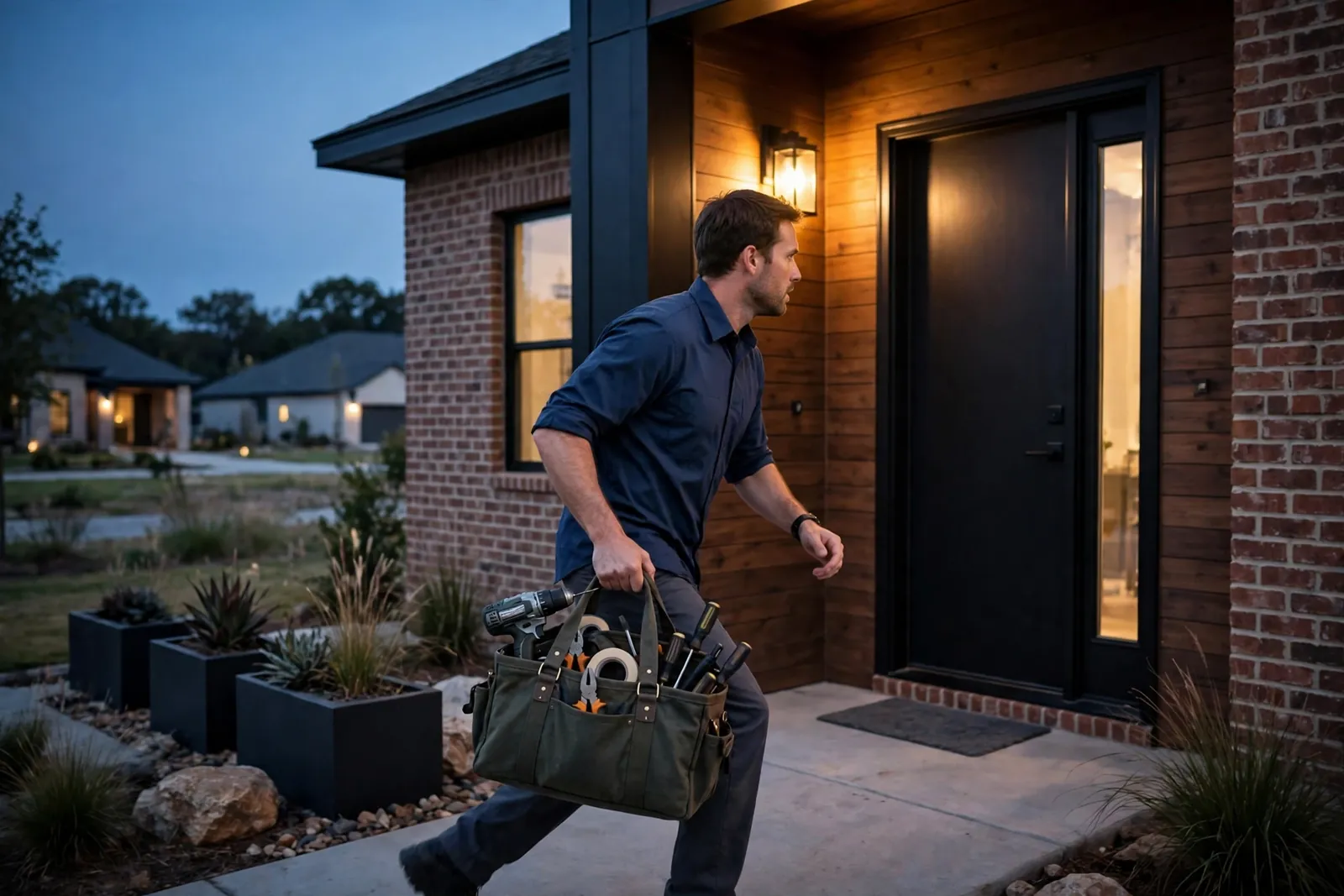
Emergency Tankless Water Heater Repair in Sugar Land, TX
No hot water on a cold morning, a unit leaking onto the floor, or a heater that fires and dies within seconds — an emergency tankless call is about getting the house back to hot water with the fewest steps in between.
Need help with your tankless water heater?
Call Now to reach a local tankless water heater professional. Describe the unit, the symptoms, and any error code on the display.
Hours: Mon–Fri 7:00 AM–10:00 PM ET · Sat 8:00 AM–10:00 PM ET · Sun 7:00 AM–9:00 PM ET
What this service does
An emergency tankless call is different from a routine repair in one way: the house has no hot water right now, and every hour without it matters more. Showers, dishes, laundry and a baby bath all stop at once, and the household starts working around the problem within an hour. The visit is shaped by that urgency — the diagnosis is fast and direct, the explanation is short, and the work starts as soon as the fault is named. But the diagnosis itself does not change. A unit that has stopped heating is still read the same way: display first, flow and supply second, parts third.
The most common emergency is the unit that worked yesterday and does not work today. Nothing changed in the house, no work was done, and the water is cold at every tap. In Sugar Land that pattern usually traces to one of a short list: the unit lost gas or power, a breaker tripped, a valve was closed during other work, the inlet filter clogged with a flake of scale, or a sensor failed overnight. The display code narrows it in seconds — ignition failure, overheating, a venting fault, or a sensor out of range — and the code decides what the visit covers.
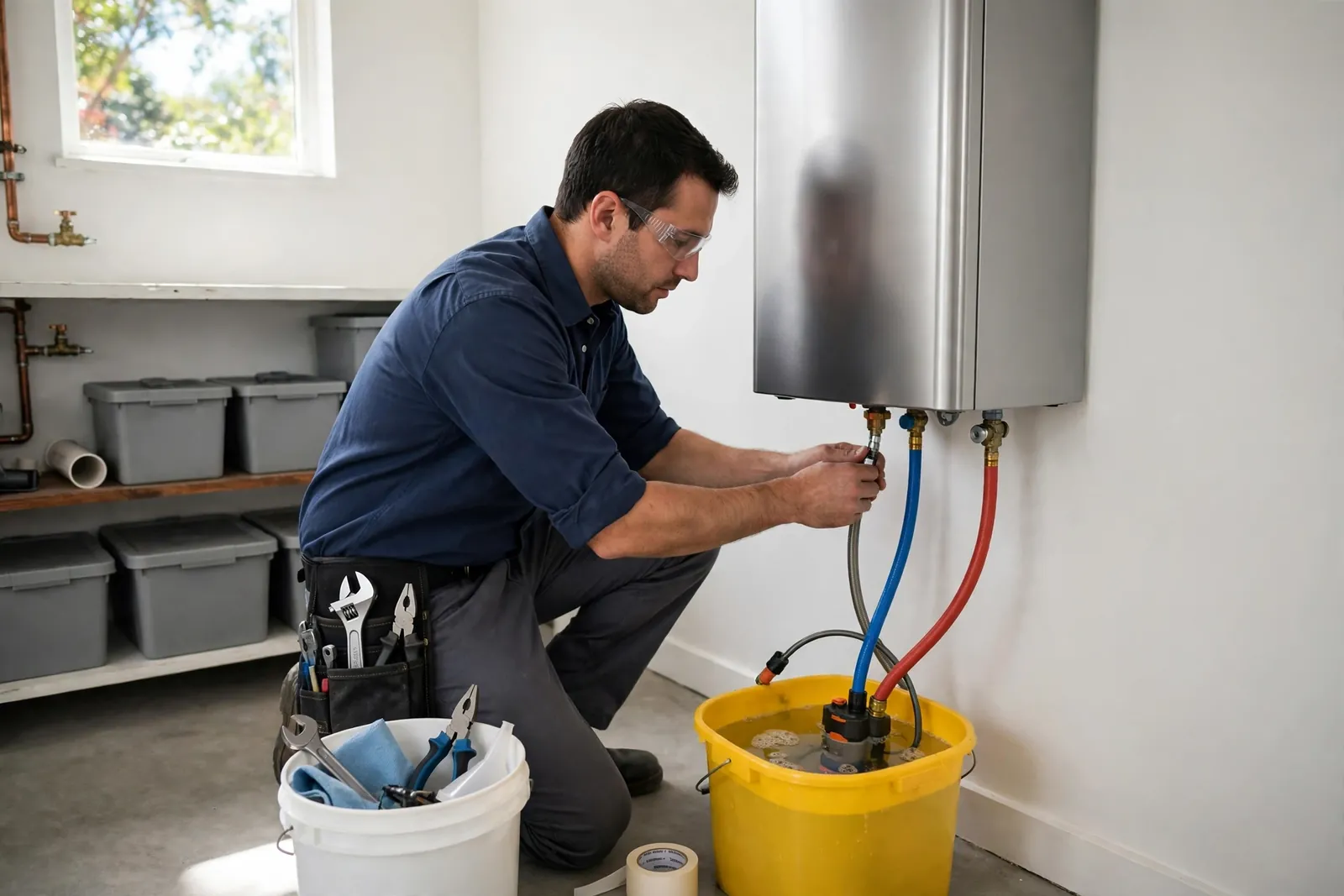
The second emergency is the leak. A tankless unit can leak from a connection, a relief valve, the heat exchanger, or the condensate drain, and the water goes where gravity takes it — down the wall, across the floor, into the room below. The first step is always the same: shut off the water to the unit where it is safe to do so, and shut off the gas or power as well. A small leak from a fitting is a repair. A leak from the heat exchanger itself is usually the end of the unit, and the visit becomes a replacement conversation instead.
The third emergency is the unit that keeps shutting off. It fires, heats for a few seconds, and dies — then fires again, and dies again. The house gets bursts of hot water and nothing steady. This short-cycling usually points to overheating protection tripping: scale insulating the heat exchanger, a venting fault, or a sensor reading wrong. It is urgent because the unit is protecting itself from damage, and every cycle adds wear. The visit checks the heat exchanger, the vent path and the sensors before anything else.
Winter adds its own emergency in Fort Bend County. The February 2021 freeze cracked tankless units across the Houston area, and every hard cold snap since has done the same to units that were never drained or protected. A frozen unit shows up as no hot water after a cold night, sometimes with a visible crack or a leak once the ice thaws. If the forecast shows a hard freeze and the unit is on an outside wall or in an unheated space, the drain-down steps in the freeze guide are worth doing before the cold arrives — after it, the work is repair or replacement.
Before you call
- Note the error code on the display, if one shows.
- Check whether other taps have hot water, and whether cold water runs normally.
- If the unit is leaking, shut off its water and gas or power where it is safe to do so.
- Take a photo of the display and the label on the unit.
- Note when the problem started and what changed just before it.
What counts as an emergency — and what to do before help arrives
Not every tankless problem is an emergency, and knowing the difference saves a household a difficult night. No hot water at all, a leak, a gas smell, or a unit that keeps shutting off are emergencies — the house cannot function normally, or the unit is at risk of damage. Lukewarm water, a slow loss of flow, or a unit that has not been descaled in a year are urgent in a different way: they need a visit soon, but the house still has hot water while it waits. The call is the same either way; the difference is what you do while you wait.
If the unit is leaking, the first move is to stop the water. Every tankless install has isolation valves on the cold inlet and the hot outlet, and closing them stops water reaching the unit. The gas valve or the electrical breaker comes next, where it is safe to reach them. Mop up what you can, move anything the water can damage, and take a photo of the leak and the display. Do not open the unit casing yourself — the gas, electrical and venting parts inside are not homeowner work.
If you smell gas, the steps are different and they are not negotiable. Leave the house, do not switch lights or appliances on or off, and call your gas utility emergency line and emergency services from outside. Do not try to find the leak, do not relight anything, and do not go back inside until you are told it is safe. A gas smell is the one tankless symptom where the right move is to leave first and ask questions later.
If there is no hot water and no leak and no smell, the checks are simple. Look at the display and write down any error code. Check whether cold water runs normally at the taps — if it does not, the problem may be the house supply rather than the unit. Check the breaker panel for a tripped breaker and the gas valve for a closed valve. Check whether other taps have hot water: if one tap is cold and the rest are hot, the problem is at that tap, not the unit. Those four checks take two minutes and they shape the whole visit.
What the service includes
Same-day diagnosis at the unit
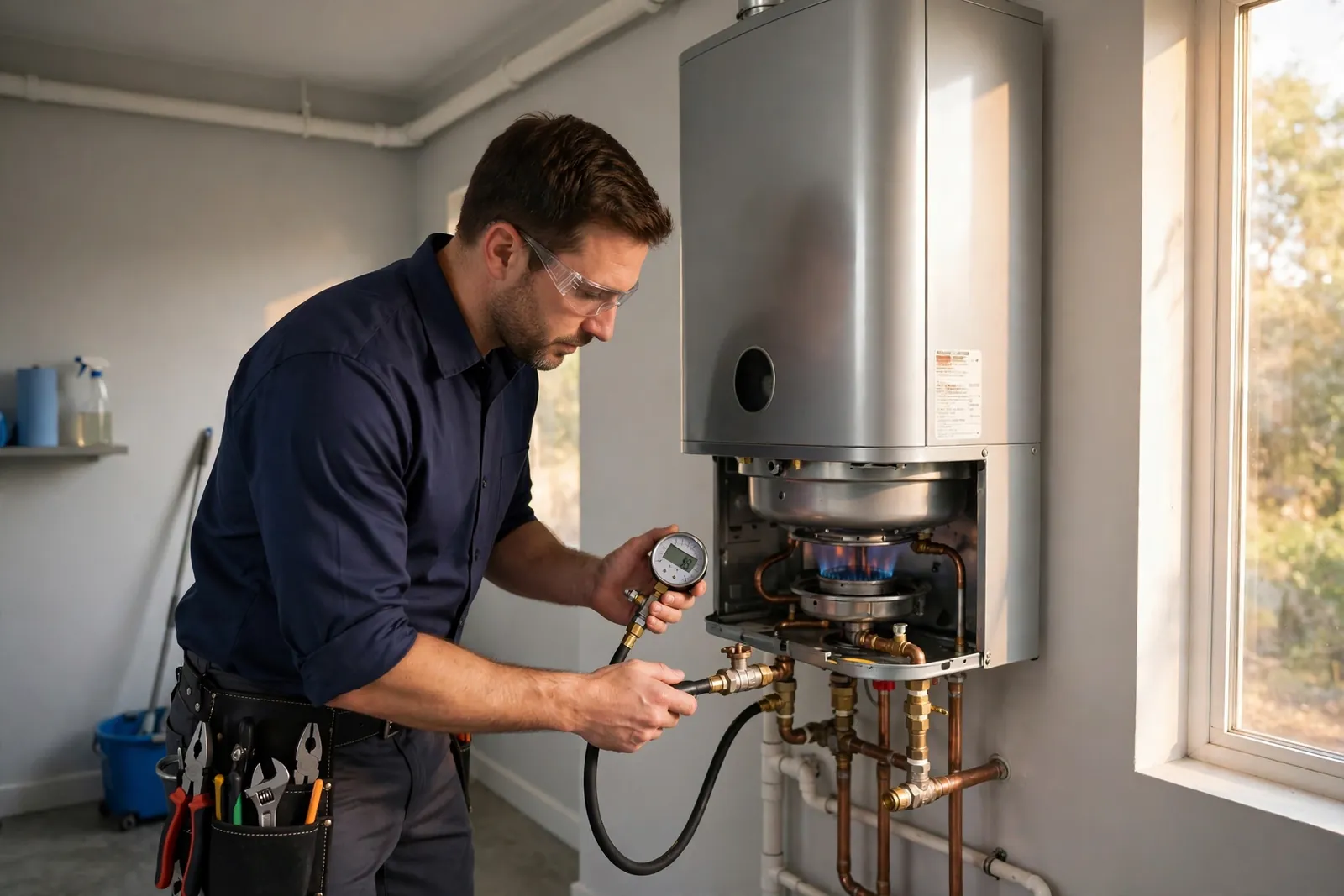
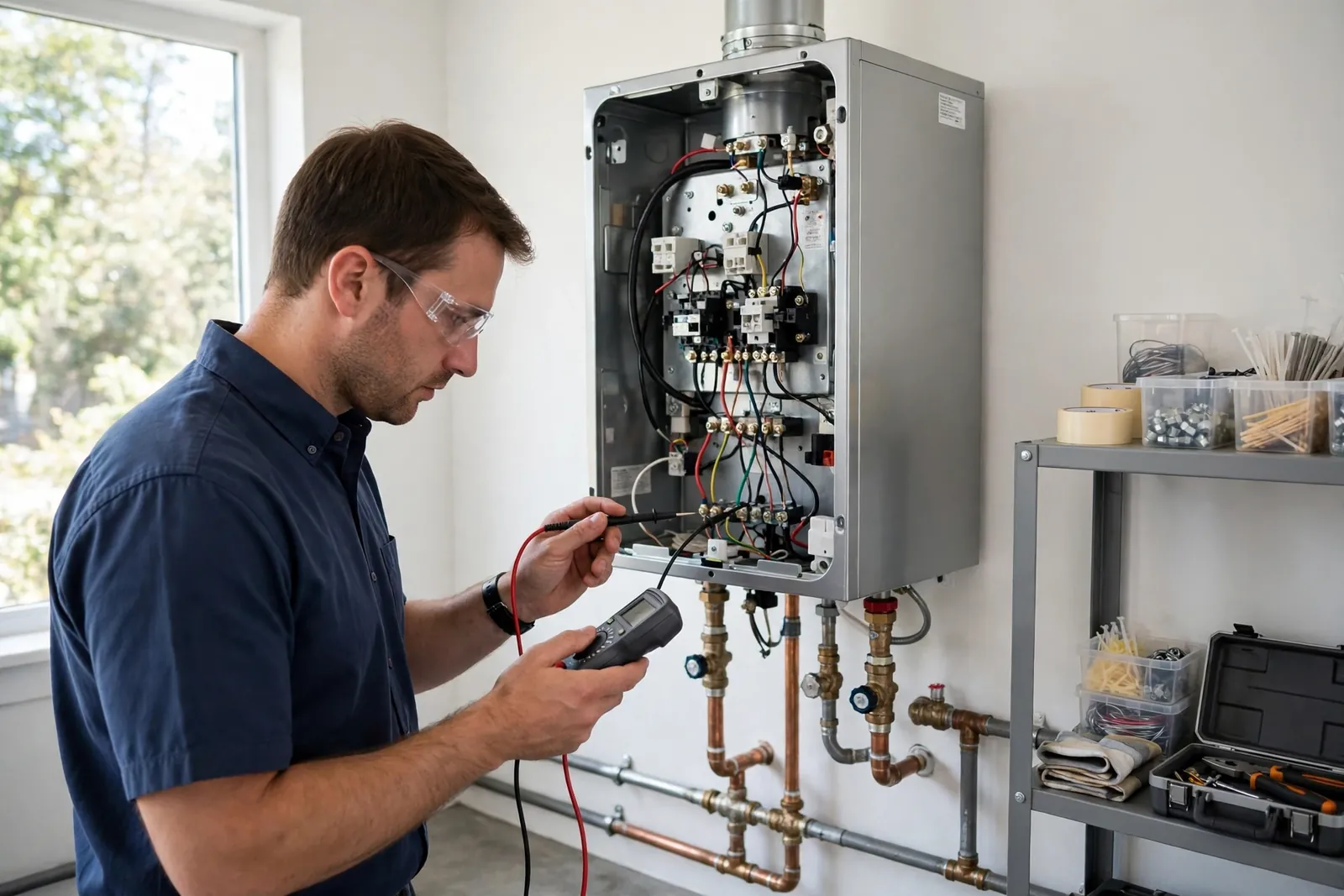
Error code read, flow and temperature checks, gas or electrical supply check, venting check, and a look at the heat exchanger and inlet filter.
Leak stop and make-safe
Water and gas or power shut off safely where the unit is leaking, and the source of the leak traced before any repair starts.
Plain explanation, fast
What failed, what it means, and whether repair or replacement fits — in short, plain words, before the work starts.
Part replacement on the visit
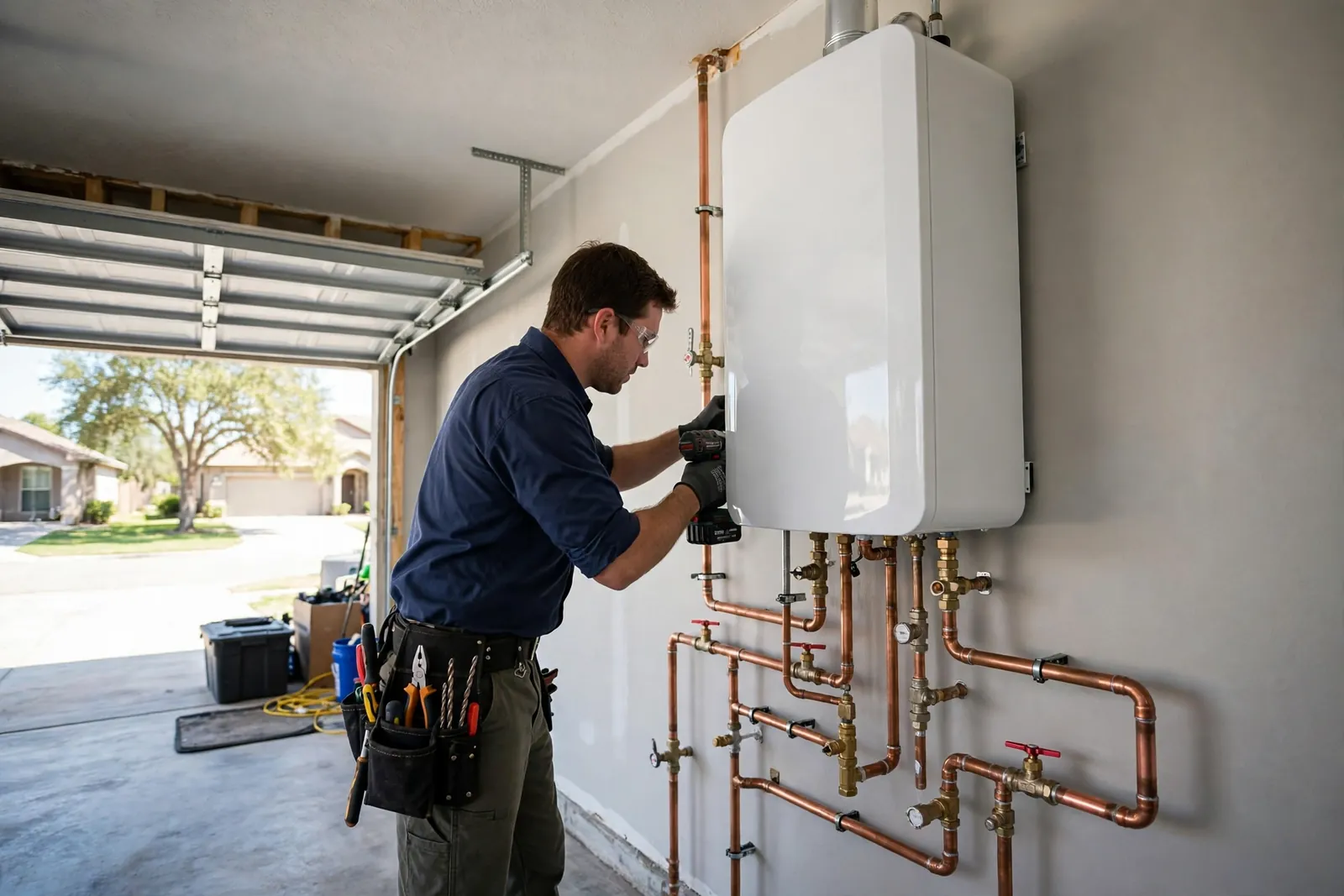
Igniters, sensors, valves, elements and fans fitted where the fault is a part and the part is available.
Temporary plan where a part must be ordered
Diagnosis, a plain plan, and a return visit with the part — so the house knows what happens next.
Testing at the taps
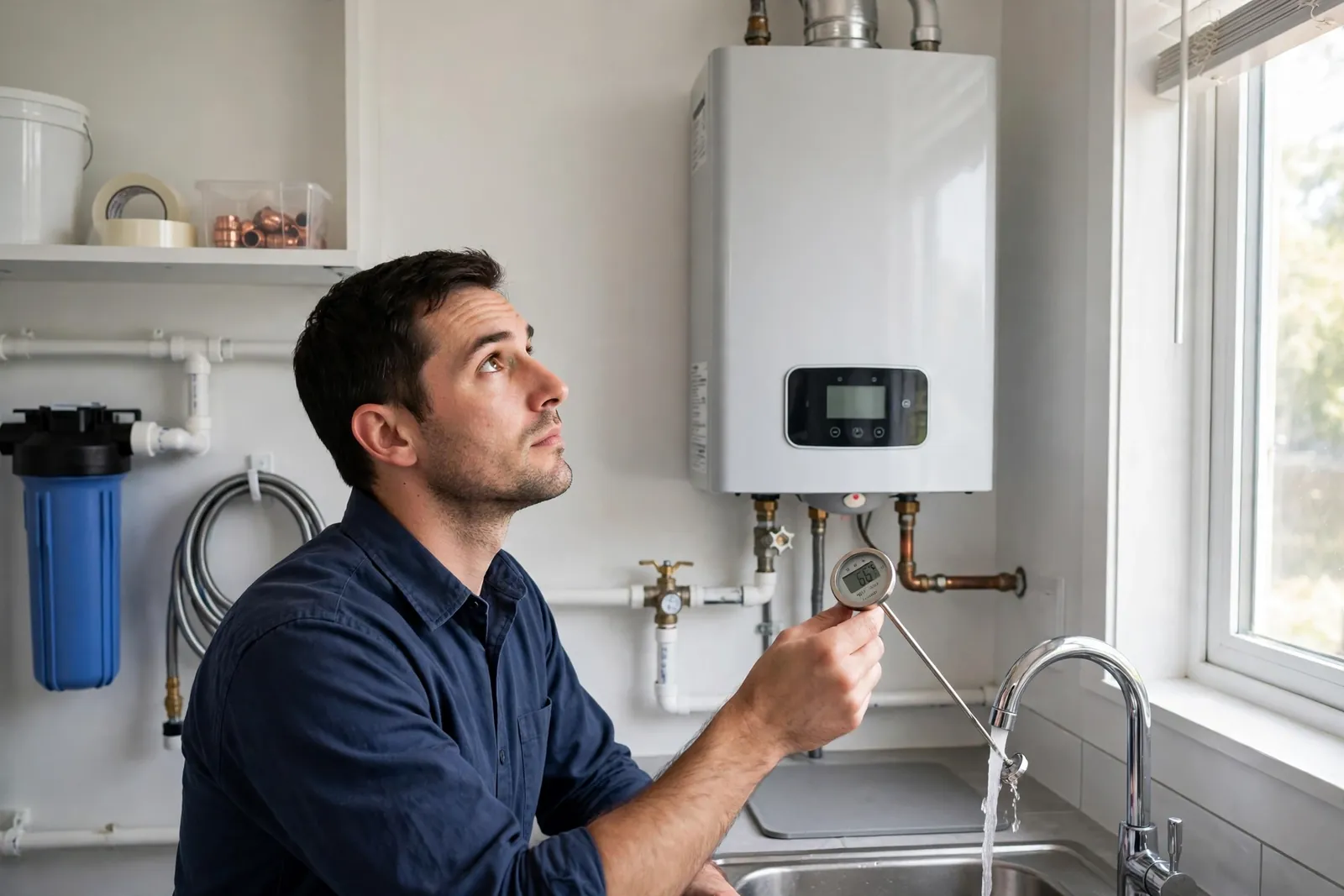
Hot water run at the taps after the work: temperature steady, flow normal, no error code showing.
How the work runs
Call and describe the emergency
No hot water, a leak, a gas smell, or a unit that keeps shutting off — and any error code on the display.
Make it safe first
Water and gas or power shut off where the unit is leaking; leave the house and call from outside if you smell gas.
Diagnosis at the unit
Error codes, flow and temperature checks, gas or electrical supply, venting, the inlet filter, and the heat exchanger.
Plain explanation
What failed, what it means, and whether repair or replacement fits — in short, plain words.
Repair on the visit
The part fitted where the fault is a part and the part is available; a plan and a return visit where it must be ordered.
Test at the taps
Hot water run at the taps: temperature steady, flow normal, no error code showing.
Tools and methods used
Error-code reading
The display code is read first, because it names the fault the unit detected and sets the order of the checks.
Flow and temperature meters
Flow rate and temperature rise are measured at the taps, so the diagnosis rests on numbers rather than a guess.
Shut-off and isolation valves
The unit isolation valves stop water reaching a leaking unit, and the gas valve or breaker stops the energy supply safely.
Gas and electrical checks
Gas pressure and electrical supply are checked at the unit, because a starved burner or a failed element both look like no hot water.
Descaling pump and solution
A circulation pump runs descaling solution through the heat exchanger where scale is behind the failure.
Leak tracing
Connections, relief valves, the heat exchanger and the condensate drain are checked in order, so the leak is found at its source.
What happens on an emergency visit
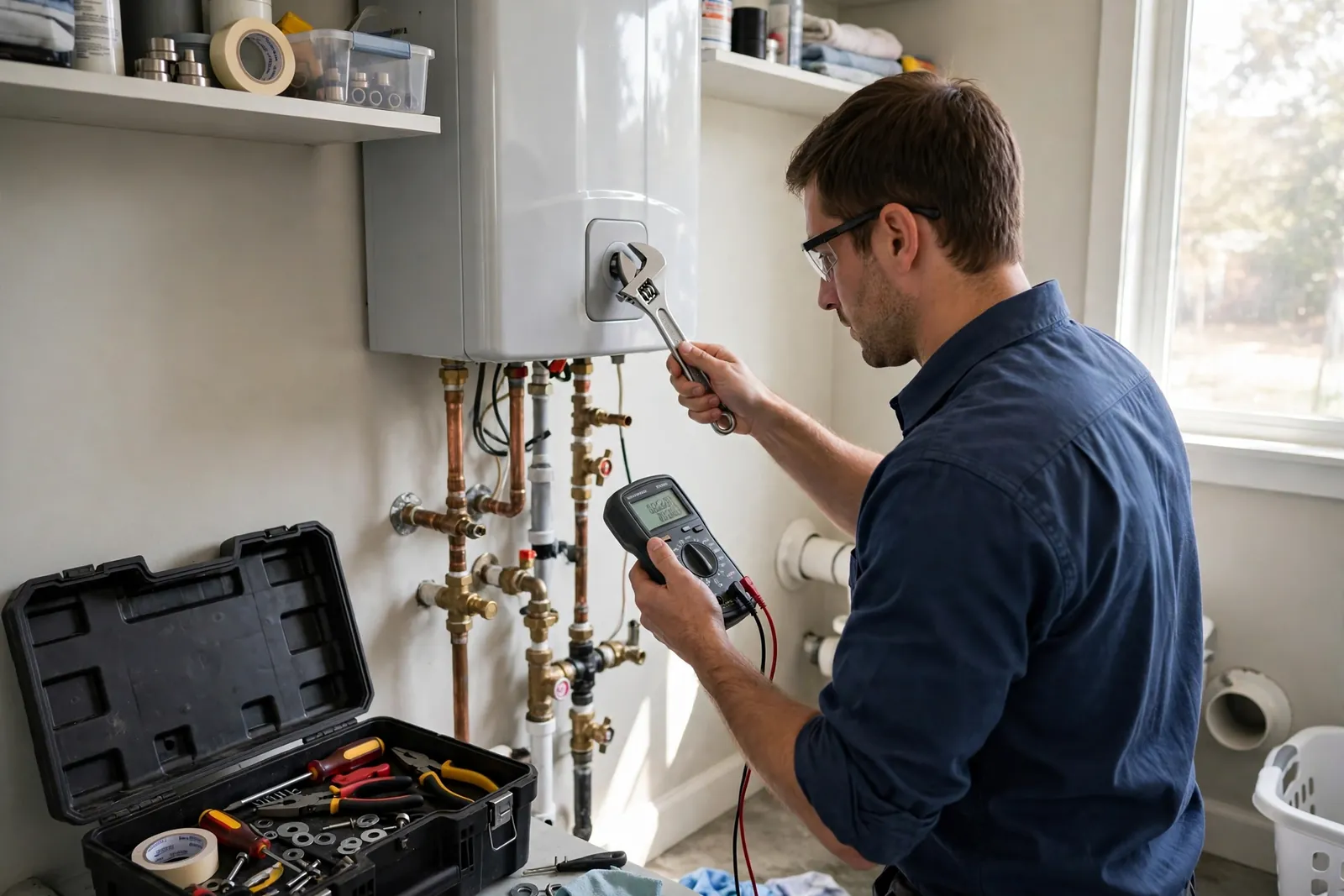
An emergency visit follows the same sequence as a routine repair, compressed. The display is read first — the error code, the set temperature, and what the unit does when a tap opens. Then the checks follow in order: water flow at the taps, the inlet filter, the gas or electrical supply, the vent path, and the heat exchanger. The difference is the pace: the explanation is short, the options are named plainly, and the work starts as soon as the fault is found.
Parts are the question that decides how fast the house gets hot water back. A failed igniter, sensor or valve that is a standard part can be fitted on the same visit. A failed control board or a heat exchanger may need ordering, and the visit then becomes diagnosis, a temporary plan, and a return with the part. That is why the call asks for the make of the unit and the error code — the answers decide what comes to the door.
After the work, the testing is the same as any repair: hot water run at the taps, temperature steady, flow normal, no error code showing, and the unit firing and shutting off as it should. The visit ends with what to watch next — the descaling interval, the filter check, and the freeze steps for the next cold snap — because an emergency repair that leaves the cause in place is a repeat call waiting to happen.
When the emergency is really a replacement
Some emergency calls end in a replacement conversation, and it is better to know the signs before the visit. A heat exchanger that is leaking is the clearest one — it is the most expensive part of the unit, and a leak there usually means the unit has reached the end of its serviceable life. A unit that was cracked in the February 2021 freeze and now leaks is in the same position: the crack is rarely the only weak point left by the cold.
Age and history shape the call as well. A unit well past a decade that has never been descaled and now needs a major part is often better replaced than repaired, because the next failure is usually close behind. A young unit with one failed sensor is the opposite — a repair, whatever the hour. The label on the unit gives its age; the flush water and the inspection give the rest, and the recommendation follows from both.
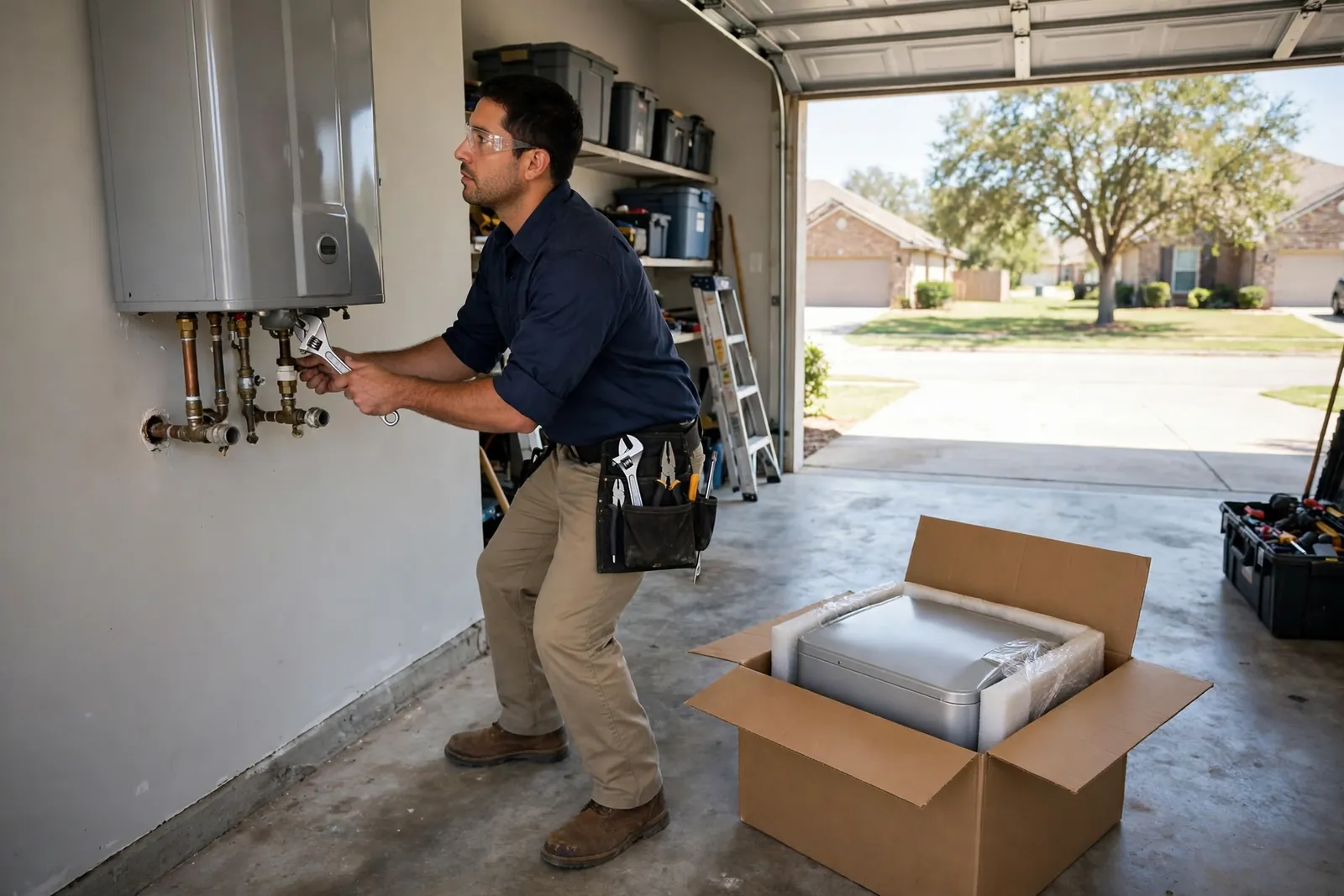
A replacement on an emergency call is not a bigger version of a repair — it is a different job, with sizing, gas or electrical supply, venting and condensate to check. The visit can still start the process: the diagnosis names the fault, the sizing is checked against the home, and the replacement is scheduled. The house gets a plan the same day, even when the new unit cannot be fitted the same day.
A house with no hot water, a leaking unit, or a heater that keeps shutting off
A tankless unit that cannot heat, or heats unevenly, leaves the house without reliable hot water — and the cause is rarely visible from the outside.
A unit diagnosed on the visit, repaired, and tested at the taps
The diagnosis names the cause — scale, flow, gas, venting or a failed part — before any work starts, and the fix is tested at the taps.
Problems this service solves
- No hot water at all, at every tap, with no warning.
- A unit leaking water onto the floor or down the wall.
- A unit that fires and shuts off within seconds, over and over.
- An error code that returns after a reset, with the water still cold.
- A unit damaged by a hard freeze, with no hot water after a cold night.
- A gas smell near the unit — leave the house and call from outside.
- Hot water that stops mid-shower and does not come back.
- A unit that trips a breaker or shuts down the moment demand peaks.
Signs you need emergency tankless repair
- There is no hot water at any tap in the house.
- Water is pooling under or around the unit, or staining the wall.
- The display shows an error code that will not clear.
- The unit fires, then dies, then fires again in a short cycle.
- You smell gas near the unit — leave the house and call from outside.
- The unit stopped working after a hard freeze or a cold night.
- The breaker trips every time the unit tries to heat.
- Hot water cuts out mid-shower and stays cold.
Related problems
Industries that use this service
Single-Family Homes · Rental Properties · Restaurants and Hospitality · All industries →
Frequently asked questions
Questions people ask about emergency tankless water heater repair, answered plainly.
Shut off the water to the unit at its isolation valves where it is safe to do so, then shut off the gas or power as well. Move anything the water can damage, mop up what you can, and take a photo of the leak and the display. Do not open the unit casing yourself.
Leave the house, do not switch lights or appliances on or off, and call your gas utility emergency line and emergency services from outside. Do not try to find the leak, do not relight anything, and do not go back inside until you are told it is safe.
The usual causes are a loss of gas or power, a tripped breaker, a closed valve, a clogged inlet filter, or a failed sensor. The display code narrows it fast — ignition failure, overheating, a venting fault, or a sensor out of range — and the code decides what the visit covers.
The diagnosis happens on the visit, and a repair follows where the fault is a part that is available — an igniter, sensor, valve, element or fan. A failed control board or heat exchanger may need ordering, and the visit then becomes diagnosis, a plain plan, and a return with the part.
That short-cycling usually means the overheat protection is tripping: scale insulating the heat exchanger, a venting fault, or a sensor reading wrong. The visit checks the heat exchanger, the vent path and the sensors before anything else, because the unit is protecting itself from damage.
A frozen unit shows up as no hot water after a cold night, sometimes with a visible crack or a leak once the ice thaws. The February 2021 freeze cracked units across the Houston area. Freeze damage to a heat exchanger usually points toward replacement, because the crack is rarely the only weak point.
No. A reset clears the code, not the fault, and if the code returns the unit is still detecting the same problem. Write the code down and call. Repeated resets can mask a fault that is getting worse, and a unit that keeps shutting off is protecting itself.
Check whether cold water runs normally at the taps. If cold water is weak or absent everywhere, the problem may be the house supply. If cold water runs fine and only hot water is missing, the problem is at the unit. Check the breaker panel and the gas valve as well.
The make of the unit if you know it, the symptoms, any error code on the display, and whether the unit is leaking. A photo of the display and the label on the unit helps — the answers decide what comes to the door.
Usually not. If one tap is cold and the rest are hot, the problem is at that tap — a fixture, a valve, or a mixing valve — rather than the unit. If every tap is cold, the unit is the problem and the call is urgent.
No hot water in your Sugar Land home?
Call Now to reach a local tankless water heater professional. Describe the unit, the symptoms, and any error code on the display.
Call now for tankless water heater help
Tap Call Now to reach a local tankless water heater professional. Tell them the make of the unit if you know it, the symptoms, and any error code on the display.
Hours: Mon–Fri 7:00 AM–10:00 PM ET · Sat 8:00 AM–10:00 PM ET · Sun 7:00 AM–9:00 PM ET
Before you call
- Note the error code on the display, if one shows.
- Check whether other taps have hot water, and whether cold water runs normally.
- If the unit is leaking, shut off its water and gas or power where it is safe to do so.
- Take a photo of the display and the label on the unit.
- Note when the problem started and what changed just before it.