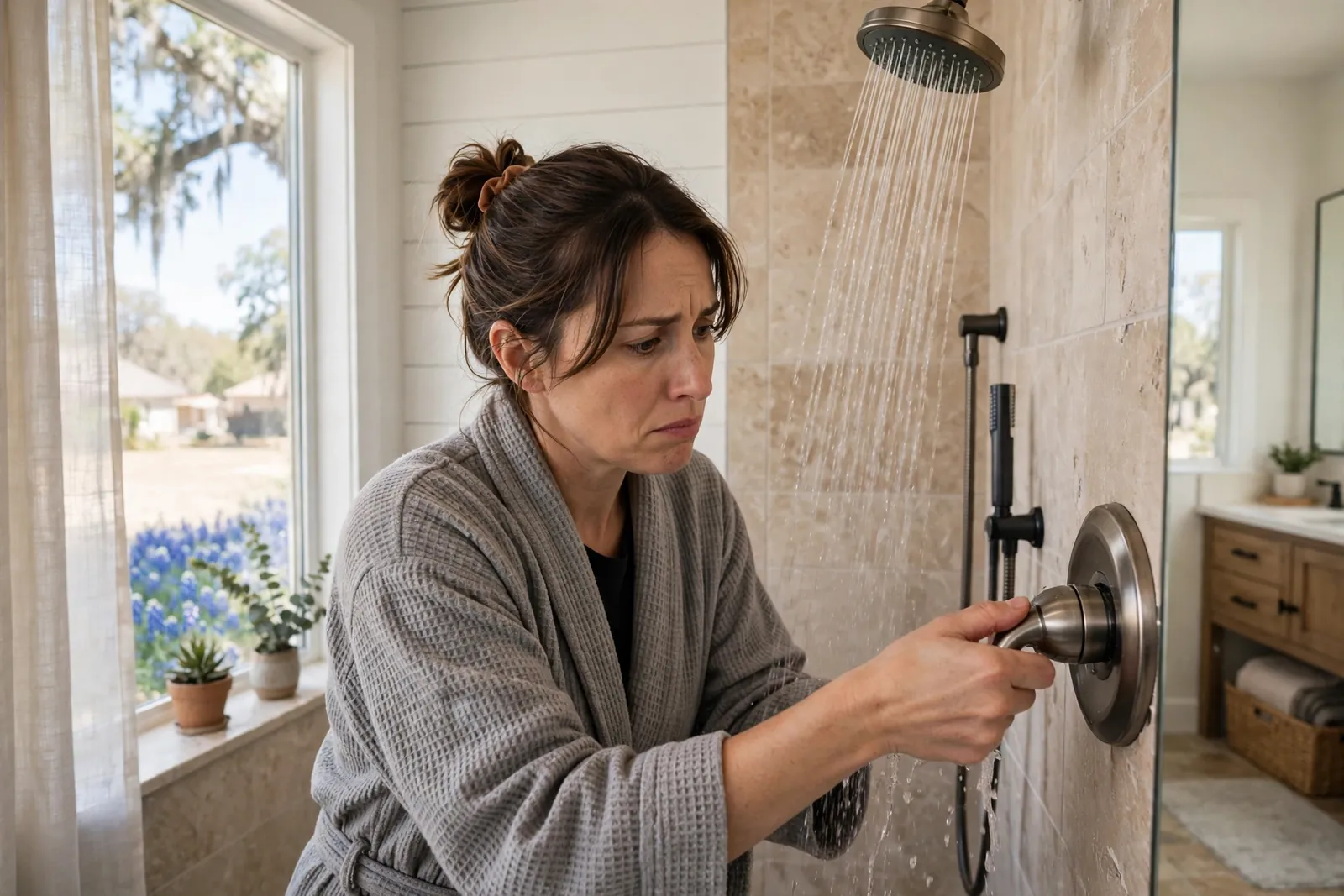
No Hot Water From a Tankless Water Heater in Sugar Land, TX
No hot water at any tap, with no warning, is the most common tankless call in Sugar Land. The diagnosis runs in order — display, flow, supply, filter, scale — and the fault is usually found before any part is touched.
Need help with your tankless water heater?
Call Now to reach a local tankless water heater professional. Describe the unit, the symptoms, and any error code on the display.
Hours: Mon–Fri 7:00 AM–10:00 PM ET · Sat 8:00 AM–10:00 PM ET · Sun 7:00 AM–9:00 PM ET
What no hot water looks like
No hot water is plain at the tap: the shower runs cold, the kitchen tap runs cold, every tap in the house is cold. The unit may be silent, or it may be running. The display may show an error code, or it may show nothing at all. The first question is whether the problem is the unit or the house: if cold water runs normally at the taps, the house supply is fine and the unit is the problem. If cold water is weak or absent everywhere, the problem may be the house supply instead.
The second question is whether the problem is at one tap or every tap. One tap cold and the rest hot means the problem is at that tap — a fixture, a valve, or a mixing valve — rather than the unit. Every tap cold means the unit is the problem, and the diagnosis starts at the display.
The third question is what changed. A unit that worked yesterday and does not work today has a different story from a unit that has been declining for months. A sudden failure points to supply, a sensor, or a part. A slow decline points to scale — a heat exchanger that has been coating over for a year or more without a flush. The history shapes the diagnosis, and the call asks for it.
The diagnosis, in order
The display comes first, because the unit is already keeping a record. An error code names the fault the unit detected — ignition failure, overheating, a venting fault, a sensor out of range — and the code decides what the visit covers. No code at all is information too: a unit with a blank display has lost power, or its control board has failed. The code is written down before the unit is reset, because a reset clears the evidence.
Flow comes second. The flow sensor must detect enough water moving to trigger the burner or the elements, and if the flow is too low the unit stays silent. The inlet filter is pulled and looked at: a clogged screen is visible at a glance, and cleaning it sometimes ends the visit. Flow is measured at the taps, because numbers end arguments about how the water feels.
Supply comes third: gas or power. A gas unit with no gas, a closed valve, or a line that cannot deliver the pressure under load will not light, or will light and die. An electric unit with a tripped breaker, a failed element, or a panel that cannot carry the load will not heat, or will heat only partly. The supply is measured at the unit, under load.
Filter and scale come fourth and fifth. The inlet filter screen catches grit and scale flakes, and when it clogs the unit starves for water. Scale coats the heat exchanger a little more every time the unit fires in hard water, until the heat cannot get through and the unit trips its overheat protection.
The causes, and how each one is found
A loss of gas or power is the first cause to check, because it is the simplest and the most common after other work: a valve closed during a renovation, a breaker tripped, a meter changed by the utility. The visit checks the valve, the breaker, and the supply at the unit.
A clogged inlet filter is the second cause, and the simplest to fix. The screen is pulled, looked at, cleaned, and the flow is checked afterwards. A filter that clogs again quickly points to scale flakes coming off the heat exchanger — and to a flush.
Scale is the third cause, and the Sugar Land cause. A heat exchanger coated in hard-water scale cannot transfer heat, and the unit trips its overheat protection. The flush dissolves the layer, and the flow and temperature are checked afterwards to prove the improvement.
A failed part is the fourth cause: an igniter, a flame sensor, a flow sensor, a temperature sensor, an element, a fan, a control board. Each one has a distinct signature in the error code and the readings, and each one is found by testing rather than by guessing.
What to do while you wait
Note the error code on the display, if one shows, and the make of the unit from the label. Check whether cold water runs normally, check the breaker panel, check the gas valve, and check whether other taps have hot water. Take a photo of the display and the label. If the unit is leaking, shut off its water and gas or power where it is safe to do so.
Do not keep resetting the unit. A reset clears the code, not the fault, and if the code returns the unit is still detecting the same problem. A unit that keeps shutting off is protecting itself from damage, and every cycle adds wear. Write the code down and call.
What to do now
- Note the error code on the display, if one shows.
- Check whether cold water runs normally at the taps.
- Check the breaker panel for a tripped breaker, and the gas valve.
- Check whether other taps have hot water.
- Take a photo of the display and the label on the unit.
- If the unit is leaking, shut off its water and gas or power where it is safe to do so.
What causes it
Loss of gas or power
A closed valve, a tripped breaker, or an interrupted supply — the simplest cause, and the first one checked.
Clogged inlet filter
Grit and scale flakes clogging the filter screen, starving the unit of water so it will not trigger.
Hard-water scale
Mineral scale coating the heat exchanger until the heat cannot get through and the unit trips its overheat protection.
Failed igniter or flame sensor
A gas unit that cannot light, or lights and dies because the flame sensor cannot prove the flame.
Failed element or breaker
An electric unit with a burned-out element, or a breaker that trips under load.
Failed flow or temperature sensor
A sensor reading wrong, so the unit never triggers or shuts itself down on a false reading.
Signs of this problem
- The water is cold at every tap in the house.
- The display shows an error code, or is blank.
- The unit is silent when a tap opens, or fires and dies within seconds.
- Cold water runs normally, but hot water never arrives.
- The problem started suddenly, with no warning.
- The unit has not been descaled in over a year.
- The breaker trips every time the unit tries to heat.
- The unit stopped working after a power cut, gas work, or a freeze.
Related service: Tankless Water Heater Not Heating
Related guide: why is my tankless unit not heating
Related service: tankless water heater not heating
Frequently asked questions
Questions people ask about no hot water, answered plainly.
Start with the display: an error code names the fault the unit detected. Common causes are no gas or power, a tripped breaker, a closed valve, a clogged inlet filter, or a failed igniter or flow sensor. If the unit is leaking, shut off its water and gas or power where it is safe to do so, then call.
Note the error code, check whether cold water runs normally, check the breaker panel and the gas valve, and check whether other taps have hot water. Take a photo of the display and the label on the unit.
Often, yes — where scale is the cause. A descale dissolves the mineral layer insulating the heat exchanger, and the flow and temperature are checked afterwards. Where the heat exchanger is damaged beyond flushing, the conversation becomes a replacement.
No. Write the code down first, then reset once. If the code returns, the unit is still detecting the same problem, and repeated resets mask a fault that is getting worse.
Usually not. If one tap is cold and the rest are hot, the problem is at that tap rather than the unit. If every tap is cold, the unit is the problem and the call is urgent.
A blank display means the unit has lost power, or its control board has failed. Check the breaker panel and the power to the unit first. If power is reaching the unit and the display stays blank, the board is the likely fault.
Yes. A hard freeze can crack the heat exchanger, the water lines and the condensate drain. The February 2021 freeze did exactly that across the Houston area. A unit that stopped working after a cold night is checked for freeze damage first.
The diagnosis itself is fast — display, flow, supply, filter, scale, in order — and the fault is usually named on the visit. Whether the repair follows the same day depends on the fault and the part.
Dealing with this problem now?
Call Now to reach a local tankless water heater professional. Describe the unit, the symptoms, and any error code on the display.
Call now for tankless water heater help
Tap Call Now to reach a local tankless water heater professional. Tell them the make of the unit if you know it, the symptoms, and any error code on the display.
Hours: Mon–Fri 7:00 AM–10:00 PM ET · Sat 8:00 AM–10:00 PM ET · Sun 7:00 AM–9:00 PM ET
Before you call
- Note the error code on the display, if one shows.
- Check whether other taps have hot water, and whether cold water runs normally.
- If the unit is leaking, shut off its water and gas or power where it is safe to do so.
- Take a photo of the display and the label on the unit.
- Note when the problem started and what changed just before it.