Tankless Water Heater Not Heating in Sugar Land, TX
A tankless unit that runs but does not heat, heats unevenly, or heats only some taps is a diagnosis job. The checks run in order — display, flow, supply, filter, scale — and the fault is usually found before any part is touched.
Need help with your tankless water heater?
Call Now to reach a local tankless water heater professional. Describe the unit, the symptoms, and any error code on the display.
Hours: Mon–Fri 7:00 AM–10:00 PM ET · Sat 8:00 AM–10:00 PM ET · Sun 7:00 AM–9:00 PM ET
What this service does
A tankless water heater that will not heat is the most common call in Sugar Land, and it is also the most misdiagnosed — because the same symptom has a dozen causes, and the cause decides the fix. The water is cold at the tap. The unit may be silent, or it may be running. The display may show an error code, or it may show nothing at all. The diagnosis is a sequence, and it runs in the same order every time: display, flow, supply, filter, scale, and then the parts.
The display comes first because the unit is already keeping a record. An error code names the fault the unit detected — ignition failure, overheating, a venting fault, a sensor out of range — and the code decides what the visit covers. No code at all is information too: a unit with a blank display has lost power, or its control board has failed. The code is written down before the unit is reset, because a reset clears the evidence and the fault returns.
Flow comes second, because a tankless unit will not heat water that is not moving. The flow sensor must detect enough water moving to trigger the burner or the elements, and if the flow is too low the unit stays silent. Low flow has its own causes: a clogged inlet filter, scale narrowing the heat exchanger, a partially closed valve, or a fixture aerator. Checking the flow at the taps — and whether cold water runs normally — separates a unit problem from a supply problem in seconds.
Supply comes third: gas or power. A gas unit with no gas, a closed valve, or a line that cannot deliver the pressure under load will not light, or will light and die. An electric unit with a tripped breaker, a failed element, or a panel that cannot carry the load will not heat, or will heat only partly. The supply is measured at the unit, under load, because a static reading tells only half the story.
Filter and scale come fourth and fifth, and in Sugar Land they are often the answer. The inlet filter screen catches grit and scale flakes, and when it clogs the unit starves for water. Scale coats the heat exchanger a little more every time the unit fires in hard water, until the heat cannot get through and the unit trips its overheat protection. A unit that has not been descaled in over a year and now will not heat is a unit whose heat exchanger is telling the story of the water it has been drinking.
Before you call
- Note the error code on the display, if one shows.
- Check whether other taps have hot water, and whether cold water runs normally.
- If the unit is leaking, shut off its water and gas or power where it is safe to do so.
- Take a photo of the display and the label on the unit.
- Note when the problem started and what changed just before it.
Why a tankless unit stops heating — the causes in order
A tankless unit stops heating when any link in its chain breaks, and the chain is short: flow, fuel, flame or elements, heat transfer, and the sensors that watch them. Flow is the trigger — no flow, no heat. Fuel is the energy — no gas or no power, no heat. Flame or elements are the heat source — a failed igniter, a fouled flame sensor, a burned-out element, and there is no heat to transfer. Heat transfer is the heat exchanger — scale insulating it, and the heat cannot reach the water. Sensors are the watchers — a sensor reading wrong, and the unit shuts itself down to protect itself.
The most common cause in Sugar Land is scale, and it is worth understanding why. Houston-area water is hard — about 8 grains per gallon in the City of Houston 2025 water quality report, a level the USGS classifies as hard — and a tankless heat exchanger is the worst place in a house for hard water: narrow passages, high temperatures, and water flowing through every day. Scale forms as a thin film, thickens with every firing, and eventually insulates the heat exchanger so thoroughly that the unit cannot heat the water passing through it. The unit trips its overheat protection, shows an error code, and the household calls.
The second most common cause is the inlet filter, and it is the simplest to fix. The filter screen sits on the cold-water inlet and catches grit and debris before they reach the inside of the unit. In hard-water country it also catches scale flakes — the pieces of mineral that break off the heat exchanger and travel downstream. When the screen clogs, flow to the unit falls, and the unit cannot heat properly or will not trigger at all. Cleaning the screen takes minutes, and it is part of every maintenance visit for exactly that reason.
The third group of causes is the parts: igniters, flame sensors, flow sensors, temperature sensors, elements, fans and control boards. Each one has a distinct signature in the error code, the flow rate and the temperature rise, and each one is found by testing rather than by guessing. A unit that lights and dies has a flame sensor problem. A unit that never triggers has a flow sensor problem. A unit that heats one tap and not two has an element or a sizing problem. The signature is the diagnosis.
What the service includes
Display and error-code reading
The error code is read and written down before any reset, because it names the fault the unit detected.
Flow and temperature measurement
Flow rate and temperature rise measured at the taps, so the diagnosis rests on numbers.
Supply checks
Gas pressure measured at the unit under load; voltage, current and continuity checked on electric units.
Inlet filter inspection
The filter screen pulled, inspected and cleaned, because a clogged screen starves the unit of water.
Scale assessment
The heat exchanger assessed by the flush water, the flow and the inspection — and flushed where scale is the cause.
Sizing check
Peak flow and temperature rise re-checked against the home, so an undersized unit is found rather than repaired in vain.
How the work runs
Call and describe the symptoms
No hot water, lukewarm water, hot at one tap only — and any error code on the display.
Display first
The error code read and written down before any reset, because it names the fault.
Flow and taps
Cold water checked at the taps, flow and temperature rise measured, inlet filter inspected.
Supply measured
Gas pressure at the unit under load; voltage, current and continuity on electric units.
Scale and sizing
Heat exchanger assessed and flushed where scale is the cause; sizing re-checked against the home.
Repair and test
The part fitted where the fault is a part; hot water run at the taps to prove the fix.
Tools and methods used
Error-code reading
The display code is read first, because it names the fault the unit detected.
Flow and temperature meters
Flow rate and temperature rise are measured at the taps, so the diagnosis rests on numbers rather than a guess about how hot the water feels.
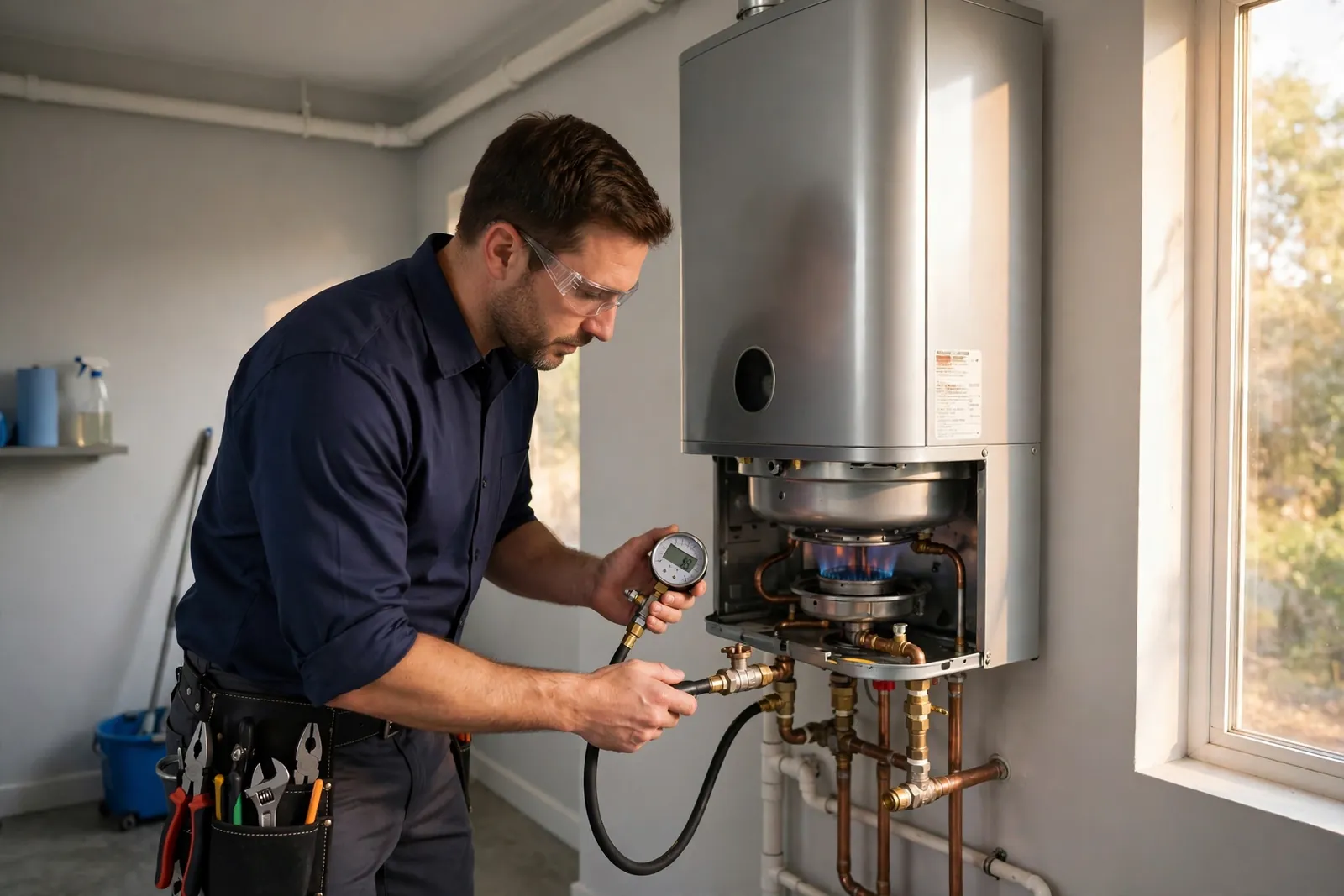
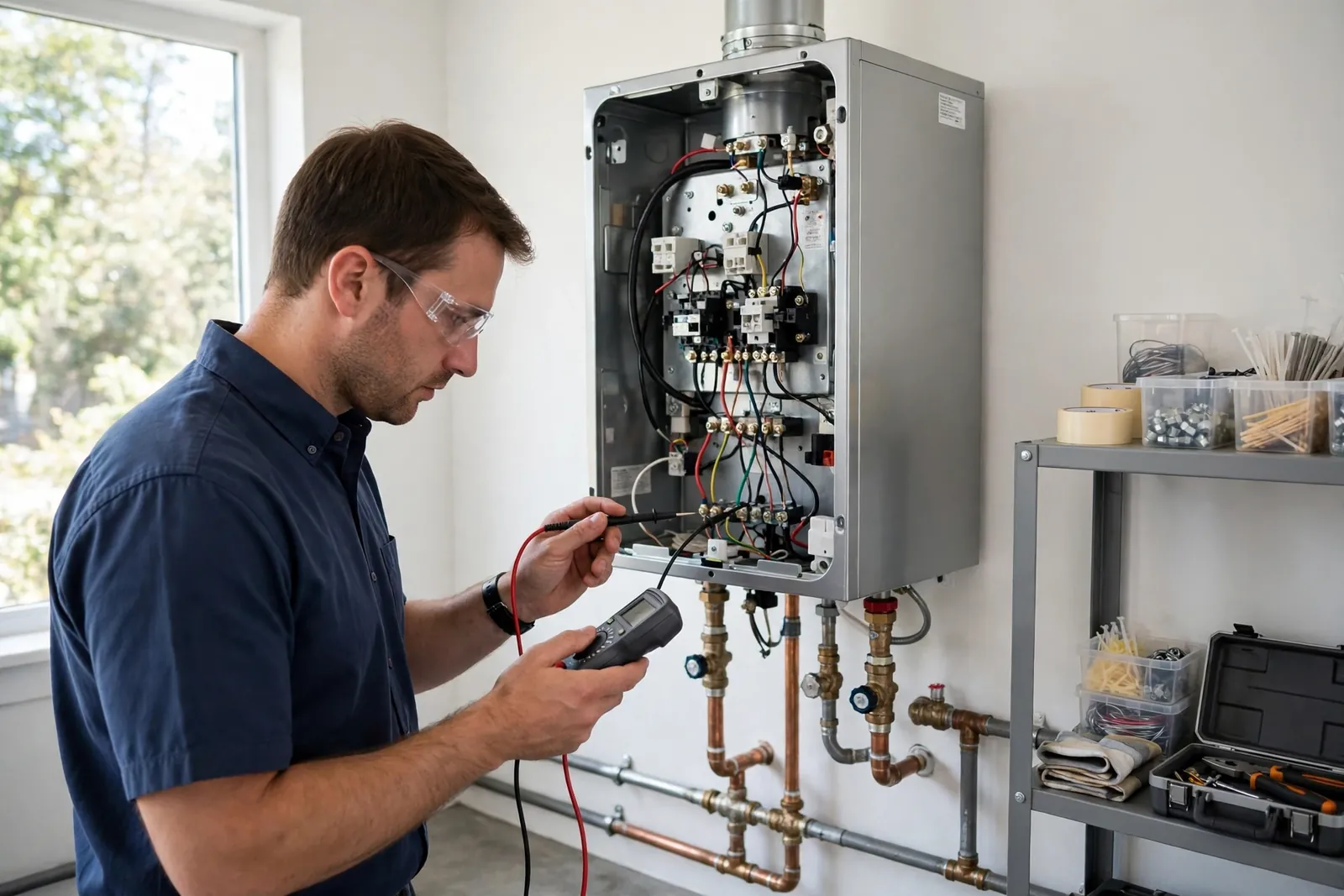
Manometer and electrical meter
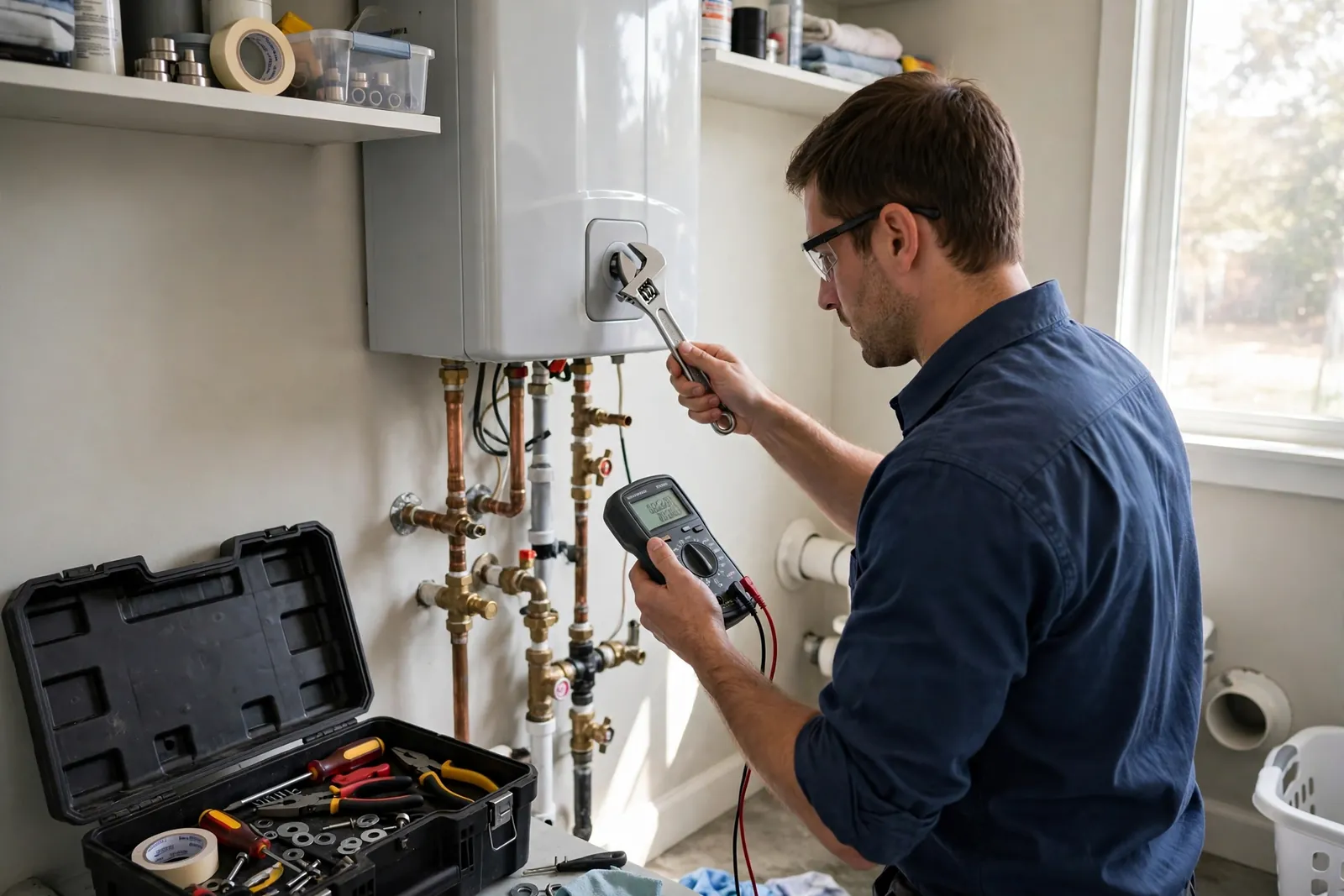
Gas pressure at the unit under load; voltage, current and continuity on electric units.
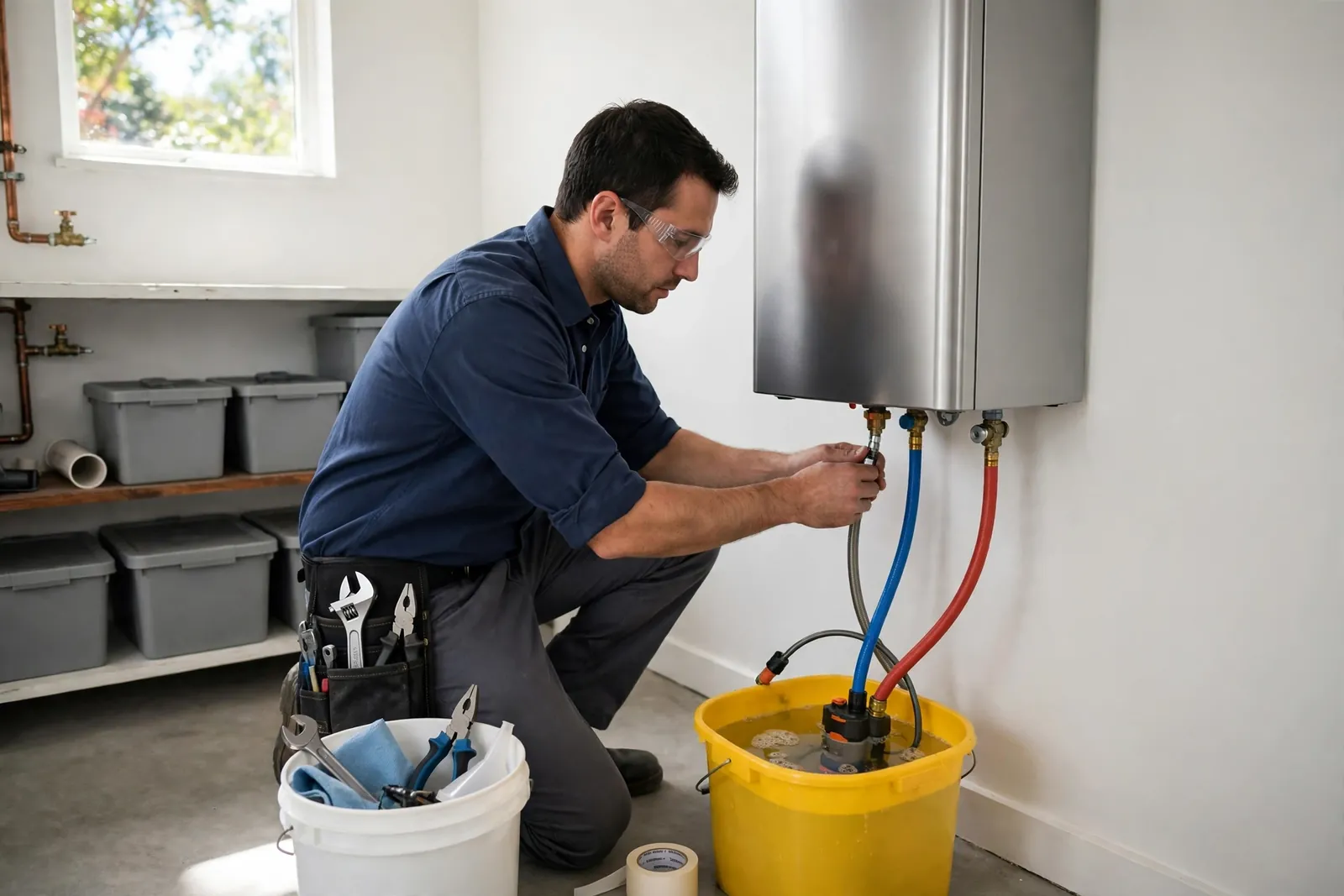
Descaling pump and solution
A circulation pump runs descaling solution through the heat exchanger where scale is behind the failure.
Filter inspection
The inlet filter screen is pulled and looked at, because a clogged screen is visible at a glance.
Sizing calculation
Peak flow rate and temperature rise worked out from the fixtures and the household, so an undersized unit is found.
The diagnosis, step by step
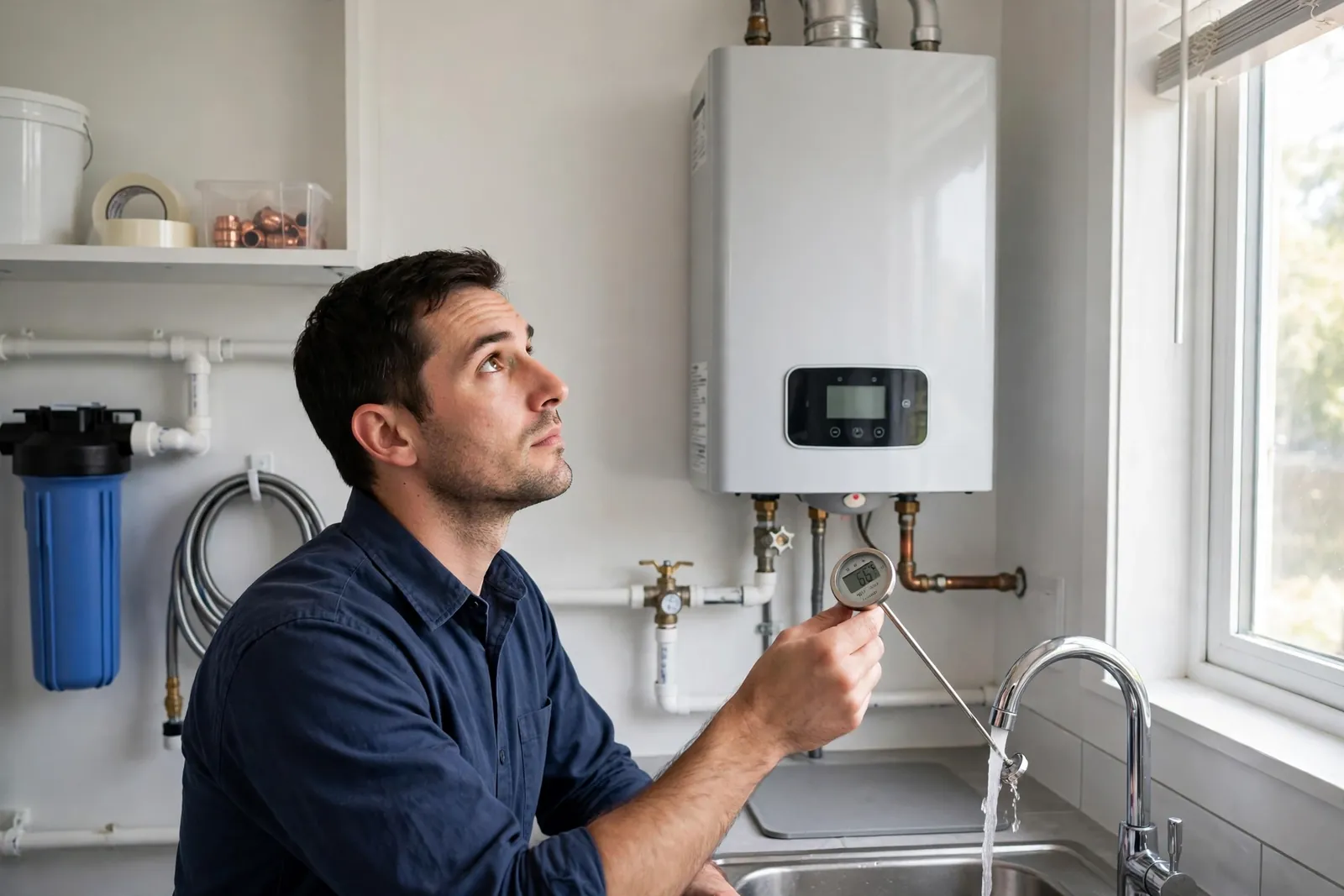
The diagnosis starts at the display. The error code is read and written down, the set temperature is noted, and the unit is watched while a tap opens: does it fire, does it light, does it stay lit, does it show a code. A unit that fires and dies has a different fault from a unit that never fires, and a unit that fires and stays lit but delivers lukewarm water has a different fault again. The watching takes a minute and it narrows the field by half.
Then the taps are checked. Cold water at every tap, hot water at none — the unit is the problem. Cold water weak everywhere — the house supply is the problem. One tap cold and the rest hot — the problem is at that tap. Flow is measured, and temperature rise is measured, because numbers end arguments about how hot the water feels. The inlet filter is pulled and looked at: a clogged screen is visible at a glance, and cleaning it sometimes ends the visit.
Then the supply is measured at the unit. Gas pressure under load for a gas unit; voltage, current and continuity for an electric unit. Then the vent path on a gas unit, and the condensate drain on a condensing unit. Then the heat exchanger — by the flush water, by the flow, and by the inspection. Only then does the conversation turn to repair or replacement, and it turns on what was found.
When not heating means the unit was never sized for the home
Some not-heating calls end with an uncomfortable finding: the unit was never sized for the home. A unit sized for one shower at a time meets a household that runs two showers and a washing machine together, and the water goes lukewarm at exactly the moment the household notices. Nothing is broken. The unit is working at its limit, and the limit is too low for the home. The diagnosis proves it with numbers: the flow rate at peak, the temperature rise the unit delivers, and the rise the home needs.
The finding matters because the fix is different. A repair cannot make an undersized unit bigger. The options are a larger unit, a second unit, or a change in how the household uses hot water at peak times. The replacement conversation that follows is a sizing conversation, not a sales conversation — peak flow rate and temperature rise worked out from the fixtures and the household, and the coldest incoming water temperature. A replacement that fixes the sizing ends the lukewarm showers; a repair on an undersized unit leaves them in place.
Winter makes the sizing question sharper. In a Sugar Land summer the incoming water is warm and the rise is small; in a winter cold snap the incoming water is much colder and the rise is large. A unit sized for summer conditions can struggle in January without anything breaking. The sizing is re-checked against the coldest incoming water temperature, because the unit must deliver on a January morning, not only on a summer afternoon.
A unit that runs but does not heat, heats unevenly, or heats only some taps
A tankless unit that cannot heat, or heats unevenly, leaves the house without reliable hot water — and the cause is rarely visible from the outside.
A unit diagnosed in order, repaired, and tested at the taps
The diagnosis names the cause — scale, flow, gas, venting or a failed part — before any work starts, and the fix is tested at the taps.
Problems this service solves
- No hot water at all, with the unit silent or running.
- Lukewarm water that never reaches the set temperature.
- Hot water at one tap and cold water at the rest.
- Water that turns hot, then cold, then hot again.
- A unit that fires and dies within seconds.
- An error code that returns after a reset, with the water still cold.
- Flow that has dropped, so the unit will not trigger at all.
- A unit that was never sized for the home and goes lukewarm at peak times.
Signs your tankless unit is not heating properly
- The water is cold at every tap, or only lukewarm.
- The display shows an error code, or flashes a code that was not there before.
- The unit fires, then dies, then fires again in a short cycle.
- One tap is hot and the rest are cold.
- Hot water takes much longer to arrive than it used to.
- The shower goes cold when another tap opens.
- The unit has not been descaled in over a year and the symptoms are getting worse.
- The problem is worse on cold mornings and better later in the day.
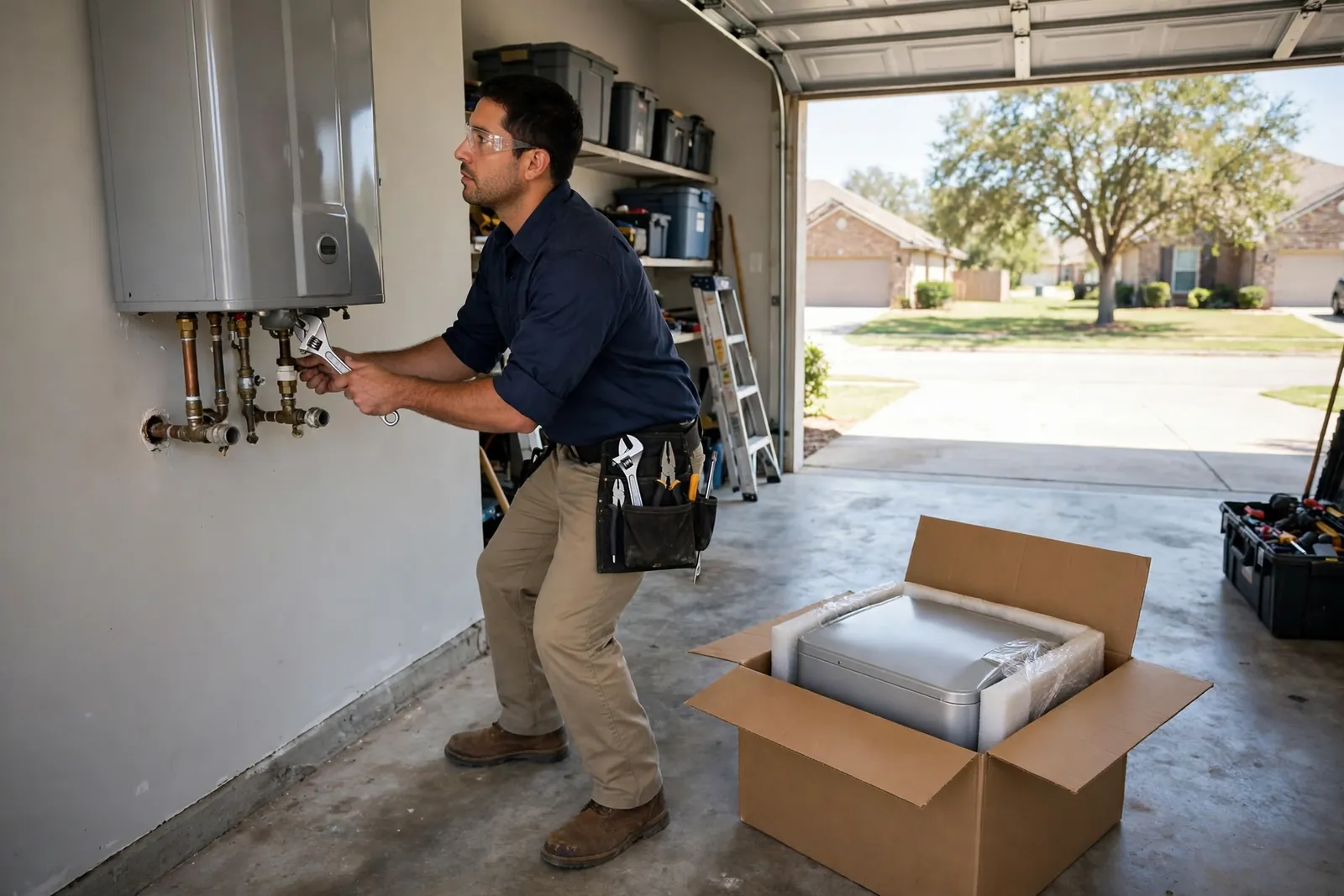
Related problems
Industries that use this service
Single-Family Homes · Rental Properties · Apartments and Condos · All industries →
Frequently asked questions
Questions people ask about tankless water heater not heating, answered plainly.
The usual causes are scale insulating the heat exchanger, a clogged inlet filter starving the unit of water, a failed element or sensor, or a gas supply that cannot deliver the pressure under load. The diagnosis runs in order — display, flow, supply, filter, scale — and the fault is usually found before any part is touched.
If one tap is hot and the rest are cold, the problem is usually at the cold taps — a fixture, a valve, or a mixing valve — rather than the unit. If every tap is cold, the unit is the problem. Check whether cold water runs normally at the cold taps first.
Winter incoming water is much colder, so the unit must deliver a larger temperature rise at the same flow rate. A unit sized for summer conditions can struggle in January without anything breaking. The sizing is re-checked against the coldest incoming water temperature.
Note the error code on the display, check whether cold water runs normally, check the breaker panel for a tripped breaker and the gas valve for a closed valve, and check whether other taps have hot water. Take a photo of the display and the label on the unit.
Often, yes — where scale is the cause. A descale and flush dissolves the mineral layer inside the heat exchanger, and the flow and temperature are checked afterwards to prove the improvement. Where the heat exchanger is damaged beyond flushing, the conversation becomes a replacement.
Usually the flame sensor is fouled and cannot prove the flame, so the unit shuts the gas off as a safety measure. Scale on the heat exchanger, a venting fault, or a sensor reading wrong can do the same. The visit checks the sensor, the heat exchanger and the vent path.
It may be, if the water goes lukewarm whenever two showers or a shower and a washing machine run together, and the diagnosis finds nothing broken. Flow rate at peak and temperature rise are measured to prove it — and a repair cannot make an undersized unit bigger.
Write the code down first, then reset once. If the code returns, the unit is still detecting the same problem, and repeated resets mask a fault that is getting worse. The code and the make of the unit are what the visit needs.
The unit can heat a fixed flow rate by a fixed temperature rise, and a second tap pushes the flow past it. It can also be a failed element or scale narrowing the heat exchanger. Flow and temperature are measured to tell the two apart.
The diagnosis itself is fast — display, flow, supply, filter, scale, in order — and the fault is usually named on the visit. Whether the repair follows the same day depends on the fault and the part: a sensor or a filter is same-visit work, a control board or a heat exchanger may need ordering.
No hot water in your Sugar Land home?
Call Now to reach a local tankless water heater professional. Describe the unit, the symptoms, and any error code on the display.
Call now for tankless water heater help
Tap Call Now to reach a local tankless water heater professional. Tell them the make of the unit if you know it, the symptoms, and any error code on the display.
Hours: Mon–Fri 7:00 AM–10:00 PM ET · Sat 8:00 AM–10:00 PM ET · Sun 7:00 AM–9:00 PM ET
Before you call
- Note the error code on the display, if one shows.
- Check whether other taps have hot water, and whether cold water runs normally.
- If the unit is leaking, shut off its water and gas or power where it is safe to do so.
- Take a photo of the display and the label on the unit.
- Note when the problem started and what changed just before it.