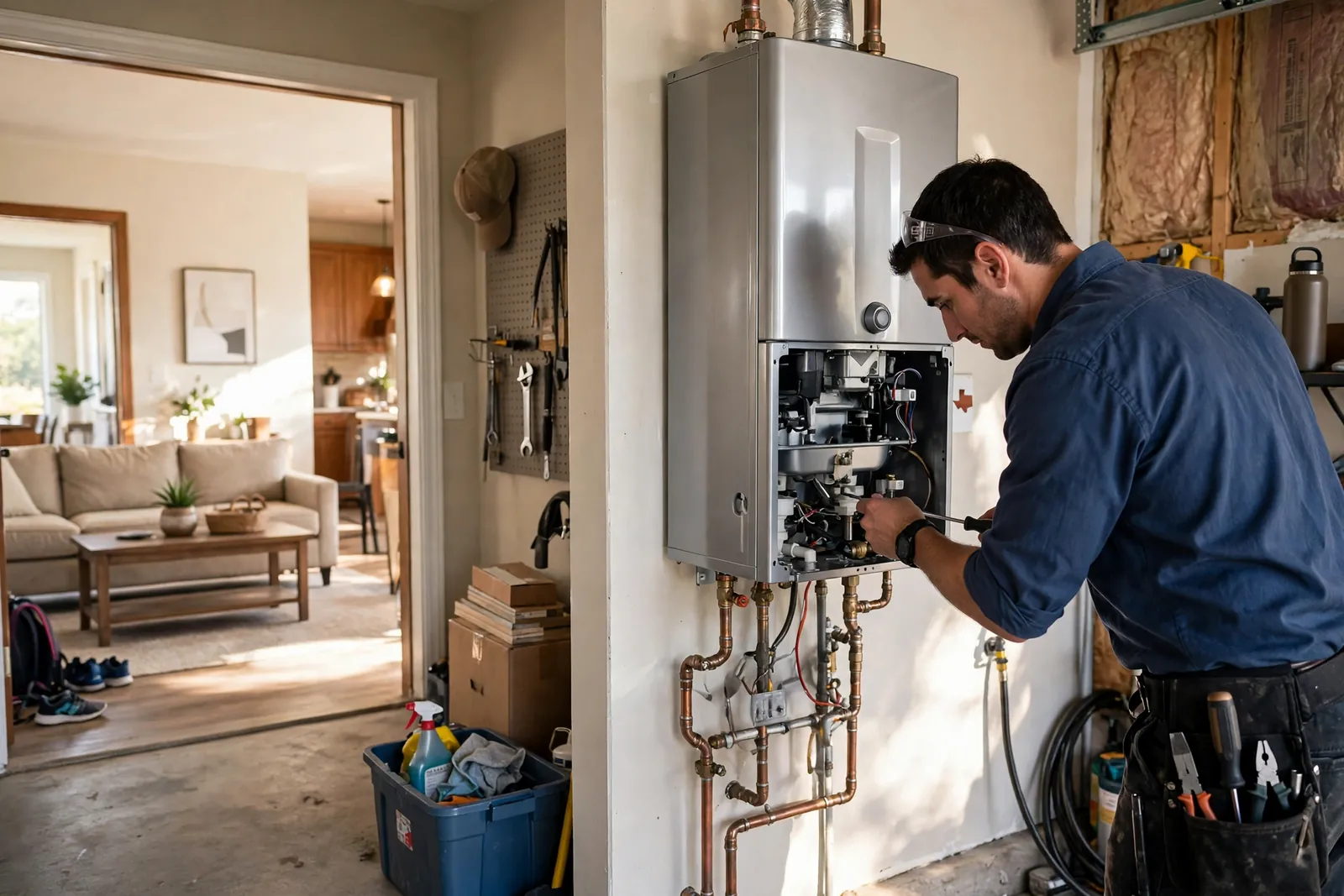
Tankless Water Heaters for Single-Family Homes in Sugar Land, TX
A family home has one tankless unit serving every tap, shower and appliance. The unit must be sized for the morning peak, descaled on the yearly routine, and ready for the next freeze.
Need help with your tankless water heater?
Call Now to reach a local tankless water heater professional. Describe the unit, the symptoms, and any error code on the display.
Hours: Mon–Fri 7:00 AM–10:00 PM ET · Sat 8:00 AM–10:00 PM ET · Sun 7:00 AM–9:00 PM ET
How a home unit is sized
A single-family home is sized by its peak, not its average. The fixtures that run at the same time — two showers, a dishwasher, a washing machine on a weekday morning — decide the flow rate, and the coldest incoming water temperature decides the temperature rise. A unit that meets the peak feels effortless all day; a unit that meets only the average goes lukewarm at exactly the moment the household notices.
Sugar Land homes make the peak a real number. The master-planned communities — First Colony, New Territory, Telfair, Riverstone, Greatwood, Sienna — are large homes with big bathrooms, soaking tubs and laundry rooms, and many of them run several hot-water draws at once. The sizing conversation asks about the fixtures, the people, and the coldest weeks, because the unit must deliver on a January morning, not only on a summer afternoon.
There is one more sizing question, and it is about the layout: how far the farthest bathroom is from the unit. A long run means a long wait for hot water, and the cold-water sandwich where taps open and close often. A recirculation setup keeps hot water near the taps, and it is sized with the unit, not added blindly afterwards.
Hard water and the yearly routine
Houston-area water is hard — about 8 grains per gallon in the City of Houston 2025 water quality report, a level the USGS classifies as hard — and a family home uses enough hot water every day to lay down scale fast. A descale and flush about once a year is the routine the water demands, with the inlet filter cleaned at the same time. Homes with a water softener can stretch the interval; homes without one should not.
The symptoms of skipped maintenance arrive in order: a shower a little less hot than it was, a tap that takes longer to warm up, temperature swings during a shower, then flow dropping and error codes on cold mornings. By the time flow has dropped noticeably, the scale layer is thick enough to matter, and the flush that would have prevented it becomes a rescue that may not fully restore the unit.
The maintenance visit is also the moment the unit is looked at as a whole: the gas or electrical supply, the venting, the condensate drain, the relief valve, and the freeze protection for the next cold snap. The visit ends with a record — what was done, what was found, and when the next visit falls — and the record is what the maker care guidance asks for.
When the unit stops heating
A home unit that stops heating is a diagnosis job, and the diagnosis runs in order: display, flow, supply, filter, scale, and then the parts. An error code names the fault the unit detected. Flow and temperature are measured at the taps. Gas pressure is measured at the unit under load, or voltage and current on an electric unit. The inlet filter is pulled and looked at. The heat exchanger is assessed by the flush water and the inspection.
The most common home fault is scale, and the second is the inlet filter — both of them cheap to fix and expensive to ignore. The third group is the parts: igniters, flame sensors, flow sensors, elements and control boards, each with a distinct signature in the error code and the readings. A unit that lights and dies has a flame sensor problem. A unit that never triggers has a flow sensor problem. The signature is the diagnosis.
One home fault is specific to the season: the freeze. The February 2021 freeze cracked units across the Houston area, and a unit cracked then can leak now, when the weakened metal finally gives way. A leak after a freeze is checked for freeze damage first, because the answer changes the recommendation toward replacement.
Repair or replace for a family home
The repair-or-replace decision for a family home turns on three things: what failed, how old the unit is, and what the heat exchanger looks like. A failed sensor, igniter, element or valve is a repair in almost every case. A leaking heat exchanger is the opposite: it is the most expensive part of the unit, and a leak there usually means the unit has reached the end of its serviceable life.
Age and history shape the call as well. A unit that is a few years old and has been descaled on schedule is worth repairing even for a major part. A unit well past a decade, never flushed, and now needing a control board is a different calculation: the next failure is usually close behind. The label on the unit gives its age; the descaling history and the inspection give the rest.
A replacement is also the chance to fix the sizing. An undersized unit, a gas line that starves the burner at peak, a vent route that was never right — all of these can be corrected at replacement time, and none of them can be corrected by a repair. A replacement that fixes the sizing ends the lukewarm showers; a repair on an undersized unit leaves them in place.
What to check before you call
Note the error code on the display, if one shows, and the make of the unit from the label. Check whether other taps have hot water, and whether cold water runs normally. If the unit is leaking, shut off its water and gas or power where it is safe to do so. Take a photo of the display and the label, and note when the problem started and what changed just before it.
Those checks take two minutes and they shape the whole visit. A household that calls with the code and the make ready gets a diagnosis that starts at the fault, not at the beginning — and the answers decide what comes to the door.
The yearly visit, and what it finds
The yearly visit is the moment the unit is looked at as a whole, not just flushed. The descale dissolves the scale on the heat exchanger, the inlet filter is pulled and cleaned, and the flow and temperature are checked afterwards to prove the improvement. Then the rest of the unit is checked: the gas or electrical supply, the venting, the condensate drain, the relief valve, and the freeze protection for the next cold snap. A unit that is looked at once a year is a unit whose faults are found early, when they are small.
The visit also checks the things the household never sees. The burner on a gas unit — flame, air, igniter, flame sensor — or the elements and electrical connections on an electric unit. The venting, for blockage, corrosion and correct sizing. The condensate drain, for a clear and freeze-proof route. The relief valve, tested to prove it opens and closes. Each check is small; together they are the difference between a unit that fails at midnight and a unit that does not.
The visit ends with a record, and the record is the point. What was done, what was found, and when the next visit falls — written down, kept per unit, and carried forward to the next visit. A household that keeps the record has a unit whose history is known, and a unit whose history is known is a unit whose faults are caught early. The record is also what the maker care guidance asks for, and it is what the next technician builds on.
Services used most
Tankless Water Heater Repair · Tankless Water Heater Maintenance · Tankless Water Heater Installation · Tankless Water Heater Replacement
Where we work
Sugar Land, TX · Katy, TX · Missouri City, TX · Pearland, TX
Related guides
How Often to Flush a Tankless Unit · How Long Tankless Units Last · Tankless vs Tank Water Heaters
Related problems
Frequently asked questions
Questions people ask about tankless water heaters in single-family homes, answered plainly.
By the peak: the fixtures that run at the same time, and the coldest incoming water temperature. A unit that meets the peak feels effortless all day; a unit that meets only the average goes lukewarm at exactly the moment the household notices.
About once a year in Sugar Land water. Houston-area water is hard, and that mineral load coats the heat exchanger a little more every time the unit fires. Homes with a water softener can stretch the interval.
The unit can heat a fixed flow rate by a fixed temperature rise, and two showers plus a washing machine can push the flow past it. It can also be scale narrowing the heat exchanger. Flow and temperature are measured to tell the two apart.
Yes, where it is sized for the home peak and the supply can deliver it — a gas line sized for the unit demand, or the electrical capacity for an electric unit. A second unit is sometimes the answer for the largest homes.
Shut off the water at the isolation valves and the gas or power where it is safe to do so, move anything the water can damage, and take a photo of the leak and the display. Do not open the unit casing yourself.
Often, yes. A recirculation pump keeps hot water near the taps so the wait is short, and it suits homes with a long run from the unit to the farthest bathroom. It is sized with the unit, not added blindly afterwards.
Call with the symptoms and the history. A unit cracked in that cold snap can leak months or years later, when the weakened metal finally gives way, and freeze damage to a heat exchanger usually points toward replacement.
The clearest signs are a leaking heat exchanger, a unit so scaled that flushing no longer restores its heating, or a major part failure on a unit well past a decade that has never been descaled. The diagnosis decides, and the recommendation follows from what it finds.
Tankless water heater trouble at your property?
Call Now to reach a local tankless water heater professional. Describe the unit, the symptoms, and any error code on the display.
Call now for tankless water heater help
Tap Call Now to reach a local tankless water heater professional. Tell them the make of the unit if you know it, the symptoms, and any error code on the display.
Hours: Mon–Fri 7:00 AM–10:00 PM ET · Sat 8:00 AM–10:00 PM ET · Sun 7:00 AM–9:00 PM ET
Before you call
- Note the error code on the display, if one shows.
- Check whether other taps have hot water, and whether cold water runs normally.
- If the unit is leaking, shut off its water and gas or power where it is safe to do so.
- Take a photo of the display and the label on the unit.
- Note when the problem started and what changed just before it.