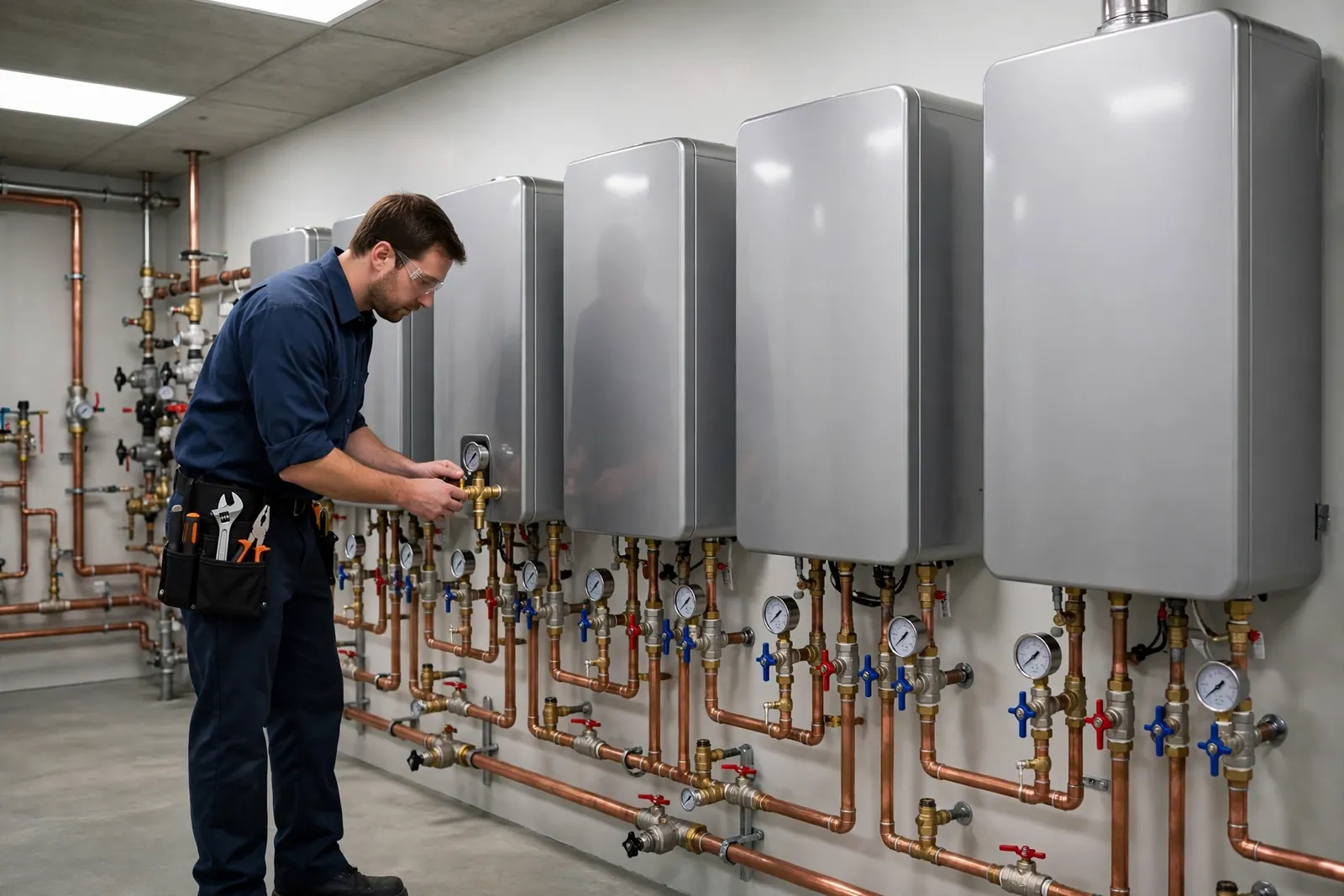
Tankless Water Heaters for Commercial Offices in Sugar Land, TX
Offices and shops need hot water for restrooms, kitchens and cleaning, on a schedule that cannot stop. Commercial tankless work is planned around the building hours, and the units are serviced in rotation.
Need help with your tankless water heater?
Call Now to reach a local tankless water heater professional. Describe the unit, the symptoms, and any error code on the display.
Hours: Mon–Fri 7:00 AM–10:00 PM ET · Sat 8:00 AM–10:00 PM ET · Sun 7:00 AM–9:00 PM ET
What an office needs from hot water
An office needs hot water for restrooms, for a kitchen or break room, and for cleaning — and it needs it on a schedule that cannot stop. The demand is not the morning peak of a hotel or the service rush of a restaurant; it is a steady draw through the working day, with a peak at the start and the end of it. A tankless setup for an office is sized for that steady draw, and for the cleaning at the end of the day.
The sizing for an office is a flow calculation: the restrooms, the kitchen, the cleaning draw, and the coldest incoming water temperature. A single unit can serve a small office; a larger building needs a set of units, sized for the building peak. A unit sized for the average will go lukewarm at the end of the day, when the cleaning crew needs hot water most.
Shared building systems are the office pattern. The units may be in a mechanical room, on a roof, or on an outside wall, and the water lines, gas lines and vent routes run through shared spaces. The building manager holds the keys to those spaces, and the work is arranged with the manager from the start — because the manager decides the hours, the access, and the schedule.
What fails first in office use
Scale fails first, and it fails at the pace the building sets. Houston-area water is hard, and an office unit that runs all day lays down scale faster than a home unit. The descaling interval is therefore set from the flush water: a heavy load shortens it, a light one stretches it. A unit that is never descaled loses heat and flow in months, not years.
The inlet filter is the second office failure, because the volume of water passing through it is far higher than in a home, and the grit and scale flakes accumulate faster. A clogged filter starves the unit of water, and the unit cannot heat properly or will not trigger at all. The filter is cleaned at every visit.
The third office failure is the sensor and the burner, working harder than they were made to in a unit that runs all day. Igniters wear, flame sensors foul, flow sensors stick. The maintenance visit checks them all, because a sensor that fails during the working day is a building without hot water at the hour it needs it most.
After-hours work and occupied space
Most commercial tankless work happens after hours, because that is when the building is empty enough for the work to move fast. Diagnosis and small repairs happen during the day; a unit replacement or a long descale waits for the evening, with the work done and the readings taken before staff arrive. The visit is planned around the building hours, and the schedule is agreed with the manager.
Occupied space is the other half of commercial work. The units are usually in a mechanical room or on an outside wall, so the work can happen without closing the space — but the hot water has to keep flowing to restrooms and kitchens while it does. A set of units makes that possible: one unit can be isolated and serviced while the rest carry the load, and the building never loses hot water entirely.
The record for a commercial job is heavier than for a home, because the building needs it: what was found, what was done, what the next interval is, and what to watch. The record goes to the manager, and it is the basis for the maintenance schedule.
Maintenance on a building schedule
Commercial maintenance is a schedule, not a reminder. The units are descaled on a fixed interval set from the flush water, the filter is cleaned at every visit, and the burner, vent and condensate drain are checked alongside. The units are serviced in rotation, so the building never loses hot water entirely, and the record is kept per unit.
The freeze question is asked for every commercial unit, because a unit on a roof, an outside wall or in an unheated plant room is exposed in a way an indoor unit is not. The February 2021 freeze cracked units across the Houston area, and the autumn check covers the internal heater, the drain-down steps, and the insulation on the water lines.
A water softener is the one addition that changes the commercial maintenance curve. It removes the calcium and magnesium before they reach the units, so scale forms far more slowly and the descaling interval stretches. For a building that runs its units all day, the softener is often the simplest maintenance there is.
Repair or replace for an office
The repair-or-replace decision for an office turns on downtime as well as cost. A failed sensor or igniter is a repair, and it happens fast. A leaking heat exchanger is usually a replacement, and it is scheduled for the hours the building can spare. The decision is made with the manager, and the schedule is part of it.
A replacement is also the chance to fix the sizing and the redundancy. A building that has grown without adding capacity, or a unit that was never sized for the cleaning draw at the end of the day — both are fixed at replacement time, with a unit or a set of units sized for the peak the building actually runs. A repair on an undersized setup leaves the lukewarm water in place.
After-hours work and the building schedule
Most commercial tankless work happens after hours, because that is when the building is empty enough for the work to move fast. Diagnosis and small repairs happen during the day; a unit replacement or a long descale waits for the evening, with the work done and the readings taken before staff arrive. The visit is planned around the building hours, and the schedule is agreed with the manager.
Occupied space is the other half of commercial work. The units are usually in a mechanical room or on an outside wall, so the work can happen without closing the space — but the hot water has to keep flowing to restrooms and kitchens while it does. A set of units makes that possible: one unit can be isolated and serviced while the rest carry the load, and the building never loses hot water entirely.
The record for a commercial job is heavier than for a home, because the building needs it: what was found, what was done, what the next interval is, and what to watch. The record goes to the manager, and it is the basis for the maintenance schedule. The schedule is the real protection, because a commercial unit that is serviced on schedule rarely fails during the working day.
Services used most
Tankless Water Heater Repair · Tankless Water Heater Maintenance · Tankless Water Heater Installation · Tankless Water Heater Replacement
Where we work
Related guides
How Often to Flush a Tankless Unit · How Long Tankless Units Last · Gas vs Electric Tankless Units
Related problems
Frequently asked questions
Questions people ask about tankless water heaters in commercial offices, answered plainly.
By the steady draw through the working day — restrooms, kitchen, cleaning — and the coldest incoming water temperature. A single unit can serve a small office; a larger building needs a set of units, sized for the building peak.
On a fixed interval set from the flush water: a heavy scale load shortens it, a light one stretches it. In Sugar Land water the interval is often twice a year for units that run all day.
The diagnosis can happen any time. A replacement or a long descale waits for after hours, when the building is empty enough for the work to move fast. A set of units lets one be serviced while the rest carry the load.
The cleaning draw at the end of the day pushes the flow past what the units can heat, or scale has narrowed the heat exchangers. Flow and temperature are measured to tell the two apart, and the sizing is re-checked against the building peak.
Call with the symptoms and the history. Units on roofs, outside walls and unheated plant rooms were among the first to crack in that cold snap, and freeze damage to a heat exchanger usually points toward replacement.
Often, yes. A softener removes the calcium and magnesium before they reach the units, so scale forms far more slowly and the descaling interval stretches. For a building that runs its units all day, it is often the simplest maintenance there is.
On a fixed schedule, arranged with the building manager: descaling on the interval the flush water sets, filter cleaning at every visit, and a freeze check in autumn. The units are serviced in rotation so the building never loses hot water entirely.
The building manager or owner, with the diagnosis in front of them. The decision turns on downtime as well as cost, and the schedule is part of it — a replacement is planned for the hours the building can spare.
Tankless water heater trouble at your property?
Call Now to reach a local tankless water heater professional. Describe the unit, the symptoms, and any error code on the display.
Call now for tankless water heater help
Tap Call Now to reach a local tankless water heater professional. Tell them the make of the unit if you know it, the symptoms, and any error code on the display.
Hours: Mon–Fri 7:00 AM–10:00 PM ET · Sat 8:00 AM–10:00 PM ET · Sun 7:00 AM–9:00 PM ET
Before you call
- Note the error code on the display, if one shows.
- Check whether other taps have hot water, and whether cold water runs normally.
- If the unit is leaking, shut off its water and gas or power where it is safe to do so.
- Take a photo of the display and the label on the unit.
- Note when the problem started and what changed just before it.