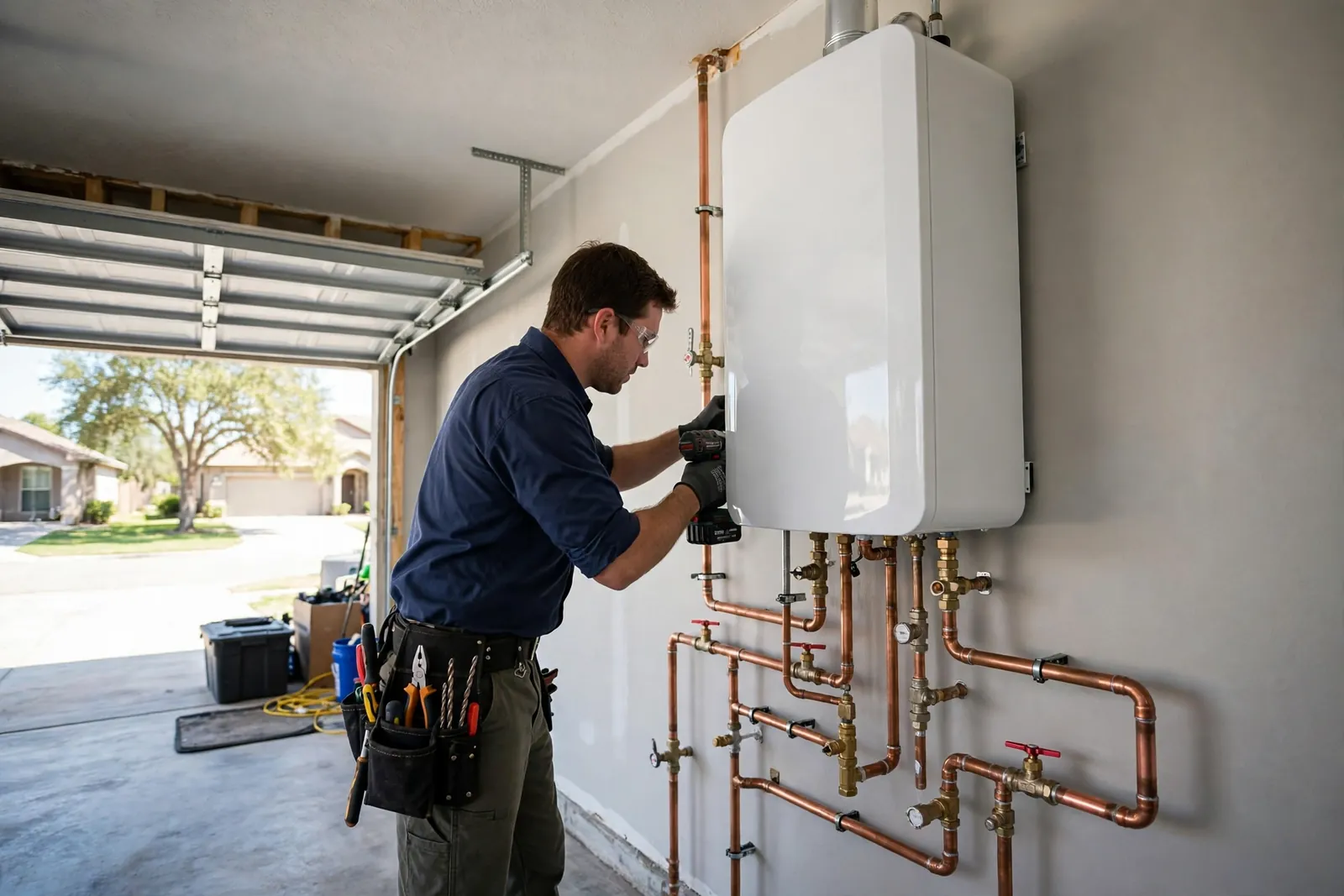
Tankless Water Heater Installation in Sugar Land, TX
A tankless installation starts with sizing, not with the unit on the wall. The unit must match the home peak hot-water demand and the incoming water temperature — and the gas line, venting and condensate path must fit the unit.
Need help with your tankless water heater?
Call Now to reach a local tankless water heater professional. Describe the unit, the symptoms, and any error code on the display.
Hours: Mon–Fri 7:00 AM–10:00 PM ET · Sat 8:00 AM–10:00 PM ET · Sun 7:00 AM–9:00 PM ET
What this service does
Switching to a tankless water heater is a sizing decision before it is a purchase decision. A tankless unit heats water as it flows, so it has no stored reserve to fall back on: it can heat a fixed amount of water by a fixed number of degrees, and no more. A unit that is too small for the home will go lukewarm the first time two showers and a washing machine run together. A unit that is oversized costs more than the home needs and cycles more than it should. The installation starts by working out what the home actually uses at peak, and what the incoming water temperature is in the coldest weeks.
Sugar Land homes make sizing interesting. The master-planned communities — First Colony, New Territory, Telfair, Riverstone, Greatwood, Sienna — are large homes with big bathrooms, soaking tubs and laundry rooms, and many of them run several hot-water draws at once in the morning. A household with two showers, a dishwasher and a washing machine running together needs a unit sized for that peak, not for one shower at a time. The sizing conversation asks about the fixtures, the habits, and the coldest incoming water temperature, because the unit must deliver on a January morning, not only on a summer afternoon.
The gas side of an installation is where most conversions from a tank unit get complicated. A gas tankless unit burns far more gas at full fire than a tank unit does, so the gas line that fed the old tank is often too small for the new unit. The line must be sized for the unit demand at peak, and the meter and the regulator must be able to deliver it. A gas line that is too small starves the burner exactly when demand peaks, and the symptom — lukewarm water when two taps run — looks like a faulty unit when it is really an undersized pipe.
Venting is the second half of the gas installation. A condensing gas unit vents through PVC or polypropylene pipe, because its exhaust is cool enough for plastic; a non-condensing unit vents hot exhaust through a metal flue. The vent path must carry exhaust outside safely, with the right slope, the right terminations, and clearance from windows and doors. The condensate from a condensing unit drains away through a trap and a drain line, and that line needs a path that cannot freeze or back up. Venting follows the unit maker instructions and local code, and it is checked as part of the installation, not assumed.
Electric tankless installation has its own supply question. An electric unit draws substantial current, and it needs dedicated circuits sized for the unit, with breakers and wiring to match. Older Sugar Land homes may need an electrical panel check before an electric unit can be fitted at all. The water side is simpler — cold in, hot out, with isolation valves and service valves fitted so the unit can be flushed and serviced without draining the house — but the electrical side decides whether the installation is possible, and at what size.
Before you call
- Note the error code on the display, if one shows.
- Check whether other taps have hot water, and whether cold water runs normally.
- If the unit is leaking, shut off its water and gas or power where it is safe to do so.
- Take a photo of the display and the label on the unit.
- Note when the problem started and what changed just before it.
How sizing works — the number that decides everything
Sizing a tankless unit comes down to two numbers: the flow rate the home needs at peak, and the temperature rise the unit must deliver. Flow rate is measured in gallons per minute, and it is the sum of the fixtures that run at the same time — a shower, a second shower, a washing machine, a dishwasher. Temperature rise is the difference between the incoming cold-water temperature and the temperature the home wants at the tap, and it changes with the seasons: in a Sugar Land summer the incoming water is warm and the rise is small; in a winter cold snap the incoming water is much colder and the rise is large.
The unit must meet the peak, not the average. A home that uses one shower at a time most of the day but two showers and a washing machine on a weekday morning needs a unit sized for that morning. The sizing conversation therefore asks about the busiest hour, not the quietest one. A unit that meets the peak will feel effortless all day; a unit that meets only the average will go lukewarm at exactly the moment the household notices.
Groundwater temperature is the quiet variable in the sizing. In Fort Bend County the incoming water temperature swings with the seasons, and the winter low is what sets the rise. A unit that delivers comfortably in August can struggle in January, when the same flow rate needs far more heat. Installations that size for the winter low do not have that problem; installations that size for a summer day do. The installer should be able to say what incoming temperature the sizing assumed, and why.
There is one more sizing question, and it is about the home, not the unit: how many bathrooms, how many people, and whether the household wants a recirculation setup for instant hot water at distant taps. A recirculation pump keeps hot water near the taps so the wait is short, and it changes how the unit cycles — so it is sized with the unit, not added blindly afterwards. A home with a long run from the unit to the farthest bathroom is the classic case, and Sugar Land larger homes often have exactly that layout.
What the service includes
Sizing for the home
Peak flow rate and temperature rise worked out from the fixtures, the household, and the coldest incoming water temperature.
Gas line sizing
The gas line, meter and regulator checked against the unit demand at peak, and upsized where the old line cannot deliver it.
Venting and condensate
Vent path fitted to the unit type — plastic for condensing, metal for non-condensing — with the condensate drain routed safely.
Water connections and valves
Cold inlet and hot outlet connected with isolation valves and service valves, so the unit can be flushed without draining the house.
Electrical work where needed
Dedicated circuits, breakers and wiring sized for an electric unit, with the panel checked before the unit is fitted.
Testing and handover
Hot water run at the taps, temperature and flow checked, the filter location shown, and the descaling interval and freeze steps explained.
How the work runs
Call and describe the home
The bathrooms, the people, the fixtures that run together, and whether the home has gas or only electric.
Sizing
Peak flow rate and temperature rise worked out from the fixtures, the household, and the coldest incoming water temperature.
Supply checks
Gas line, meter and regulator for a gas unit; panel and circuits for an electric unit; vent route and condensate path.
Unit fitted
Mounted on the wall, water and gas or electrical connected, isolation and service valves fitted.
Venting and condensate
Vent path fitted to the unit type, condensate drain routed safely, connections checked for leaks.
Test and handover
Hot water run at the taps, temperature and flow checked, filter location shown, descaling interval and freeze steps explained.
Tools and methods used
Sizing calculation
Peak flow rate and temperature rise worked out from the fixtures and the household, so the unit matches the home rather than a guess.
Gas pressure checks
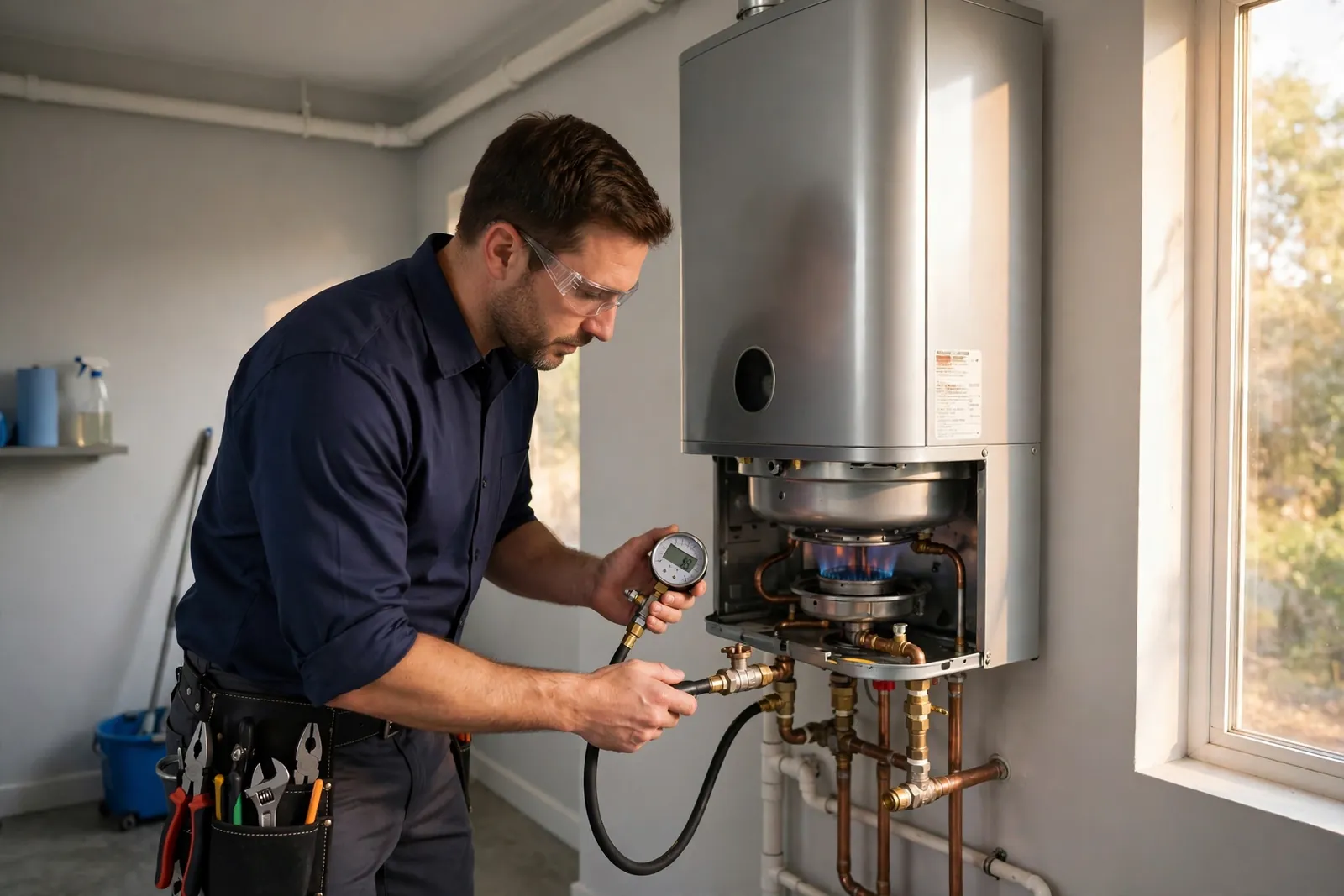
Gas pressure measured at the unit, so the line and the regulator are proven able to deliver the unit demand at peak.
Venting layout
The vent path planned to the unit maker instructions and local code, with the right slope, terminations and clearances.
Electrical load check
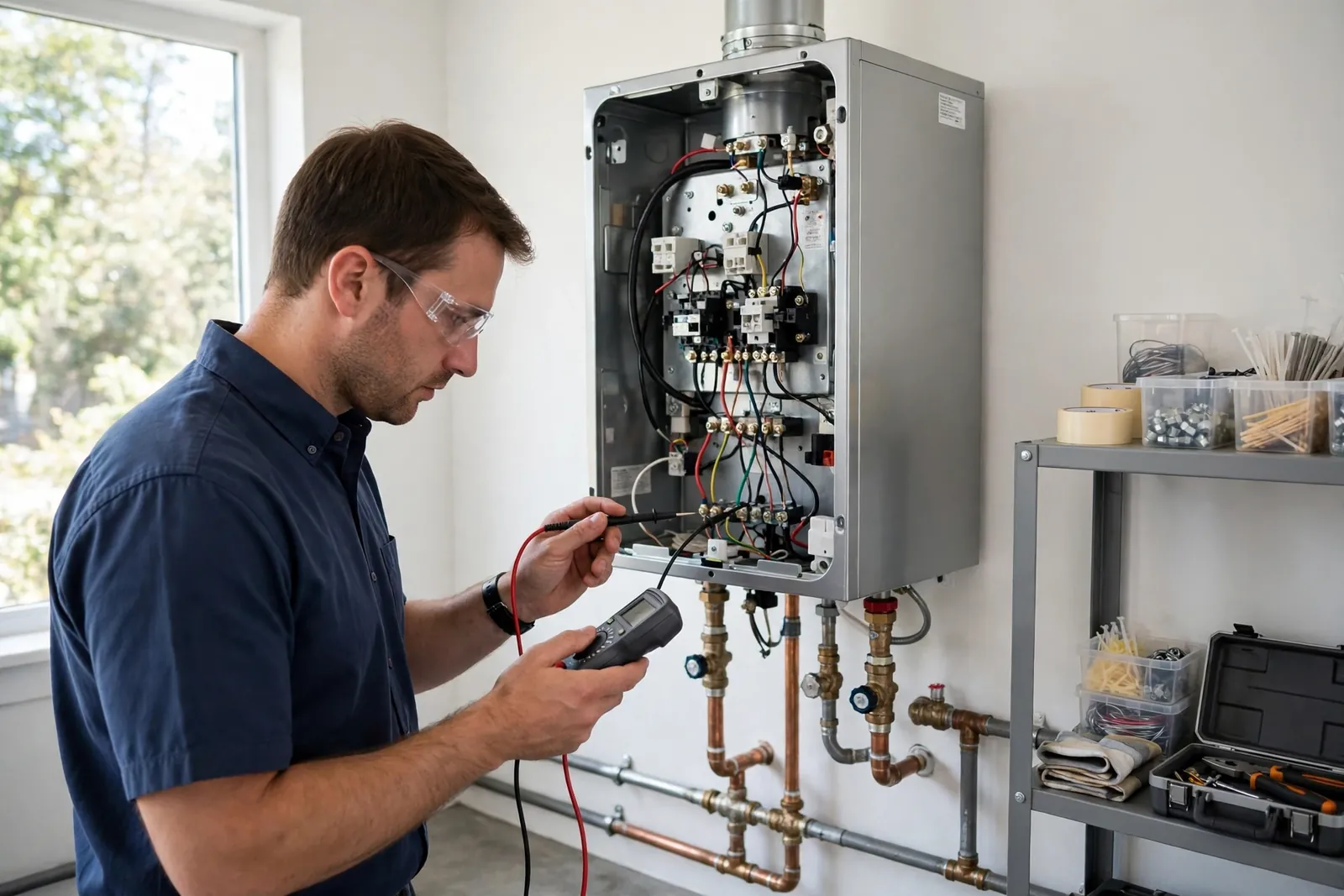
The panel and the circuits checked against the electric unit demand, so the installation is possible before the unit is fitted.
Leak and combustion checks
Water and gas connections checked for leaks, and the burner checked for a clean, steady flame.
Temperature and flow meters
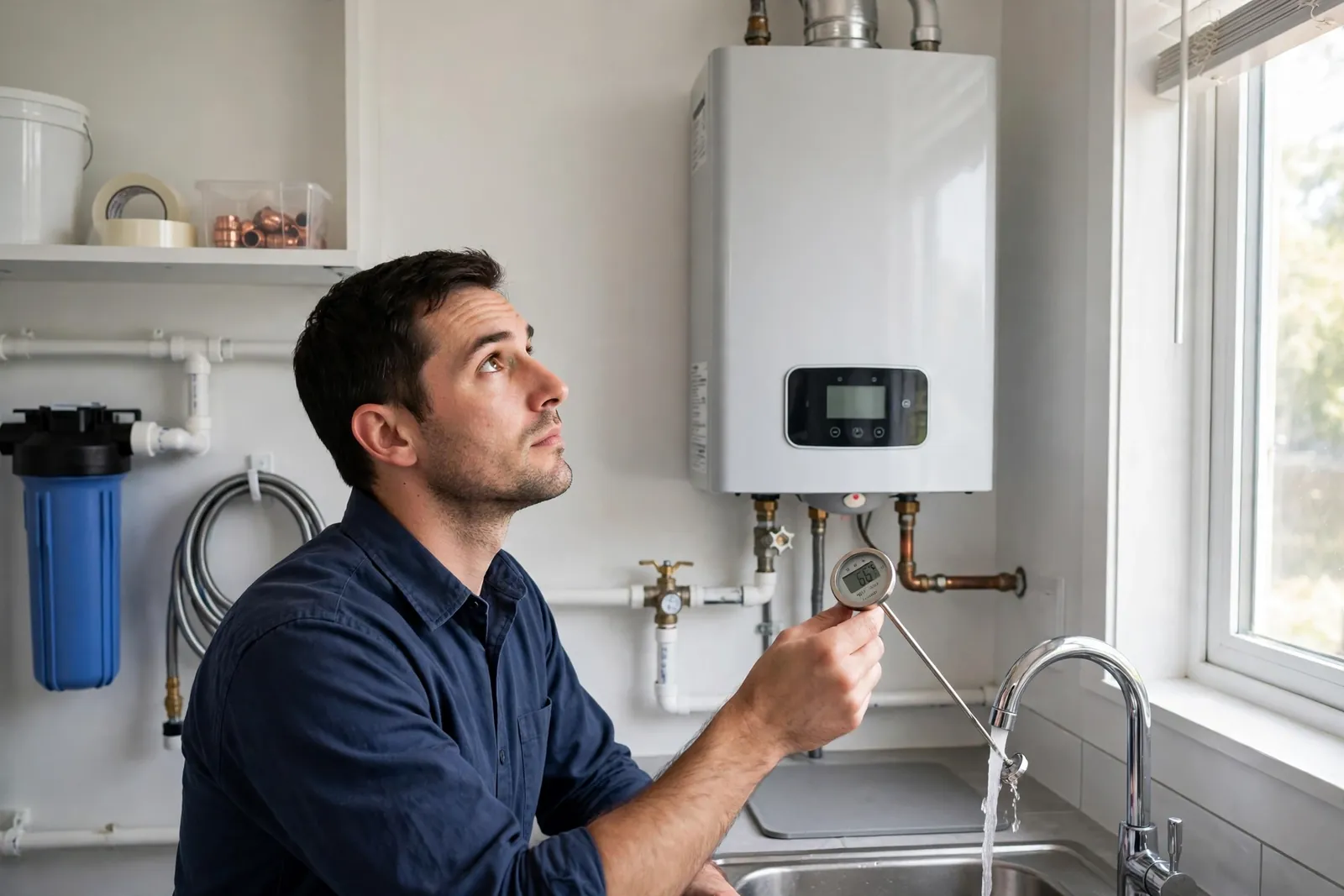
Flow rate and temperature rise measured at the taps after the install, proving the unit delivers what the sizing promised.
Switching from a tank unit to tankless
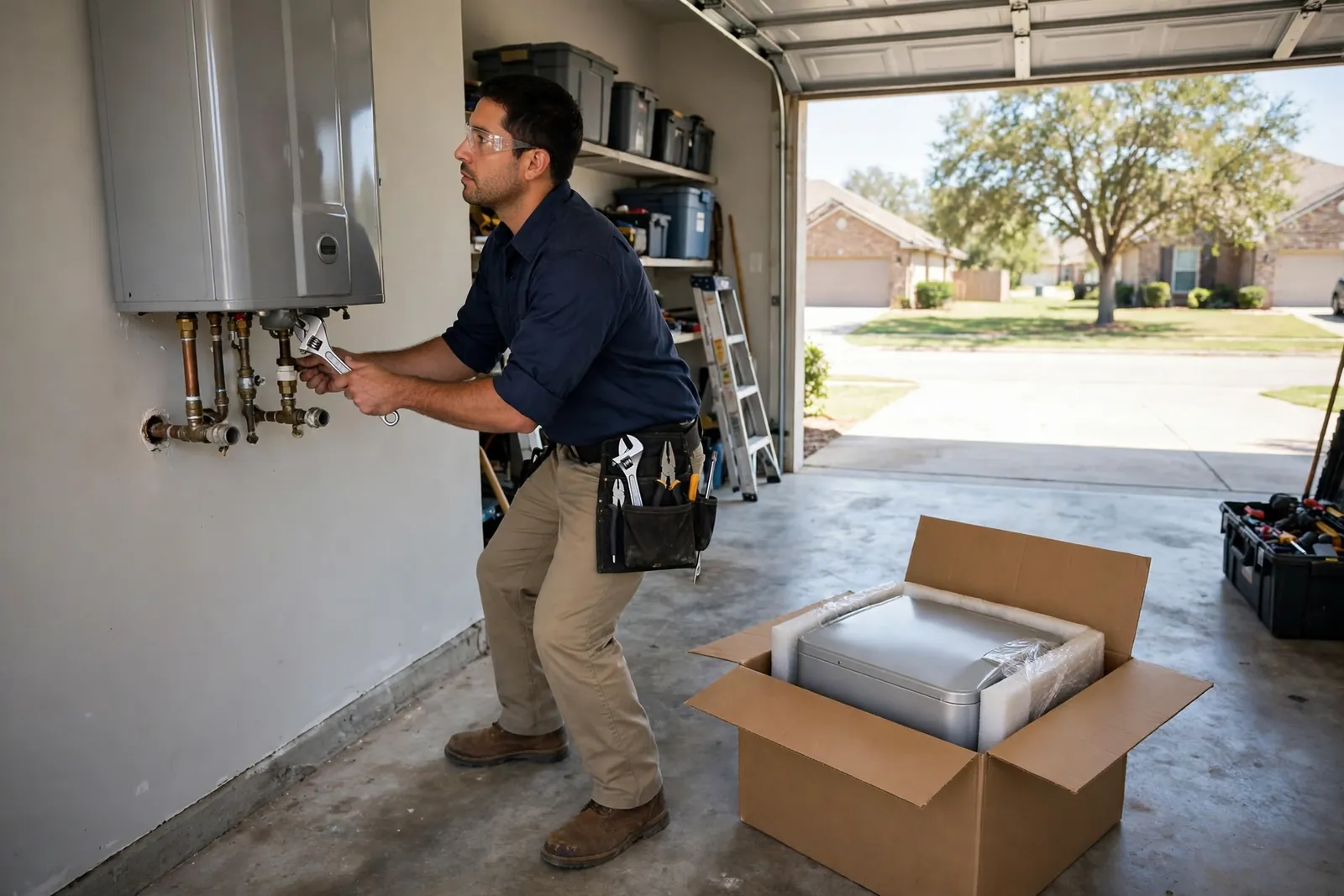
A conversion from a tank water heater to a tankless unit is the most common installation in Sugar Land, and it is more than a swap. The tank unit had a gas line, a vent and a water connection sized for a tank; the tankless unit needs a gas line sized for its peak demand, a vent path that fits its type, and a condensate drain if it is a condensing unit. The old tank location may not suit the new unit at all — tankless units are often mounted on an outside wall or in a different spot, and the water lines must be rerouted to match.
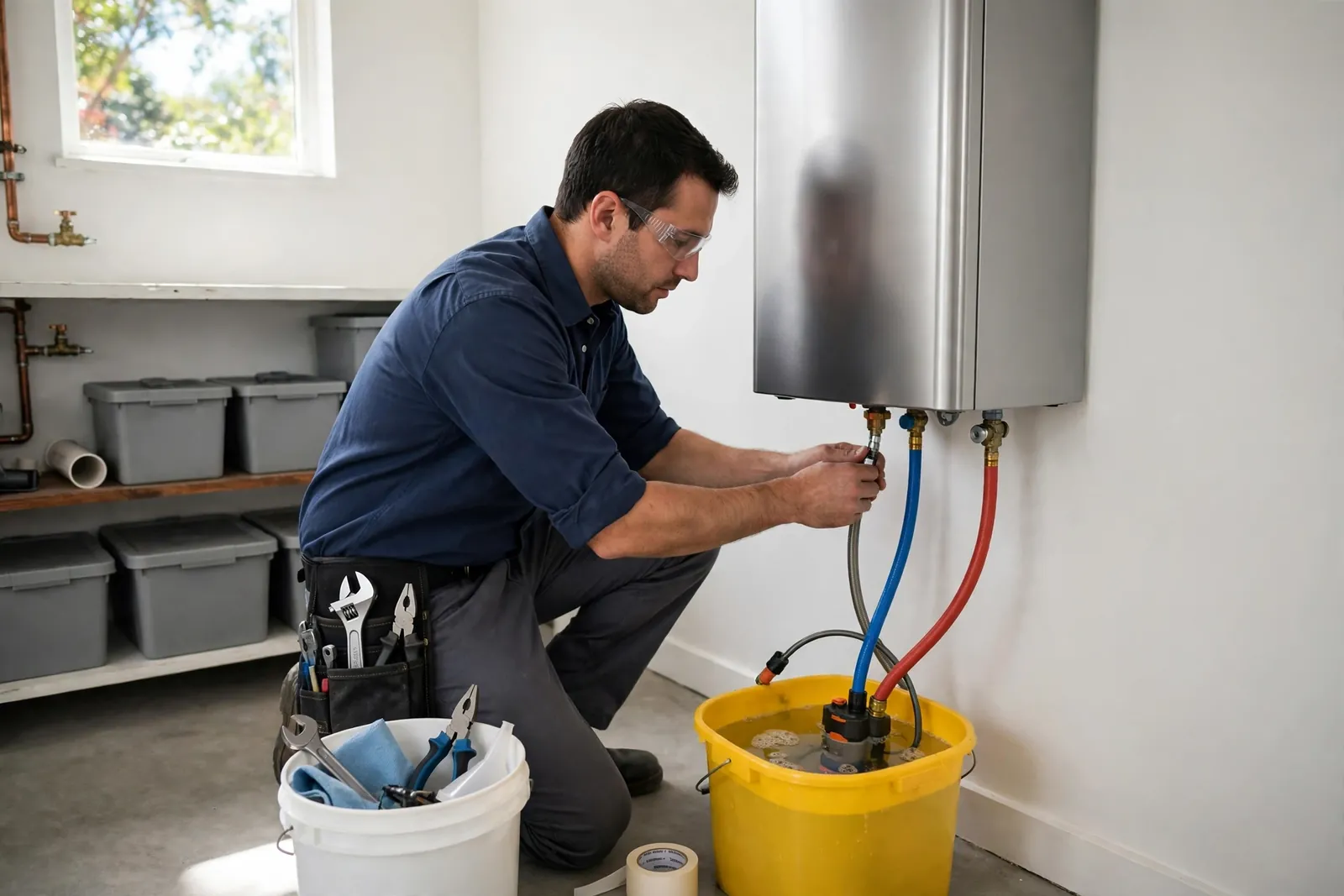
The removal of the old tank is part of the job: draining it, disconnecting gas and water, and taking it away. The space it leaves behind is often the first thing the homeowner notices — a closet or a garage corner that is suddenly empty. The new unit mounts on a wall, and the installation includes isolation valves and service valves on the cold inlet and hot outlet, so the unit can be flushed and serviced without draining the house.
One more conversion detail matters in hard-water country: the descaling routine starts on day one. A new unit in Sugar Land water begins scaling from its first firing, and the yearly flush is what keeps it heating the way it did on installation day. The installation visit should end with the maintenance interval explained, the filter location shown, and the freeze steps for the next cold snap covered — because a new unit that is never descaled becomes an old unit fast.
Gas vs electric: which fits the home
The choice between a gas and an electric tankless unit is usually made by the house, not the homeowner. A home with a gas supply and a vent path that fits a gas unit is a natural gas candidate; a home without gas, or without a practical vent route, is an electric candidate. The gas unit heats with a burner and needs gas at the right pressure, combustion air and venting. The electric unit heats with elements and needs the electrical capacity to match — dedicated circuits, breakers and wiring sized for the unit.
Performance differs in the ways that matter at the tap. A gas unit can deliver a higher flow rate at a higher temperature rise, which is why larger homes with several bathrooms usually end up with gas. An electric unit is simpler to install where the electrical capacity exists, has no venting and no combustion air to arrange, and suits smaller homes or point-of-use setups. The comparison guide walks through both in detail, with the sizing question at the centre of it.
There is no universal right answer, and a recommendation that does not ask about the home peak demand, the gas supply, the electrical panel and the vent route is not a recommendation. The installation visit asks those questions first, and the unit follows from the answers.
A home with a tank unit, or no tankless unit at all
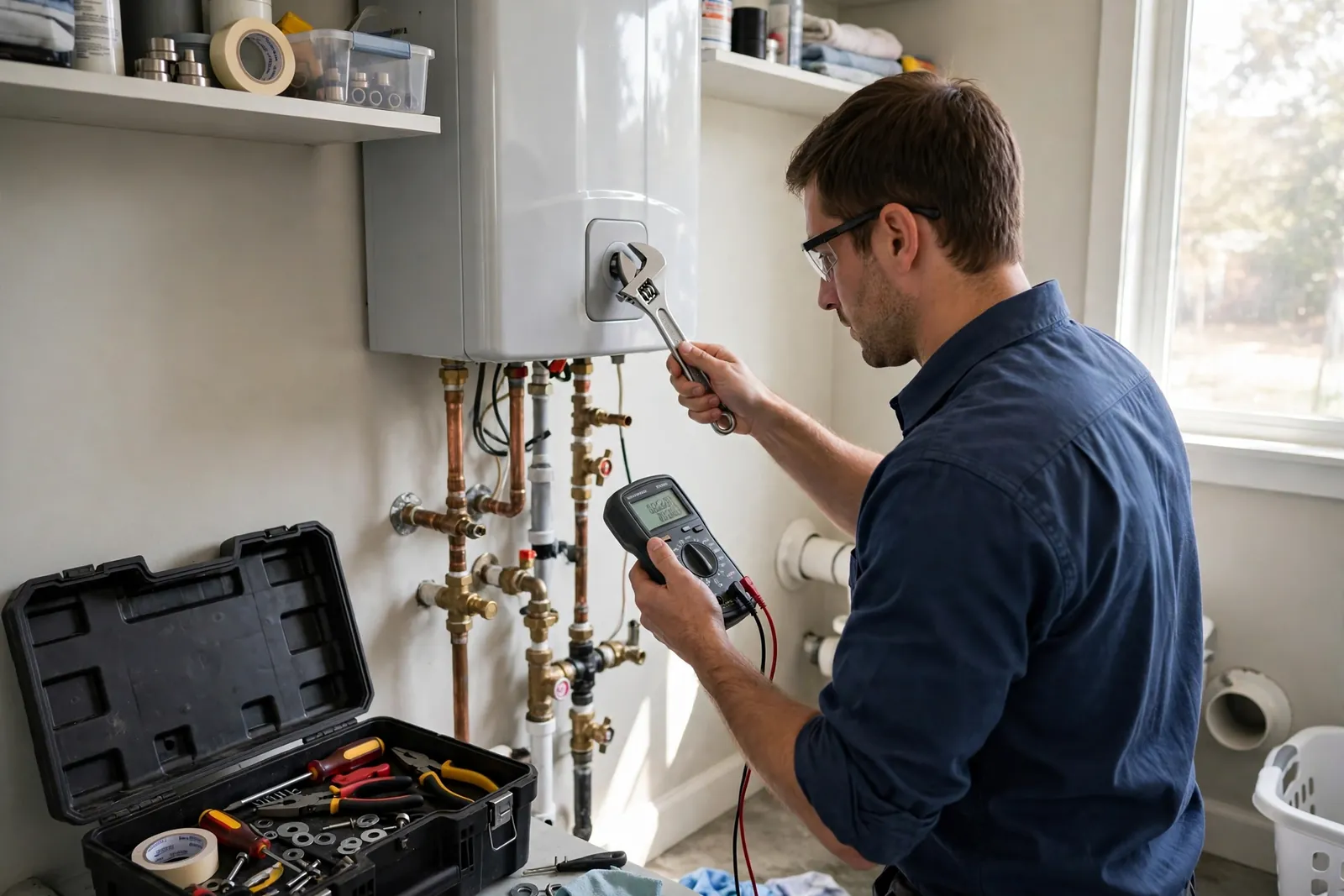
A tankless unit that cannot heat, or heats unevenly, leaves the house without reliable hot water — and the cause is rarely visible from the outside.
A tankless unit sized for the home, fitted, and tested at the taps
The diagnosis names the cause — scale, flow, gas, venting or a failed part — before any work starts, and the fix is tested at the taps.
Problems this service solves
- A tank water heater that has failed and the household wants to switch to tankless.
- A home that runs out of hot water when two showers run together.
- A new build or addition that needs a hot-water system from scratch.
- A second tankless unit for a large home with distant bathrooms.
- A tank unit in a garage or closet the household wants the space back from.
- A home that wants hot water on demand rather than stored in a tank.
- A point-of-use setup for a distant bathroom, kitchen or outbuilding.
- A replacement for an old tankless unit that was never sized for the home.
Signs a tankless installation fits your home
- The household regularly runs out of hot water at peak times.
- Two showers and a washing machine running together is a normal morning.
- The old tank unit has failed, or is near the end of its life.
- The home is large, with bathrooms far from the water heater.
- There is a gas supply and a vent route that fit a gas unit, or the electrical capacity for an electric one.
- The household wants endless hot water rather than a tank that empties.
- A new addition, garage apartment or outbuilding needs its own hot water.
- The tank closet or garage space is wanted back for something else.
Related problems
Industries that use this service
Single-Family Homes · Apartments and Condos · Commercial Offices · All industries →
Frequently asked questions
Questions people ask about tankless water heater installation, answered plainly.
Sizing comes down to two numbers: the flow rate the home needs at peak — the fixtures that run at the same time — and the temperature rise the unit must deliver, which depends on the incoming cold-water temperature in the coldest weeks. The unit must meet the peak, not the average.
Yes, and it is the most common installation in Sugar Land. The conversion needs a gas line sized for the tankless unit peak demand, a vent path that fits the unit type, and a condensate drain if it is a condensing unit. The old tank is drained, disconnected and taken away as part of the job.
Often, yes. A gas tankless unit burns far more gas at full fire than a tank unit does, so the gas line that fed the old tank is often too small. The line, meter and regulator are checked against the unit demand at peak, and upsized where the old line cannot deliver it.
A condensing unit captures extra heat from its own exhaust, which makes it more efficient, and it produces condensate that drains away through a trap and a drain line. A non-condensing unit vents hotter exhaust through a metal flue and makes no condensate. The venting rules are different for each.
It can where the electrical capacity exists — dedicated circuits, breakers and wiring sized for the unit. Larger homes with several bathrooms usually end up with gas, because a gas unit can deliver a higher flow rate at a higher temperature rise. The panel is checked before an electric unit is fitted.
It depends on the conversion: a straightforward replacement in the same spot is faster than a conversion that needs a new gas line, a new vent route, or water lines rerouted to a new location. The sizing and supply checks happen first, and the visit is planned around what they find.
Often on an outside wall or in a garage, utility room or closet — wherever the gas or electrical supply, the vent route and the water lines meet. The old tank location may not suit the new unit, and the water lines are rerouted to match the new spot.
Yes. A new unit in Sugar Land water begins scaling from its first firing, and the yearly descale and flush is what keeps it heating the way it did on installation day. The installation visit ends with the maintenance interval explained and the filter location shown.
A recirculation pump keeps hot water near the taps so the wait is short. It suits homes with a long run from the unit to the farthest bathroom — a common layout in larger Sugar Land homes. It is sized with the unit, not added blindly afterwards.
A tankless unit can be damaged by a hard freeze if it is on an outside wall or in an unheated space and is never drained or protected. The February 2021 freeze cracked units across the Houston area. The freeze guide covers the drain-down and protection steps for the next cold snap.
No hot water in your Sugar Land home?
Call Now to reach a local tankless water heater professional. Describe the unit, the symptoms, and any error code on the display.
Call now for tankless water heater help
Tap Call Now to reach a local tankless water heater professional. Tell them the make of the unit if you know it, the symptoms, and any error code on the display.
Hours: Mon–Fri 7:00 AM–10:00 PM ET · Sat 8:00 AM–10:00 PM ET · Sun 7:00 AM–9:00 PM ET
Before you call
- Note the error code on the display, if one shows.
- Check whether other taps have hot water, and whether cold water runs normally.
- If the unit is leaking, shut off its water and gas or power where it is safe to do so.
- Take a photo of the display and the label on the unit.
- Note when the problem started and what changed just before it.