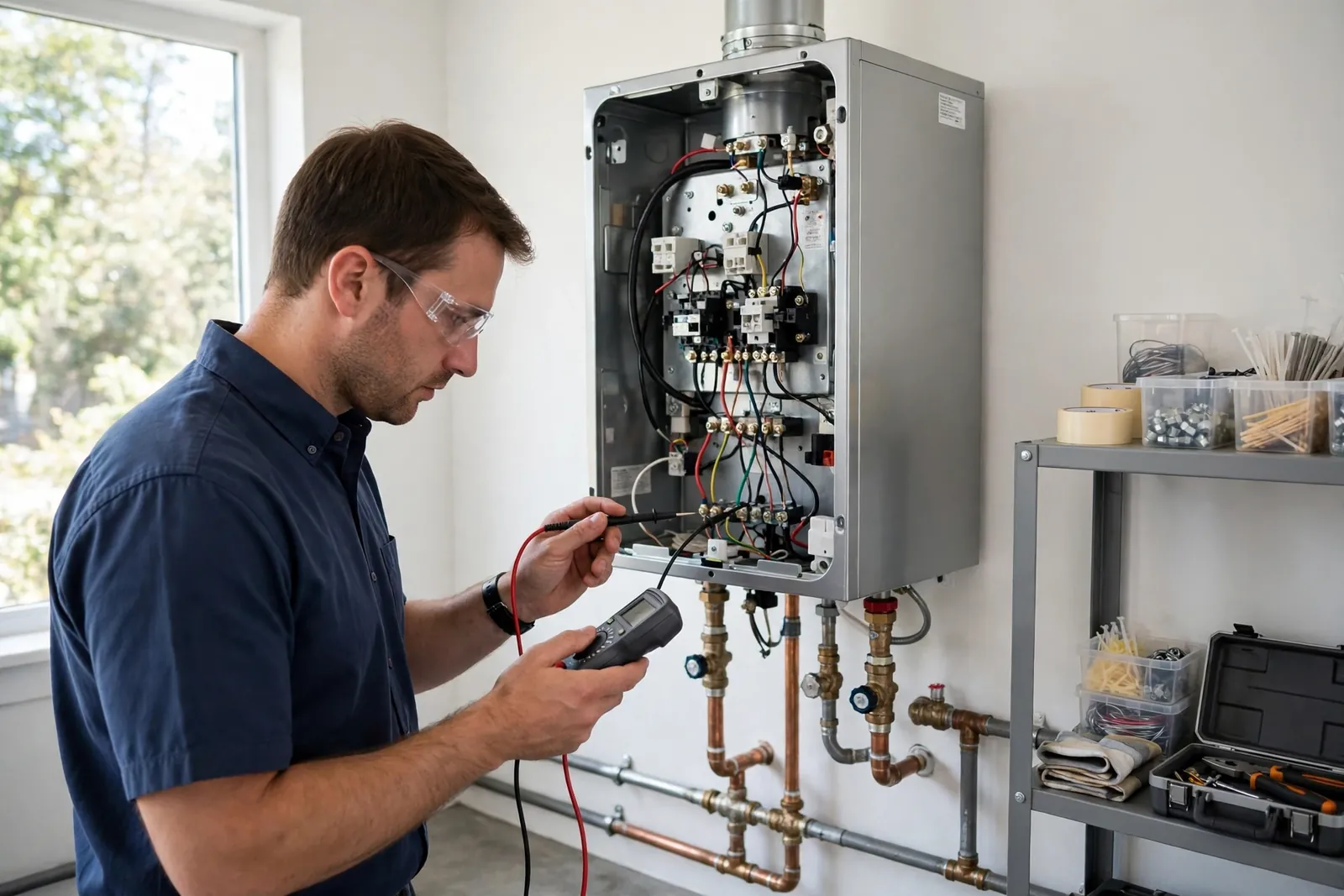
Electric Tankless Water Heater Repair in Sugar Land, TX
An electric tankless unit heats water with elements, so its faults are elements, breakers, sensors and flow. The diagnosis is electrical first, and the water side second.
Need help with your tankless water heater?
Call Now to reach a local tankless water heater professional. Describe the unit, the symptoms, and any error code on the display.
Hours: Mon–Fri 7:00 AM–10:00 PM ET · Sat 8:00 AM–10:00 PM ET · Sun 7:00 AM–9:00 PM ET
What this service does
An electric tankless water heater has no burner, no gas line and no vent. It has heating elements, a flow sensor, temperature sensors, and a control board that ties them together. When a hot tap opens, the flow sensor tells the unit water is moving, the board energises the elements, and cold water passes through the heating chamber and leaves hot. Close the tap and the elements switch off. Every electric fault is a break somewhere in that chain — no power, a failed element, a sensor reading wrong, or flow too low to trigger the heat.
A failed element is the most common electric fault, and it has a distinct signature: the unit runs, the display shows normal, but the water is lukewarm or cold. An electric unit usually has several elements, and one failed element leaves the rest working — so the unit heats, but not enough. The diagnosis is electrical: voltage, current and continuity checked at each element, so the failed one is found rather than assumed. An element can also fail from scale, because hard water coats the element and the chamber the same way it coats a gas heat exchanger.
A tripped breaker is the second electric fault, and it is the one households meet most. An electric tankless unit draws substantial current, and it needs dedicated circuits sized for the unit, with breakers and wiring to match. A breaker that trips every time the unit tries to heat is telling the truth: the circuit cannot carry the load, or a component inside the unit is shorting. Resetting the breaker without finding the cause is not a fix — the trip will return, and the underlying fault will get worse.
Sensor faults are the third electric pattern. The flow sensor must detect water moving before the unit will heat at all; a stuck or scaled flow sensor leaves the unit silent when a tap opens. The temperature sensors must read correctly for the board to modulate the elements; a sensor reading wrong leaves the water lukewarm or scalding, or shuts the unit down on a false overheat. The control board itself can fail, and a failed board usually shows up as a unit that will not respond at all — no display, no heat, no error code.
Scale is the quiet electric fault, and it is the Sugar Land story again. Houston-area water is hard, and an electric unit has no burner to hide behind: scale coats the elements and the chamber directly, insulating them from the water they are meant to heat. The symptoms are the same as a gas unit with scale — lukewarm water, falling flow, error codes — and the remedy is the same: a descale and flush, on the yearly routine the water here demands.
Before you call
- Note the error code on the display, if one shows.
- Check whether other taps have hot water, and whether cold water runs normally.
- If the unit is leaking, shut off its water and gas or power where it is safe to do so.
- Take a photo of the display and the label on the unit.
- Note when the problem started and what changed just before it.
How an electric tankless unit works — power, elements, sensors
An electric tankless unit turns electricity into hot water in four steps. The flow sensor detects water moving. The control board energises the heating elements. The elements heat the water as it passes through the chamber. The temperature sensors feed back to the board, which modulates the elements to hold the set temperature. Each step has a check: the flow sensor if the flow is too low to trigger the heat, the elements if one has failed, the sensors if a reading is wrong, and the board if the signals do not add up.
The elements are the working heart of the unit. They are metal coils or rods inside the heating chamber, and they heat by resistance — current passing through them makes heat, and the water carries it away. An element fails in two ways: it burns out, usually from age or from running dry, or it scales over, because hard water coats it with mineral that insulates it from the water. A scaled element runs hotter than it should, because the heat cannot get out, and eventually it fails. The yearly descale prevents both.
The electrical supply is part of the unit, in practice if not on paper. An electric tankless unit draws substantial current, and it needs dedicated circuits, breakers and wiring sized for the unit. Older Sugar Land homes may need a panel check before an electric unit can be fitted at all, and a unit fitted to an undersized panel will trip breakers at peak demand. The supply is checked before any part is ordered, because a failed element and a starved circuit look the same at the tap.
There is no venting on an electric unit, and no combustion air, and no condensate drain. That is the whole advantage of electric: the installation is simpler, the unit can go where a gas unit cannot, and there is nothing to vent. The trade is capacity — an electric unit is limited by the electrical supply in a way a gas unit is not, and larger homes with several bathrooms usually end up with gas for that reason. The choice is made by the house, and the sizing conversation starts from there.
What the service includes
Electrical diagnosis
Voltage, current and continuity checked at each element, so the failed one is found rather than assumed.
Breaker and panel check
Breakers, wiring and panel capacity checked against the unit demand, so a starved circuit is found before any part is ordered.
Element replacement
Failed elements replaced, with the chamber checked for scale damage at the same time.
Sensor and board checks
Flow and temperature sensors checked for correct readings, and the control board checked for faults.
Descale and flush
A descale and flush where scale is the cause, with the inlet filter cleaned at the same time.
Testing at the taps
Hot water run at the taps after the work: temperature steady, flow normal, no error code showing.
How the work runs
Call and describe the unit
The make if you know it, the symptoms, any error code, and whether the unit is gas or electric.
Electrical checks first
Breakers, wiring, voltage at the unit, and the current each element draws.
Sensor and board checks
Flow and temperature sensors tested for correct readings, and the control board checked.
Scale check
The chamber and the elements checked for scale, and a descale done where scale is the cause.
Repair
The part fitted where the fault is a part — element, sensor, breaker or board.
Test at the taps
Hot water run at the taps, temperature steady, flow normal, no error code showing.
Tools and methods used
Electrical meter
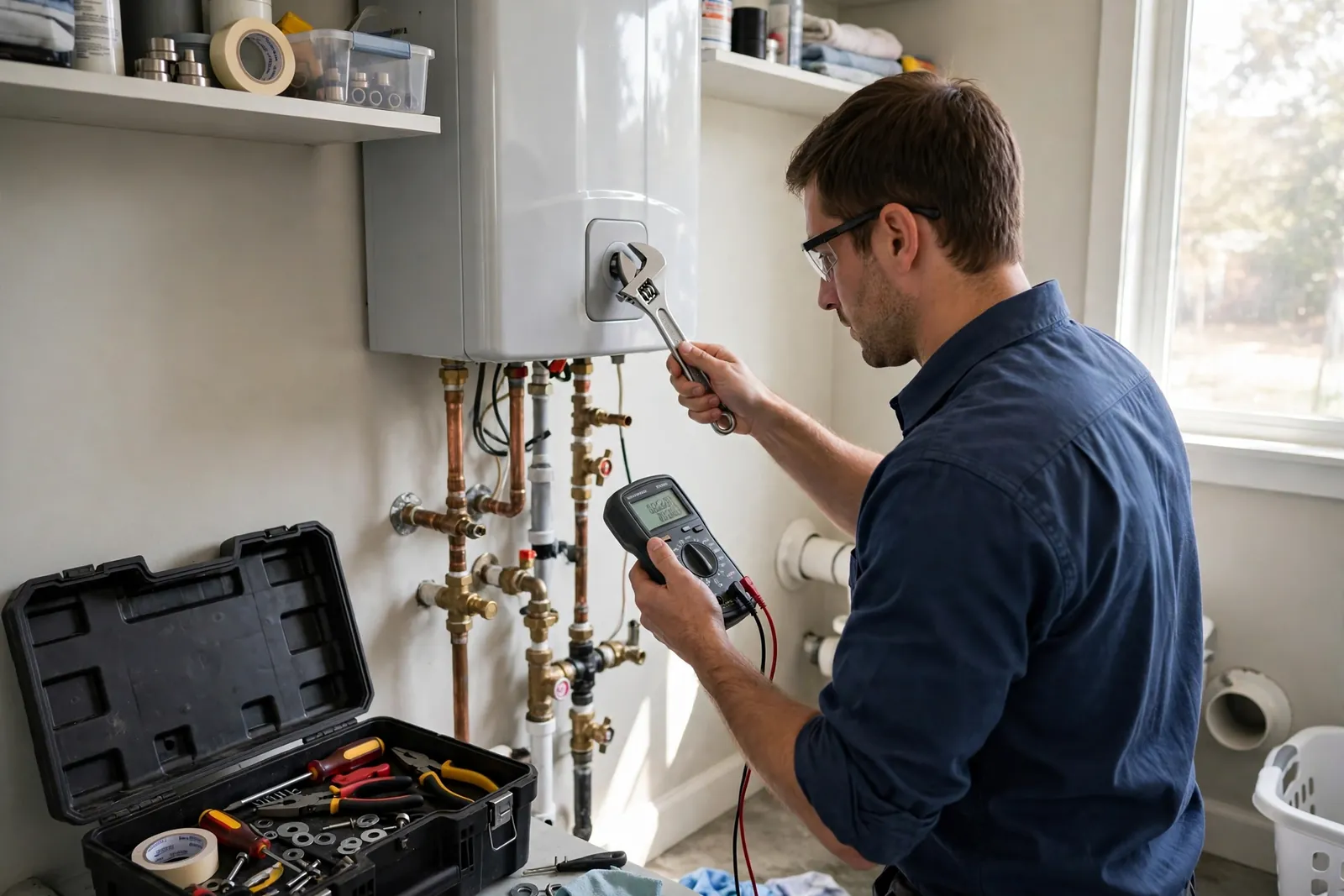
Voltage, current and continuity are checked at each element, so a failed element is found at its source.
Flow and temperature meters
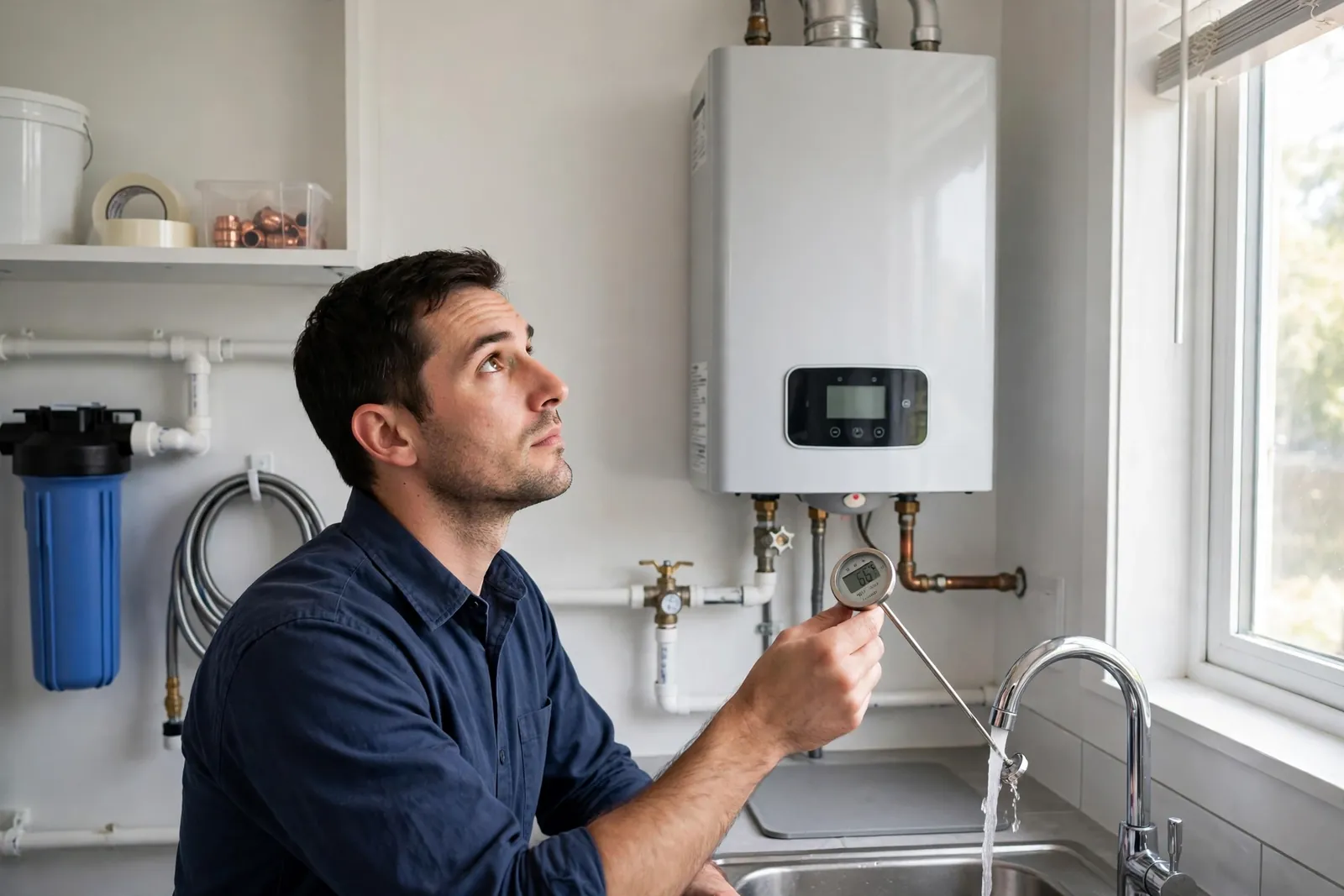
Flow rate and temperature rise are measured at the taps, so the diagnosis rests on numbers.
Error-code reading
The display code is read first, because it names the fault the unit detected — element, sensor, or flow.
Descaling pump and solution
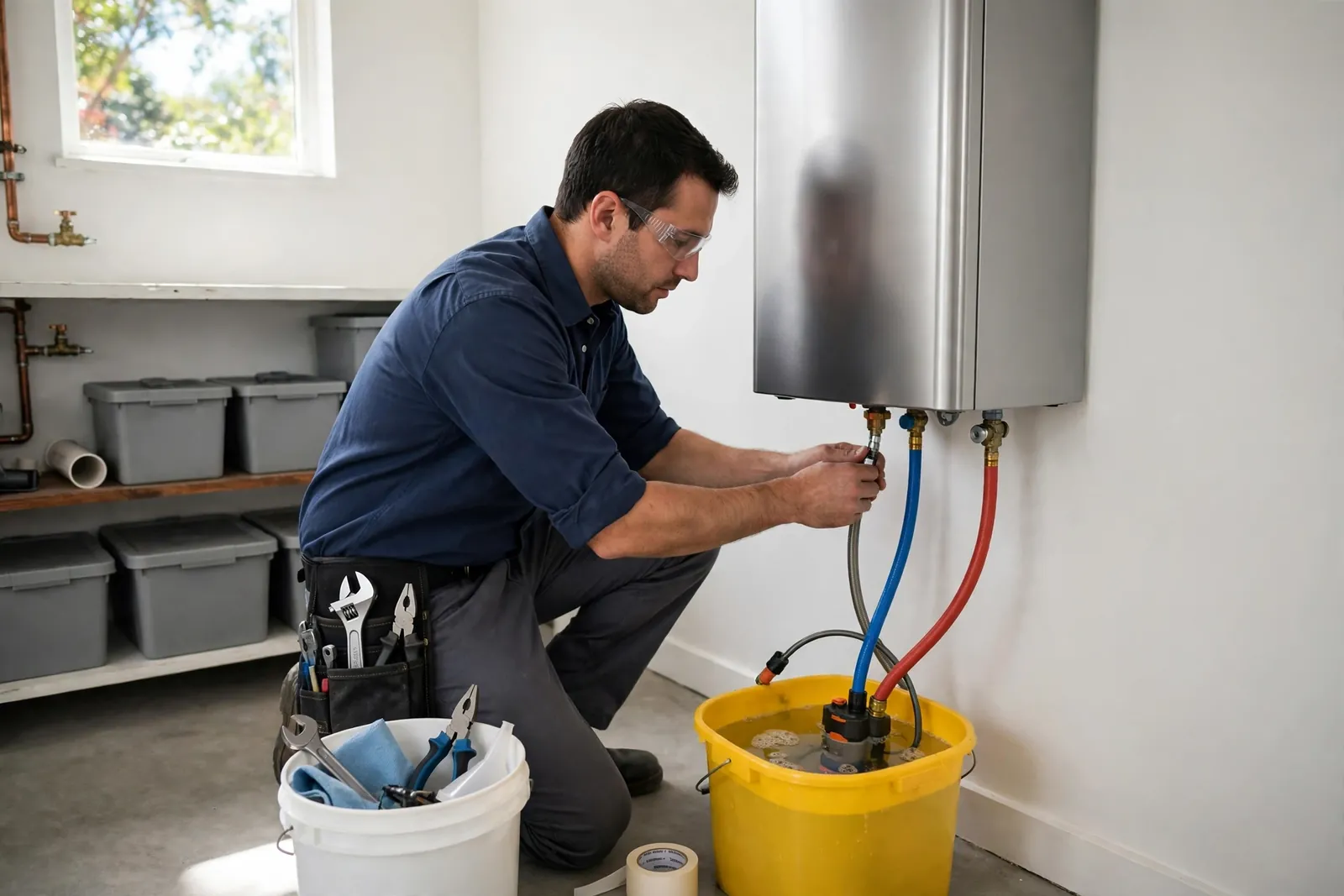
A circulation pump runs descaling solution through the chamber, dissolving the mineral layer hard water leaves behind.
Breaker and panel inspection
The panel, breakers and wiring are inspected for capacity, heat damage and correct sizing.
Sensor testing
Flow and temperature sensors are tested for correct readings, so a sensor fault is found rather than assumed.
Elements, breakers, and the panel
The electrical side of an electric tankless unit is a system, not a single wire. The unit needs dedicated circuits, and each circuit needs a breaker and wiring sized for the current it carries. The panel must have the capacity for all of them together, plus the rest of the house. A unit fitted to a panel that cannot carry it will trip breakers at peak demand, and the symptom — no hot water when the household needs it most — looks like a broken unit when the panel is the problem.
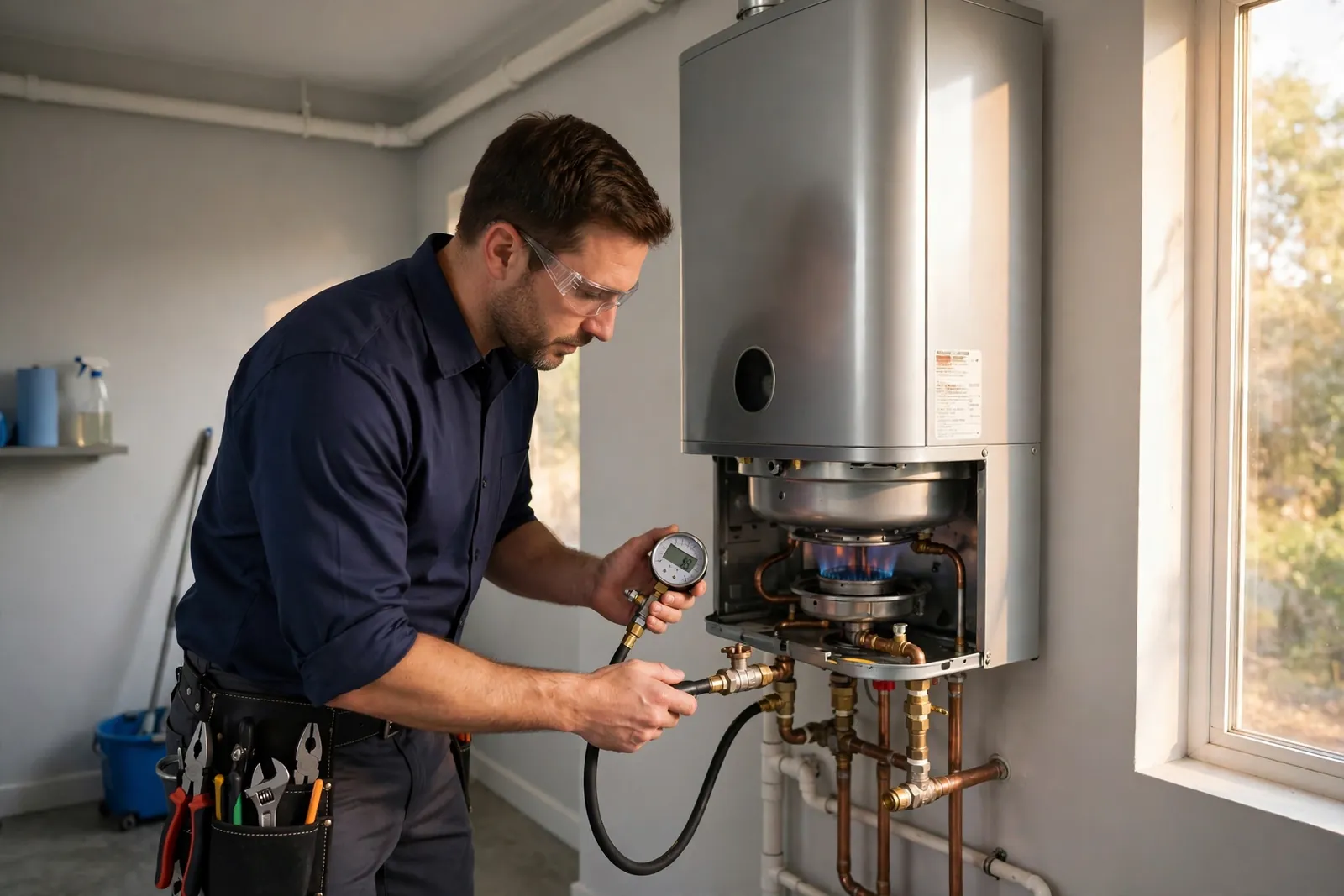
The diagnosis checks the supply in order: the breakers, the wiring, the voltage at the unit, and the current each element draws. An element that draws no current has failed. An element that draws the wrong current is failing. A breaker that trips under load is either undersized or protecting a short. The meter settles each question in seconds, and the repair follows from the readings rather than from a guess about which part to change.
A panel upgrade is sometimes the real repair, and it is worth naming plainly. An electric unit that cannot be fed properly cannot heat properly, whatever part is changed inside it. The visit checks the panel before any part is ordered, because a new element in a starved unit is money spent on the wrong problem.
Scale on elements, and the yearly flush
Scale coats an electric element the same way it coats a gas heat exchanger, and with the same result: the heat cannot get out, the element runs hotter than it should, and eventually it fails. The symptoms arrive in the same order — lukewarm water, temperature swings, falling flow, error codes on cold mornings — and the remedy is the same: a descale and flush, on the yearly routine the water here demands.
The flush on an electric unit follows the same steps as on a gas unit: the unit is isolated, a pump circulates descaling solution through the chamber, and the solution is monitored until it stops changing. The inlet filter is cleaned at the same time, and the flow is checked afterwards. The difference is only in what is checked alongside: the elements for scale damage, the sensors for correct readings, and the board for faults. A scaled element that has already failed is replaced; a scaled element that has not is cleaned and kept.
Homes with a water softener can stretch the interval, because the softener removes the calcium and magnesium before they reach the unit. Homes without one should not — in Sugar Land water, a year without a flush is a year of scale on the elements. The maintenance visit is the record that the routine happened, and the record is what the maker care guidance asks for.
An electric unit that heats unevenly, trips a breaker, or shows an element or sensor fault
A tankless unit that cannot heat, or heats unevenly, leaves the house without reliable hot water — and the cause is rarely visible from the outside.
An electric unit diagnosed electrically, repaired, and tested at the taps
The diagnosis names the cause — scale, flow, gas, venting or a failed part — before any work starts, and the fix is tested at the taps.
Problems this service solves
- An element that has burned out, leaving the water lukewarm.
- A breaker that trips every time the unit tries to heat.
- A flow sensor that is stuck, so the unit never heats at all.
- A temperature sensor reading wrong, leaving the water lukewarm or scalding.
- A control board that has failed, leaving the unit unresponsive.
- Scale coating the elements and the chamber from hard water.
- A panel that cannot carry the unit at peak demand.
- A unit that heats one tap and goes cold when a second opens.
Signs your electric tankless unit needs repair
- The water is lukewarm even though the display shows normal.
- The breaker trips every time the unit tries to heat.
- The unit does not respond at all — no display, no heat, no error code.
- The display shows an element or sensor error code.
- One tap is hot and the rest are cold, or the reverse.
- The temperature swings during a shower without anyone touching a tap.
- The unit has not been descaled in over a year and the symptoms are getting worse.
- The panel feels warm, or a breaker smells hot, when the unit runs.

Related problems
Industries that use this service
Single-Family Homes · Apartments and Condos · Commercial Offices · All industries →
Frequently asked questions
Questions people ask about electric tankless water heater repair, answered plainly.
Usually one element has failed, leaving the rest working — so the unit heats, but not enough. Scale on the elements and the chamber does the same thing, by insulating the elements from the water. Voltage, current and continuity are checked at each element to find the failed one.
The breaker is telling the truth: either the circuit cannot carry the load, or a component inside the unit is shorting. An electric tankless unit draws substantial current and needs dedicated circuits sized for the unit. Resetting the breaker without finding the cause is not a fix.
It can where the electrical capacity exists — dedicated circuits, breakers and wiring sized for the unit, and a panel with the capacity for all of them. Larger homes with several bathrooms usually end up with gas, because a gas unit can deliver a higher flow rate at a higher temperature rise.
It means the control board detected a problem with a heating element — no current, wrong current, or an overheat reading. Codes vary by maker, so the exact code and the make of the unit matter. The elements are checked electrically to find the failed one.
The usual causes are no power to the unit, a tripped breaker, a stuck flow sensor that never tells the unit water is moving, or a failed control board. The diagnosis checks the supply first, then the sensors, then the board.
Yes. Hard water coats the elements and the chamber the same way it coats a gas heat exchanger, insulating them from the water. The yearly descale and flush is the routine in Sugar Land water, and homes with a water softener can stretch the interval.
The unit is at its limit: it can heat a fixed flow rate by a fixed temperature rise, and a second tap pushes the flow past it. It can also be a failed element — the unit heats, but not enough for two taps. Flow and temperature are measured to tell the two apart.
Once, to see if it holds. If it trips again, the cause needs finding — an undersized circuit, a failing element, or a short inside the unit. Repeated resets mask a fault that is getting worse, and a breaker that smells hot needs the power left off and a call.
About once a year in Sugar Land conditions: a descale and flush, an inlet-filter clean, element and sensor checks, and a panel and breaker check. The visit ends with a record of what was done and when the next visit falls.
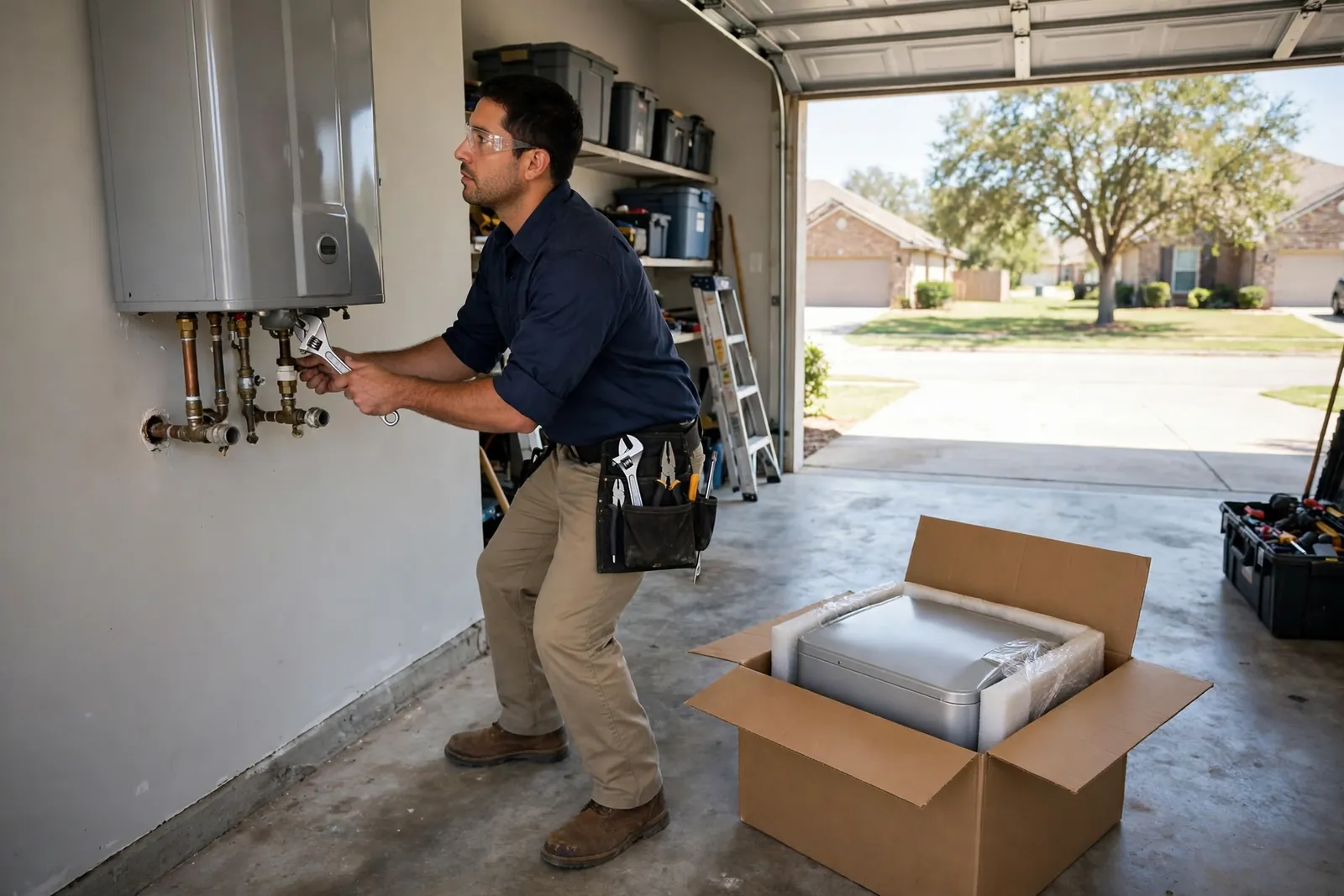
It is effectively a replacement, not a conversion: the fuel, the venting and the electrical supply are all different. The choice is made by the house — gas supply and vent route, or electrical capacity — and the sizing conversation starts from there.
No hot water in your Sugar Land home?
Call Now to reach a local tankless water heater professional. Describe the unit, the symptoms, and any error code on the display.
Call now for tankless water heater help
Tap Call Now to reach a local tankless water heater professional. Tell them the make of the unit if you know it, the symptoms, and any error code on the display.
Hours: Mon–Fri 7:00 AM–10:00 PM ET · Sat 8:00 AM–10:00 PM ET · Sun 7:00 AM–9:00 PM ET
Before you call
- Note the error code on the display, if one shows.
- Check whether other taps have hot water, and whether cold water runs normally.
- If the unit is leaking, shut off its water and gas or power where it is safe to do so.
- Take a photo of the display and the label on the unit.
- Note when the problem started and what changed just before it.