Low Water Pressure From a Tankless Water Heater in Sugar Land, TX
Low flow at the taps can come from a clogged inlet filter, scale narrowing the heat exchanger, or the house supply itself. The checks separate the three in minutes — and the fix follows from which one it is.
Need help with your tankless water heater?
Call Now to reach a local tankless water heater professional. Describe the unit, the symptoms, and any error code on the display.
Hours: Mon–Fri 7:00 AM–10:00 PM ET · Sat 8:00 AM–10:00 PM ET · Sun 7:00 AM–9:00 PM ET
What low pressure looks like
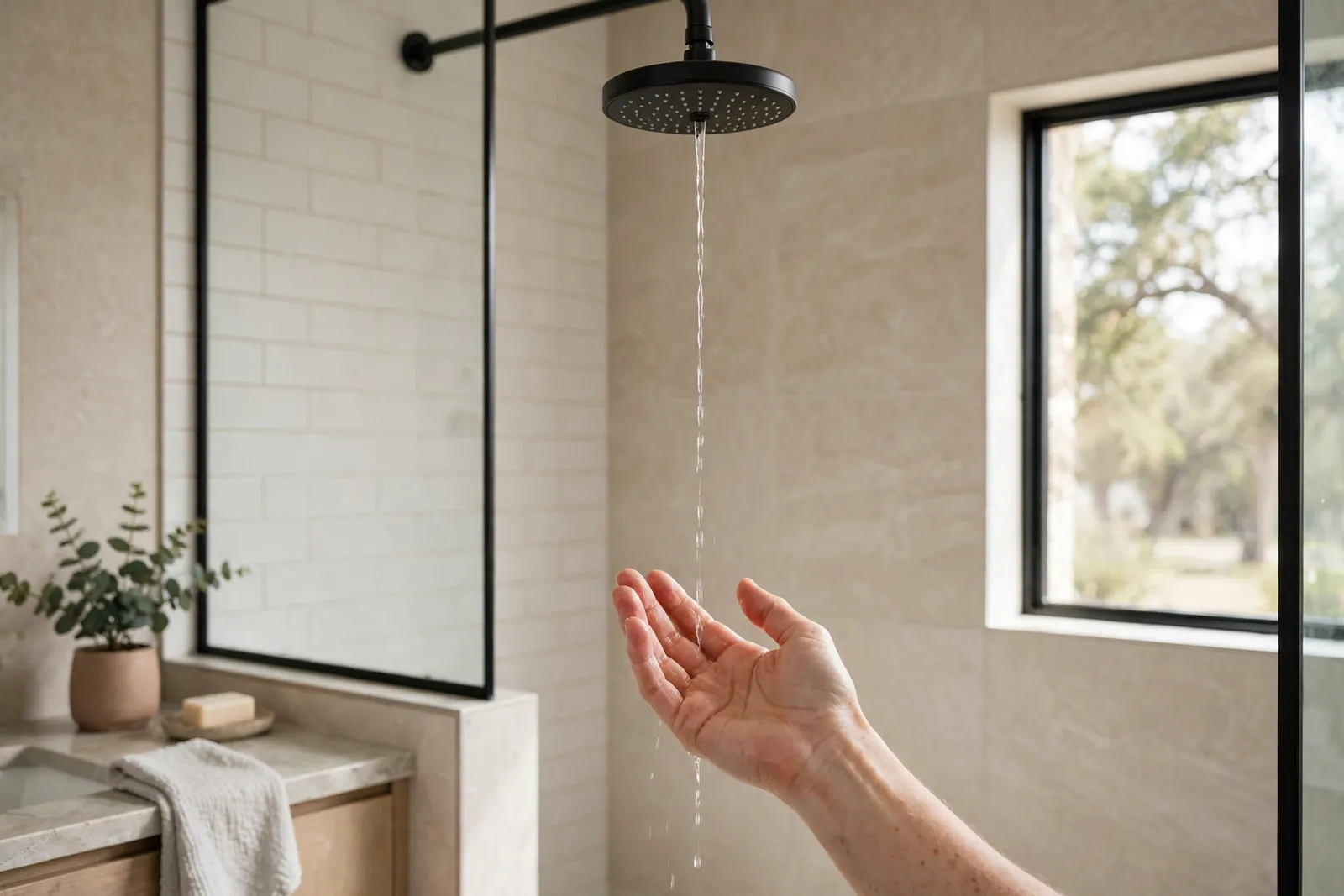
Low pressure from a tankless unit shows up as a weak shower, a tap that trickles, or a flow that has dropped a little at a time over months. The water may still be hot — the unit is heating what reaches it — but there is less of it, and the shower is unsatisfying. Or the flow may be so low that the unit will not trigger at all, and the water runs cold because the burner or the elements never switch on.
The first question is whether the low flow is at one tap or every tap. One tap weak and the rest strong means the problem is at that tap — a fixture aerator, a valve, or a mixing valve. Every tap weak means the problem is upstream: the unit, its inlet filter, or the house supply. The second question is whether cold water is weak too. Cold water weak everywhere means the house supply. Cold water strong and hot water weak means the unit.
The third question is how fast it happened. A sudden drop points to a filter clogged by a scale flake, a valve closed during other work, or a supply interruption. A slow decline over months points to scale, building a little more with every firing until the heat exchanger narrows enough to matter.
The causes, and how each one is found
A clogged inlet filter is the first cause, and the simplest to fix. The filter screen sits on the cold-water inlet and catches grit and debris before they reach the inside of the unit. In hard-water country it also catches scale flakes — the pieces of mineral that break off the heat exchanger and travel downstream. When the screen clogs, flow to the unit falls. The screen is pulled, looked at, cleaned, and the flow is checked afterwards.
Scale is the second cause, and the Sugar Land cause. Hard water coats the heat exchanger a little more every time the unit fires, narrowing the passages the water flows through. The flow drops a little at a time, and the household adapts until the shower is plainly weak. A descale dissolves the layer, and the flow is checked afterwards to prove the improvement.
A partially closed valve is the third cause, and it is the one households cause themselves: a valve closed during other work and never fully reopened, or a service valve left half-shut after a flush. The valves are checked as part of the visit, because a half-closed valve looks exactly like a scaled heat exchanger at the tap.
The house supply is the fourth cause. A pressure problem in the building supply, a main valve partially closed, or a supply interruption upstream shows up as low flow at every tap, hot and cold alike. The cold-water check separates it: cold water weak everywhere means the house, and the unit is not the problem.
Why low flow can mean no hot water
A tankless unit will not heat water that is not moving fast enough. The flow sensor must detect enough water moving to trigger the burner or the elements, and if the flow is below that threshold the unit stays silent — and the water runs cold. A household that reports no hot water may actually have a low-flow problem, and the fix is the filter or the flush, not a part.
The threshold is the reason a weak shower and a cold shower can be the same fault. A clogged filter drops the flow below the trigger point at the shower, while the kitchen tap — with a higher flow — still triggers the unit and still gets hot water. The pattern, hot at one tap and cold at another, points straight to the filter.
The visit measures the flow at the taps, because numbers end arguments about how weak the water feels. The flow before the filter is cleaned, and the flow after, are the proof — and the difference is usually obvious at the first shower afterwards.
What to do while you wait
Check whether the low flow is at one tap or every tap, and whether cold water is weak too. Check the aerators on the affected taps — a clogged aerator is a fixture problem, not a unit problem, and it is fixed by cleaning the aerator. Note the error code on the display, if one shows, and when the problem started.
Do not turn the temperature up to compensate. A higher setting on a starved unit does not fix the flow, and it can mask a fault that is getting worse. Note the pattern, and call with it.
What to do now
- Check whether the low flow is at one tap or every tap.
- Check whether cold water is weak too.
- Clean the aerators on the affected taps.
- Note the error code on the display, if one shows.
- Check the valves around the unit are fully open.
- Note when the problem started and whether it is getting worse.
What causes it
Clogged inlet filter
Grit and scale flakes clogging the filter screen, starving the unit of water.
Hard-water scale
Mineral scale narrowing the heat exchanger passages, dropping the flow a little at a time.
Partially closed valve
A valve closed during other work and never fully reopened, or a service valve left half-shut.
House supply pressure
A pressure problem in the building supply, showing up as low flow at every tap, hot and cold alike.
Clogged fixture aerator
A tap aerator clogged with grit, affecting one tap rather than the unit.
Failed flow sensor
A sensor that reads low, so the unit triggers late or not at all.
Signs of this problem
- The shower is weak, or the flow has dropped over months.
- One tap is weak and the rest are strong.
- Cold water is strong but hot water is weak.
- The unit will not trigger at the shower, but works at the kitchen tap.
- The flow dropped suddenly after other work in the house.
- The display shows a flow or sensor code.
- The unit has not been descaled in over a year.
- The water is hot, but there is not enough of it.
Related service: Tankless Water Heater Repair
Related guide: maintenance checklist
Related service: tankless water heater repair
Frequently asked questions
Questions people ask about low water pressure, answered plainly.
The usual causes are a clogged inlet filter, scale narrowing the heat exchanger, a partially closed valve, or a pressure problem in the house supply. The checks separate them: one tap weak means the fixture, every tap weak with cold water strong means the unit, every tap weak including cold means the house.
The shower draws less flow than the kitchen tap, and a clogged filter or a scaled heat exchanger can drop the flow below the level the shower needs — or below the level that triggers the unit at all. The filter is pulled and looked at first.
Often, yes — where scale is the cause. A descale dissolves the mineral layer narrowing the heat exchanger, and the flow is checked afterwards to prove the improvement. Where the cause is a clogged filter, cleaning the filter is the fix.
A tankless unit will not heat water that is not moving fast enough. The flow sensor must detect enough water moving to trigger the burner or the elements, and if the flow is below that threshold the unit stays silent and the water runs cold.
Yes — at one tap. A tap aerator clogged with grit affects that tap only, and cleaning it is a fixture fix, not a unit fix. Low flow at every tap points to the unit or the house supply instead.
Check the cold water. Cold water weak everywhere means the house supply. Cold water strong and hot water weak means the unit. The visit measures the flow at the taps to settle it.
The inlet filter screen sits on the cold-water inlet and catches grit and debris before they reach the inside of the unit. In hard-water country it also catches scale flakes, and when it clogs the unit starves for water. It is cleaned at every maintenance visit.
The diagnosis itself is fast — taps, cold water, filter, flow measurement, in order — and the fault is usually named on the visit. A clogged filter is same-visit work; a descale follows where scale is the cause.
Dealing with this problem now?
Call Now to reach a local tankless water heater professional. Describe the unit, the symptoms, and any error code on the display.
Call now for tankless water heater help
Tap Call Now to reach a local tankless water heater professional. Tell them the make of the unit if you know it, the symptoms, and any error code on the display.
Hours: Mon–Fri 7:00 AM–10:00 PM ET · Sat 8:00 AM–10:00 PM ET · Sun 7:00 AM–9:00 PM ET
Before you call
- Note the error code on the display, if one shows.
- Check whether other taps have hot water, and whether cold water runs normally.
- If the unit is leaking, shut off its water and gas or power where it is safe to do so.
- Take a photo of the display and the label on the unit.
- Note when the problem started and what changed just before it.