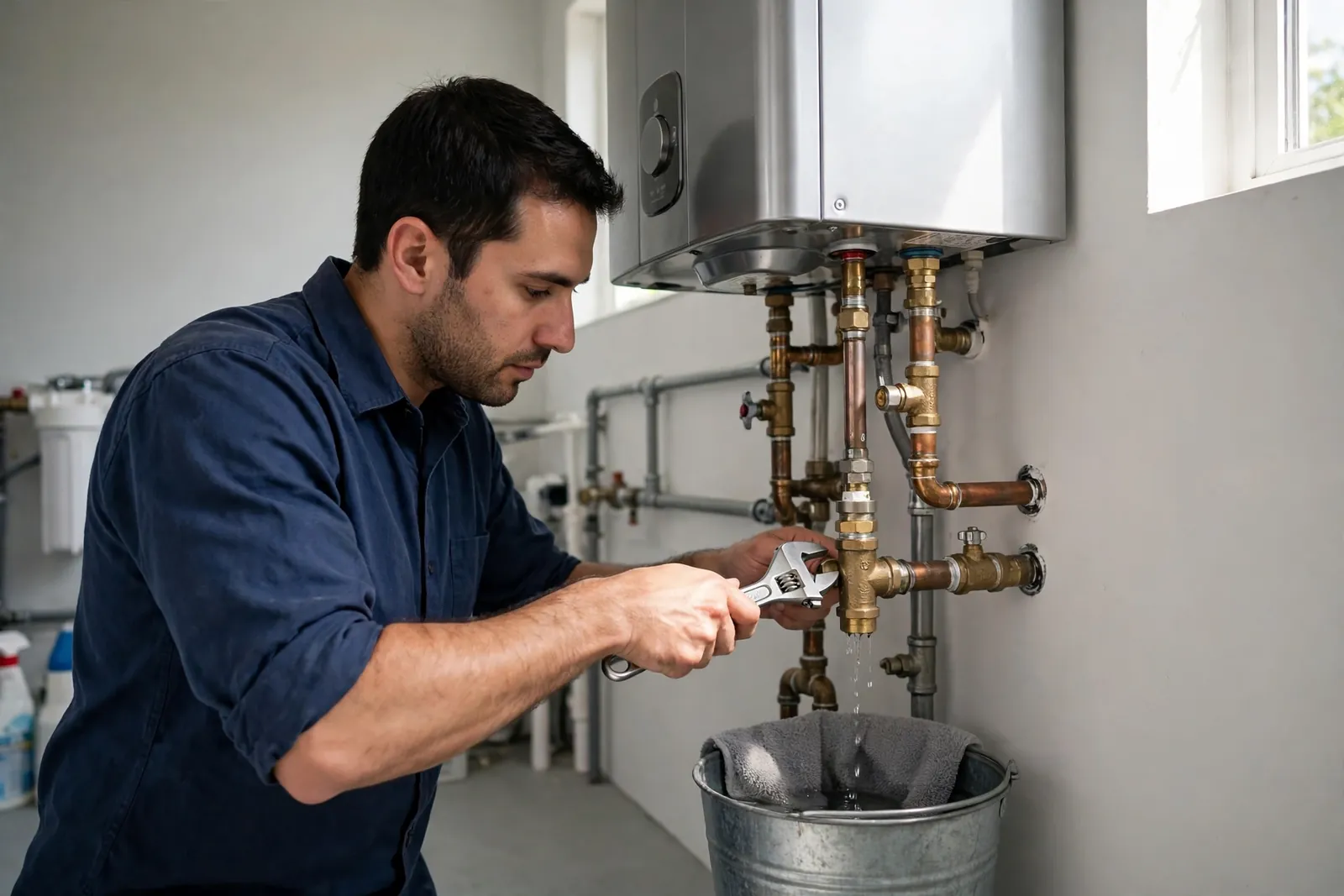
Tankless Water Heater Leak Repair in Sugar Land, TX
A leaking tankless unit is a tracing job before it is a repair job. The water can come from a connection, a relief valve, the heat exchanger, or the condensate drain — and each one points to a different fix.
Need help with your tankless water heater?
Call Now to reach a local tankless water heater professional. Describe the unit, the symptoms, and any error code on the display.
Hours: Mon–Fri 7:00 AM–10:00 PM ET · Sat 8:00 AM–10:00 PM ET · Sun 7:00 AM–9:00 PM ET
What this service does
Water under a tankless unit is never a single problem. It is a symptom with four usual sources, and the repair depends entirely on which one it is. A connection leak is a fitting that has worked loose or a seal that has failed — a repair. A relief valve leak is a valve doing its job, or a valve that has failed — a repair, or a sign of pressure trouble elsewhere. A condensate drain leak is a blocked or frozen drain — a repair. A heat exchanger leak is the unit itself failing — and that is usually a replacement conversation, not a repair.
The first step is always the same, and it is about safety before diagnosis: shut off the water to the unit at its isolation valves where it is safe to do so, and shut off the gas or power as well. Then mop up what you can, move anything the water can damage, and take a photo of the leak and the display. The water will tell its own story while you wait — where it comes from, how fast it comes, and whether it stops when the unit is isolated. A leak that stops when the unit is isolated is coming from the unit; a leak that continues is coming from the house plumbing.
Connection leaks are the most common and the least serious. The cold inlet, the hot outlet, the relief valve connection and the condensate connection are all joints, and joints work loose with thermal expansion and contraction — the unit heating and cooling, day after day, year after year. A weeping joint shows up as a slow damp patch, or as mineral staining on the pipe below it. The repair is to remake the joint: tighten, reseal, or replace the fitting, and check the rest while the unit is open.
Relief valve leaks are the ones that confuse households, because the valve is meant to leak — it is a safety device that opens when the pressure inside the unit gets too high. A valve that weeps occasionally is doing its job. A valve that leaks constantly has either failed itself, or is responding to pressure trouble elsewhere: a closed system with nowhere for expanded water to go, or a pressure problem in the house supply. The diagnosis checks the valve and the pressure, because replacing the valve without finding the pressure cause leaves the new valve leaking too.
Heat exchanger leaks are the serious ones. The heat exchanger is a coil of copper or stainless steel that carries water through the burner flame, and it lives a hard life: high temperatures, hard water, and constant expansion and contraction. A leak there shows up as water under the unit, or as damp on the wall behind it, and it usually means the unit has reached the end of its serviceable life. Freeze damage is the local version of the same story: the February 2021 freeze cracked heat exchangers across the Houston area, and a unit that was cracked then can leak now.
Before you call
- Note the error code on the display, if one shows.
- Check whether other taps have hot water, and whether cold water runs normally.
- If the unit is leaking, shut off its water and gas or power where it is safe to do so.
- Take a photo of the display and the label on the unit.
- Note when the problem started and what changed just before it.
Where tankless leaks come from — the four sources
Connections are the first source, and the easiest to find. The cold-water inlet, the hot-water outlet, the relief valve connection and the condensate connection are all joints, and each one can weep. The water appears below the joint, and the mineral staining on the pipe below it shows how long it has been weeping. The repair is to remake the joint — tighten, reseal, or replace the fitting — and to check the other joints while the unit is open, because a house that has one loose joint often has another.
The relief valve is the second source, and it needs a different kind of diagnosis. The valve is a safety device that opens when the pressure inside the unit gets too high, and a valve that weeps occasionally is doing its job. A valve that leaks constantly has either failed, or is responding to pressure trouble elsewhere. The pressure is measured, the valve is tested, and the house supply is checked — because a new valve on a system with nowhere for expanded water to go will leak the same way.
The condensate drain is the third source, and it is specific to condensing gas units. A condensing unit makes acidic condensate that drains away through a trap and a drain line, and when that drain clogs — or freezes in a hard cold snap — the condensate backs up and leaks from the unit. The drain is checked for blockage and for a freeze-proof route, and the trap is cleaned. A condensate leak that is fixed by clearing the drain is a repair; a condensate leak that returns points to the drain route itself.
The heat exchanger is the fourth source, and it is the one that changes the conversation. A leak from the heat exchanger itself — from the coil, not from a joint — usually means the unit has reached the end of its serviceable life. The part is the bulk of the unit cost, and fitting a new one into an old unit leaves every other worn part in place. Freeze damage is the local version: a heat exchanger cracked in the February 2021 freeze can leak months or years later, when the weakened metal finally gives way.
What the service includes
Make-safe first
Water and gas or power shut off safely where the unit is leaking, before any diagnosis starts.
Leak tracing
Connections, relief valve, heat exchanger and condensate drain checked in order, so the leak is found at its source.
Connection repair
Joints remade — tightened, resealed, or refitted — with the other joints checked while the unit is open.
Relief valve testing
The valve tested and the pressure measured, so a pressure cause is found rather than a valve replaced in vain.
Condensate drain clearing
The trap and drain line checked for blockage and a freeze-proof route, on condensing units.
Plain repair-or-replace explanation
What the leak is, what it means, and whether repair or replacement fits — in plain words.
How the work runs
Call and describe the leak
Where the water is, how fast it comes, and whether it stops when the unit is isolated.
Make it safe
Water and gas or power shut off where it is safe to do so; move anything the water can damage.
Trace the source
Connections, relief valve, heat exchanger and condensate drain checked in order.
Pressure and valve checks
The pressure measured, the relief valve tested, the drain checked for blockage.
Repair or replace
The joint remade, the valve replaced, the drain cleared — or a replacement conversation where the heat exchanger is leaking.
Test dry
The unit run and watched: no water under it, no damp on the wall, no weep at any joint.
Tools and methods used
Leak tracing by eye and hand
The water is followed to its source — below a joint, at the valve, from the drain, or from the unit body itself.
Pressure measurement
The pressure is measured at the unit, so a relief valve leak is traced to its cause rather than its symptom.
Isolation valves
The unit isolation valves stop water reaching the unit, proving whether the leak is from the unit or the house.
Inspection of the heat exchanger
The heat exchanger is inspected for leaks, scale damage and freeze damage, because that is the part that decides repair or replace.
Drain inspection
The condensate trap and drain line are inspected for blockage and for a route that cannot freeze.
What to do when you find a leak
Shut off the water to the unit at its isolation valves where it is safe to do so, then shut off the gas or power as well. Move anything the water can damage — boxes, electronics, anything on the floor near the unit. Mop up what you can, and take a photo of the leak and the display. Note whether the leak stops when the unit is isolated: a leak that stops is coming from the unit, and a leak that continues is coming from the house plumbing.
Do not open the unit casing yourself. The gas, electrical and venting parts inside are not homeowner work, and a leak from the heat exchanger can be hot water under pressure. If the unit is in a garage or a closet, ventilate the space. If the water has reached electrical outlets or the panel, stay clear and call — water and electricity together are the one combination where waiting is the right move.
Leaks after a freeze
A leak that appears after a hard freeze is a different diagnosis from a leak that appears on an ordinary day. The February 2021 freeze cracked heat exchangers, water lines and condensate drains across the Houston area, and a unit that was cracked then can leak now — when the weakened metal finally gives way, or when the next cold snap finishes the job. A leak after a freeze is checked for freeze damage first: the heat exchanger, the water lines, and the condensate drain, in that order.
The freeze check matters because it changes the recommendation. A connection leak after a freeze is a repair. A heat exchanger leak after a freeze is usually a replacement, because the crack is rarely the only weak point the cold left behind. The visit asks about the 2021 freeze for exactly that reason — the answer changes what happens next.
A unit leaking water onto the floor or down the wall, with the source unknown
A tankless unit that cannot heat, or heats unevenly, leaves the house without reliable hot water — and the cause is rarely visible from the outside.
A leak traced to its source, repaired, and the unit tested dry at the taps
The diagnosis names the cause — scale, flow, gas, venting or a failed part — before any work starts, and the fix is tested at the taps.
Problems this service solves
- A connection weeping at the cold inlet or hot outlet.
- A relief valve that leaks constantly, or weeps without stopping.
- A condensate drain that has clogged or frozen and backs up.
- A heat exchanger leaking from the coil itself.
- A leak that appeared after a hard freeze.
- Water staining the wall behind the unit, with no visible source.
- A leak that stops when the unit is isolated — and one that does not.
- Mineral staining on the pipes below the unit, showing a slow weep.
Signs your tankless unit is leaking
- Water is pooling under or around the unit.
- The wall behind the unit is damp or stained.
- There is a slow drip from a connection, visible when the unit runs.
- The relief valve pipe is wet, or water is coming from it constantly.
- The floor near the unit is damp, with no other source in sight.
- Mineral staining has appeared on the pipes below the unit.
- The unit leaks more when it heats, and less when it is idle.
- A leak appeared after a hard freeze or a cold night.
Other tankless water heater services
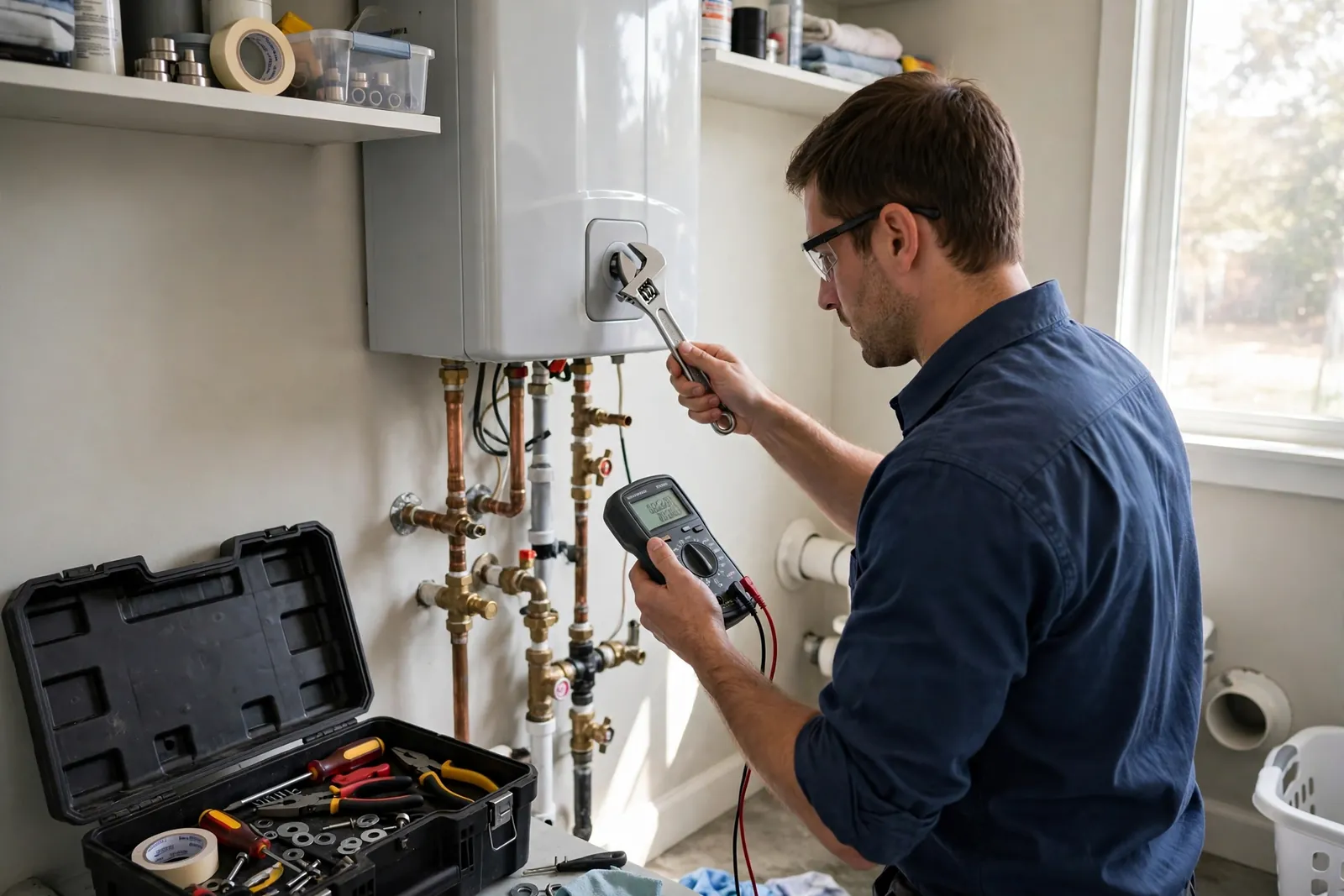
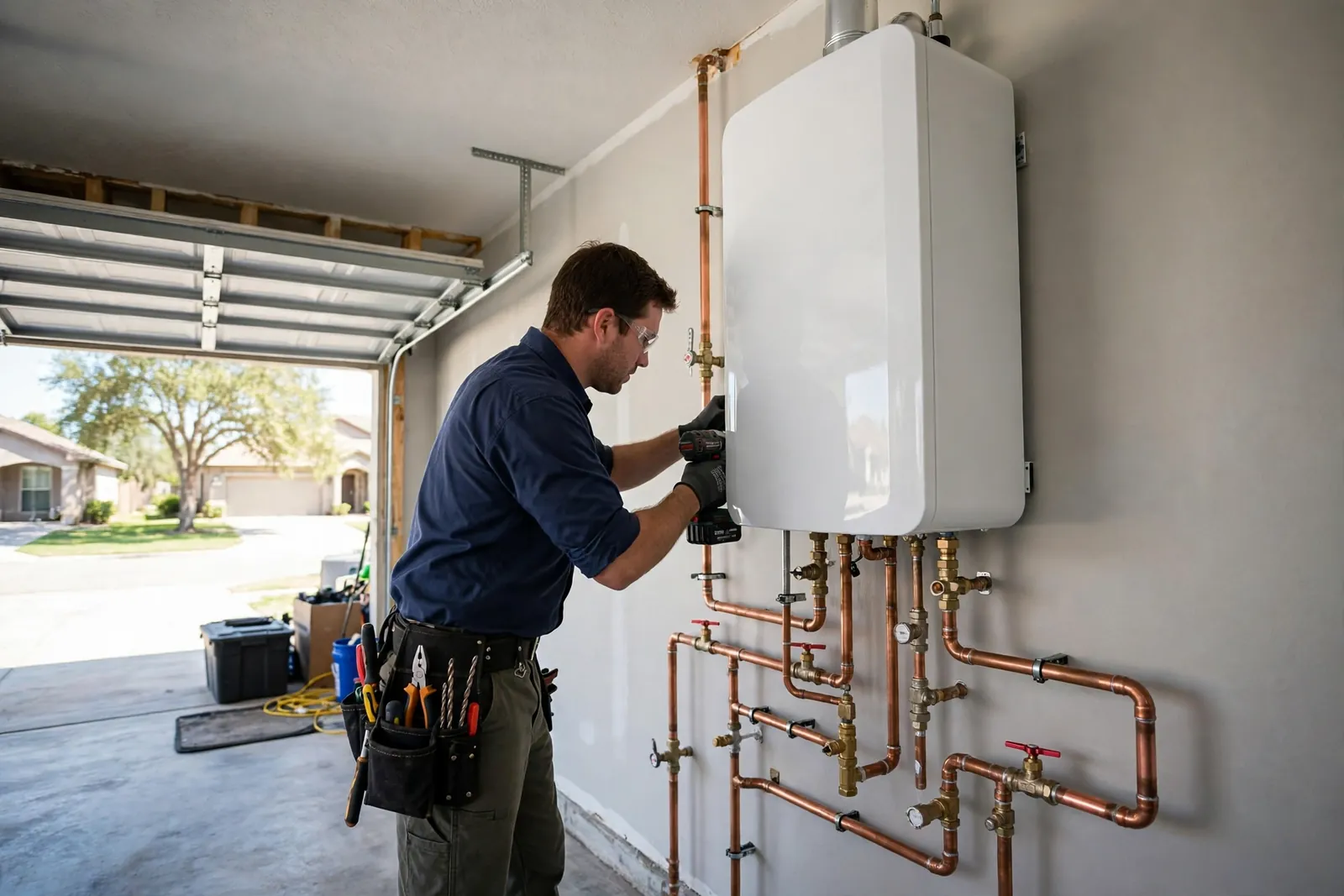
Related problems
Industries that use this service
Single-Family Homes · Rental Properties · Apartments and Condos · All industries →
Frequently asked questions
Questions people ask about tankless water heater leak repair, answered plainly.
Shut off the water to the unit at its isolation valves where it is safe to do so, then shut off the gas or power as well. Move anything the water can damage, mop up what you can, and take a photo of the leak and the display. Do not open the unit casing yourself.
Follow the water: below a joint means a connection, at the relief valve pipe means the valve or the pressure, from the drain means the condensate line, and from the unit body means the heat exchanger. A leak that stops when the unit is isolated is coming from the unit; one that continues is coming from the house plumbing.
It depends. A valve that weeps occasionally is doing its job — it opens when the pressure inside the unit gets too high. A valve that leaks constantly has either failed, or is responding to pressure trouble elsewhere. The pressure is measured and the valve is tested, because a new valve on a system with nowhere for expanded water to go will leak the same way.
Usually not sensibly. The heat exchanger is the most expensive part of the unit, and fitting a new one into an old unit leaves every other worn part in place. A leaking heat exchanger usually means the unit has reached the end of its serviceable life, and replacement is the right call.
A hard freeze can crack the heat exchanger, the water lines and the condensate drain. The February 2021 freeze did exactly that across the Houston area, and a unit cracked then can leak now, when the weakened metal finally gives way. A leak after a freeze is checked for freeze damage first.
A condensing gas unit makes acidic condensate that drains away through a trap and a drain line. When that drain clogs — or freezes in a hard cold snap — the condensate backs up and leaks from the unit. The drain is checked for blockage and for a freeze-proof route.
Yes — shut off the water at the isolation valves and the gas or power where it is safe to do so. A leaking unit that keeps running can make the damage worse, and hot water under pressure is not something to work around.
It depends on the source: a weeping joint is a slow damp patch, while a heat exchanger leak or a burst connection can put a real volume of water on the floor. Either way, the first move is to shut the water off and mop up what you can, then call.
Not from the same source, where the repair found the cause: a remade joint, a tested valve, a cleared drain. A leak that returns points to a cause that was missed — pressure trouble behind a valve, or a drain route that freezes — and the diagnosis continues from there.
It depends on the source. A connection, a valve or a drain is a repair. A heat exchanger leak is usually a replacement, because the part is the bulk of the unit cost and the unit has reached the end of its serviceable life. The tracing decides which one it is.
No hot water in your Sugar Land home?
Call Now to reach a local tankless water heater professional. Describe the unit, the symptoms, and any error code on the display.
Call now for tankless water heater help
Tap Call Now to reach a local tankless water heater professional. Tell them the make of the unit if you know it, the symptoms, and any error code on the display.
Hours: Mon–Fri 7:00 AM–10:00 PM ET · Sat 8:00 AM–10:00 PM ET · Sun 7:00 AM–9:00 PM ET
Before you call
- Note the error code on the display, if one shows.
- Check whether other taps have hot water, and whether cold water runs normally.
- If the unit is leaking, shut off its water and gas or power where it is safe to do so.
- Take a photo of the display and the label on the unit.
- Note when the problem started and what changed just before it.