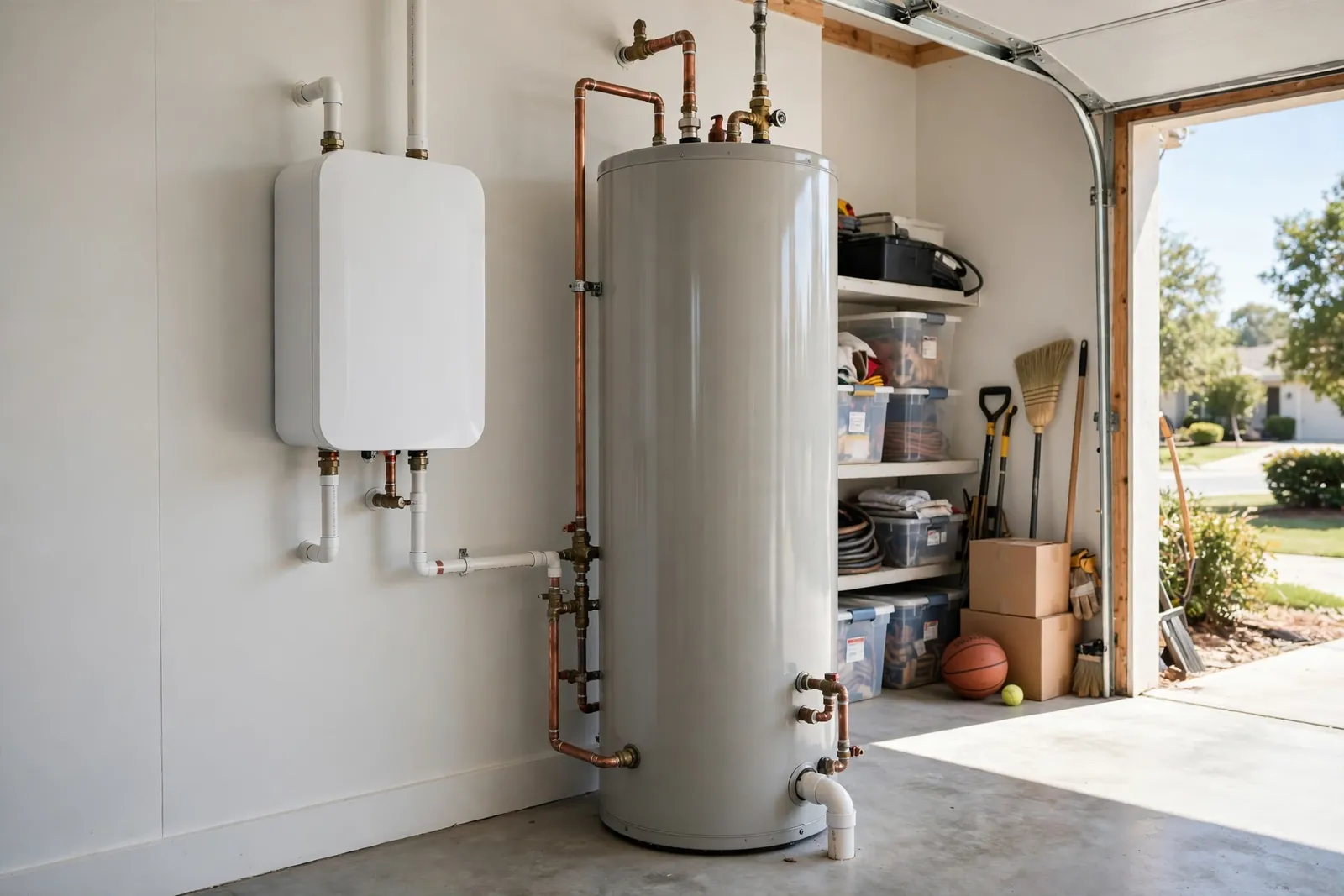
Tankless vs Tank Water Heater in Sugar Land, TX
A tankless unit heats water as it flows; a tank unit keeps a store of hot water ready. The choice turns on the household peak, the hard water here, and how much the family values endless hot water against a simpler unit.
Sugar Land Tankless Pros · 2026-11-17 · Comparison Guide
The short version
Problem: A tankless unit heats water as it flows, so the hot water does not run out — a tank unit keeps a store ready, and the store can run out.
What to do: Hard water is the deciding factor in Sugar Land: a tankless unit needs a yearly descale, a tank unit needs a yearly flush and anode check.
When to call: The choice turns on the household peak, the space, and the maintenance the family will actually keep.
How the two work
A tankless water heater heats water as it flows through the unit. Cold water enters, the burner or the elements fire, and hot water leaves — on demand, for as long as the tap runs. There is no store of hot water, and no tank to keep hot all day. The unit is sized by flow rate: how much water it can heat, by how many degrees, at once.
A tank water heater keeps a store of hot water ready. The tank — usually 40 or 50 gallons in a home — holds water at the set temperature all day, reheating as it is used. The store is the limit: a household that draws more than the tank holds, faster than the burner or elements can reheat it, runs out of hot water and waits for the tank to recover.
The difference is the difference between a tap and a bucket. A tankless unit is a tap: the water keeps coming as long as the flow is within its limit. A tank unit is a bucket: the water is ready, and when the bucket is empty, the household waits.
Endless hot water, and its limit
A tankless unit does not run out of hot water, and that is the reason most households choose one. A long shower, a soaking tub, a household where two showers run together — the hot water keeps coming, as long as the flow is within the unit limit. The limit is the flow rate, not the time: a unit that can heat a fixed flow by a fixed rise cannot heat a flow past that limit, and two showers plus a washing machine can push it past.
A tank unit runs out, and the wait is the recovery time: the time the burner or elements need to reheat the tank. A household that showers back to back, or runs a bath after the laundry, knows the wait well. The tank is sized for the household peak, and a household that has outgrown its tank waits more often.
The sizing question is therefore different for each. A tankless unit is sized by the peak flow rate and the coldest incoming water temperature. A tank unit is sized by the volume the household draws at peak. Both are sized for the peak, not the average — and both go lukewarm when the peak is underestimated.
Hard water and maintenance
Hard water is the deciding factor in Sugar Land, and it treats the two differently. A tankless unit needs a descale and flush about once a year, with the inlet filter cleaned at the same time, because scale coats the heat exchanger a little more every time the unit fires. A tank unit needs a flush and an anode check about once a year as well, because scale settles in the tank and the anode rod — the sacrificial rod that protects the tank from corrosion — wears away.
The maintenance is therefore a wash in frequency, and different in kind. A tankless flush is a descale of the heat exchanger. A tank flush is a drain of sediment, and a check of the anode rod. Both are yearly routines, and both are skipped at a cost: a tankless unit that is never descaled loses heat and flow; a tank unit whose anode is never checked corrodes from the inside.
A water softener helps both, by removing the calcium and magnesium before they reach the unit. For a tankless unit it stretches the descaling interval. For a tank unit it slows the sediment and the anode wear. The softener is the one addition that changes the maintenance curve for either.
Space, venting and installation
A tankless unit is small — wall-mounted, about the size of a suitcase — and it frees the space a tank occupied. A tank unit is large, and it needs the floor space, the clearance, and the drain pan. A household that wants the space back chooses tankless; a household with the space already there keeps the tank.
Venting is where the two diverge most. A tankless gas unit needs a vent rated for its exhaust temperature, sized to the unit maker instructions and local code, and the vent route matters — a long or wrongly sized vent is a fault, not a detail. A tank unit vents differently, and a replacement of one kind with the other is a venting job as well as a plumbing job.
The gas line is the second divergence. A tankless gas unit draws far more gas at peak than a tank unit, and a gas line sized for a tank unit starves a tankless burner exactly when demand peaks. A conversion from tank to tankless therefore includes a gas-line check, and often a gas-line upgrade. An electric tankless unit has the same question on the electrical side: the panel and the circuits must carry the load.
Which one fits a Sugar Land home
A large Sugar Land home, with big bathrooms and several hot-water draws at once, is the natural tankless home — where the unit is sized for the peak, the gas line can deliver, and the household keeps the yearly descale. The endless hot water is the payoff, and the maintenance is the price.
A smaller home, with a modest peak and a household that values simplicity, is the natural tank home — where the tank is sized for the peak, the anode is checked yearly, and the unit is replaced when the tank corrodes. The simplicity is the payoff, and the recovery wait is the price.
A home with hard water and no softener needs the maintenance either way, and the household that will keep the routine is the household that should choose the unit that needs it. A tankless unit that is never descaled fails sooner than a tank unit that is never flushed — and the other way around. The choice is therefore about the routine the family will actually keep.
Switching from tank to tankless
A switch from tank to tankless is a job with four parts: the unit, the gas line or the electrical supply, the venting, and the water lines. The gas line is checked for the peak demand of the tankless burner, and upgraded where it cannot deliver. The venting is sized to the unit maker instructions and local code. The water lines are re-routed to the wall-mounted unit, with isolation valves and a drain for the flush.
The switch is also the moment to fix the sizing. A household that ran out of hot water with a tank, and switches to a tankless unit sized for the same underestimated peak, will go lukewarm at the same hour. The sizing is re-checked against the household peak — the fixtures, the people, the coldest incoming water — before the unit is chosen.
The switch is worth planning in the off-season, not in the middle of a failure. A planned switch happens on the household schedule, with the sizing done properly and the venting and gas line checked. A switch forced by a leaking tank happens at midnight, with water on the floor, and the sizing done in a hurry.
Related: lukewarm water problem · tankless water heater installation · tankless water heater help in Sugar Land
Related guides
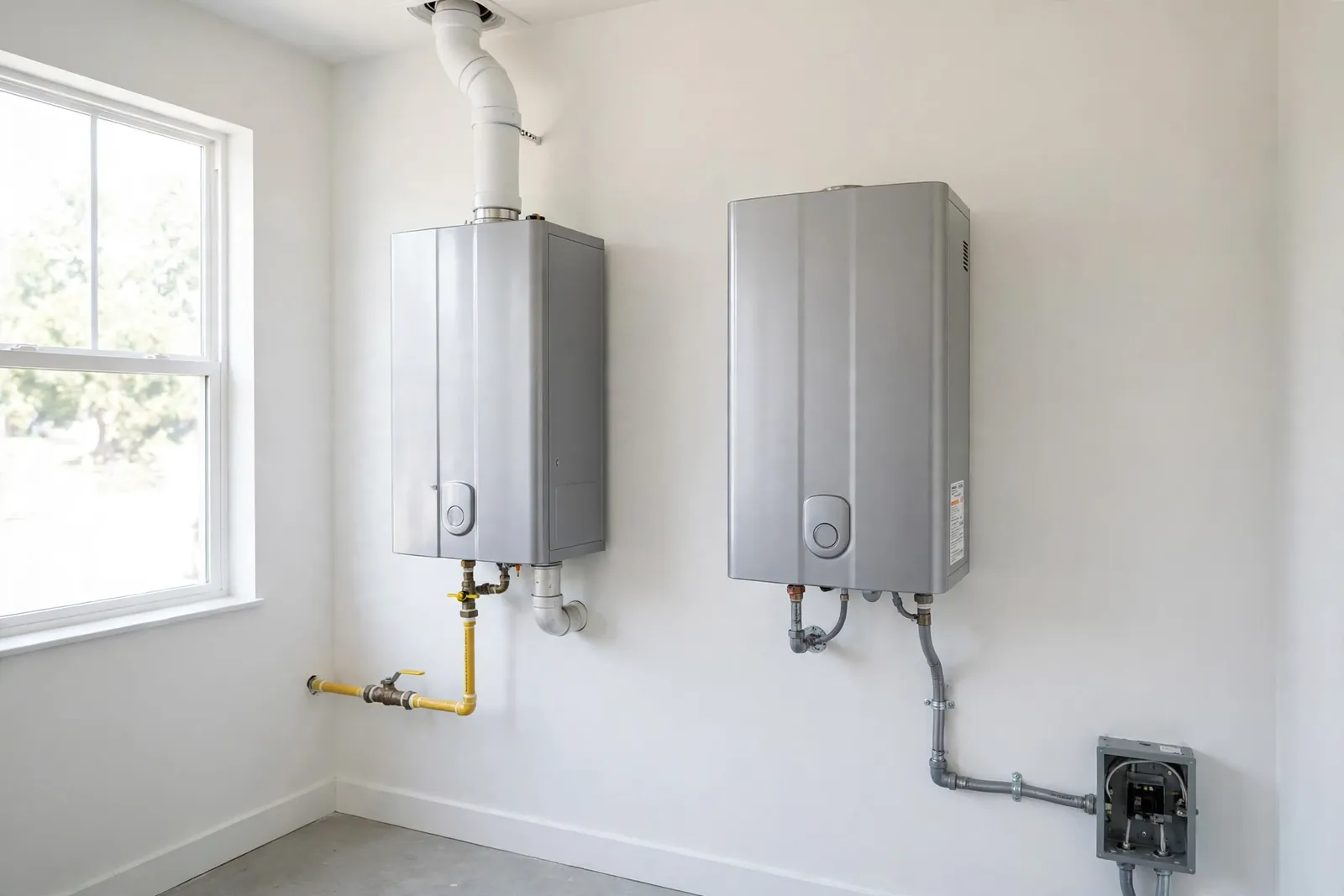 Comparison Guide
Gas vs Electric Tankless Water Heater in Sugar Land, TX
A gas unit heats more water at once; an electric unit is simpler to vent and install. The choice turns on the flow rate the home needs, the gas line, the panel, and the coldest incoming water in January.
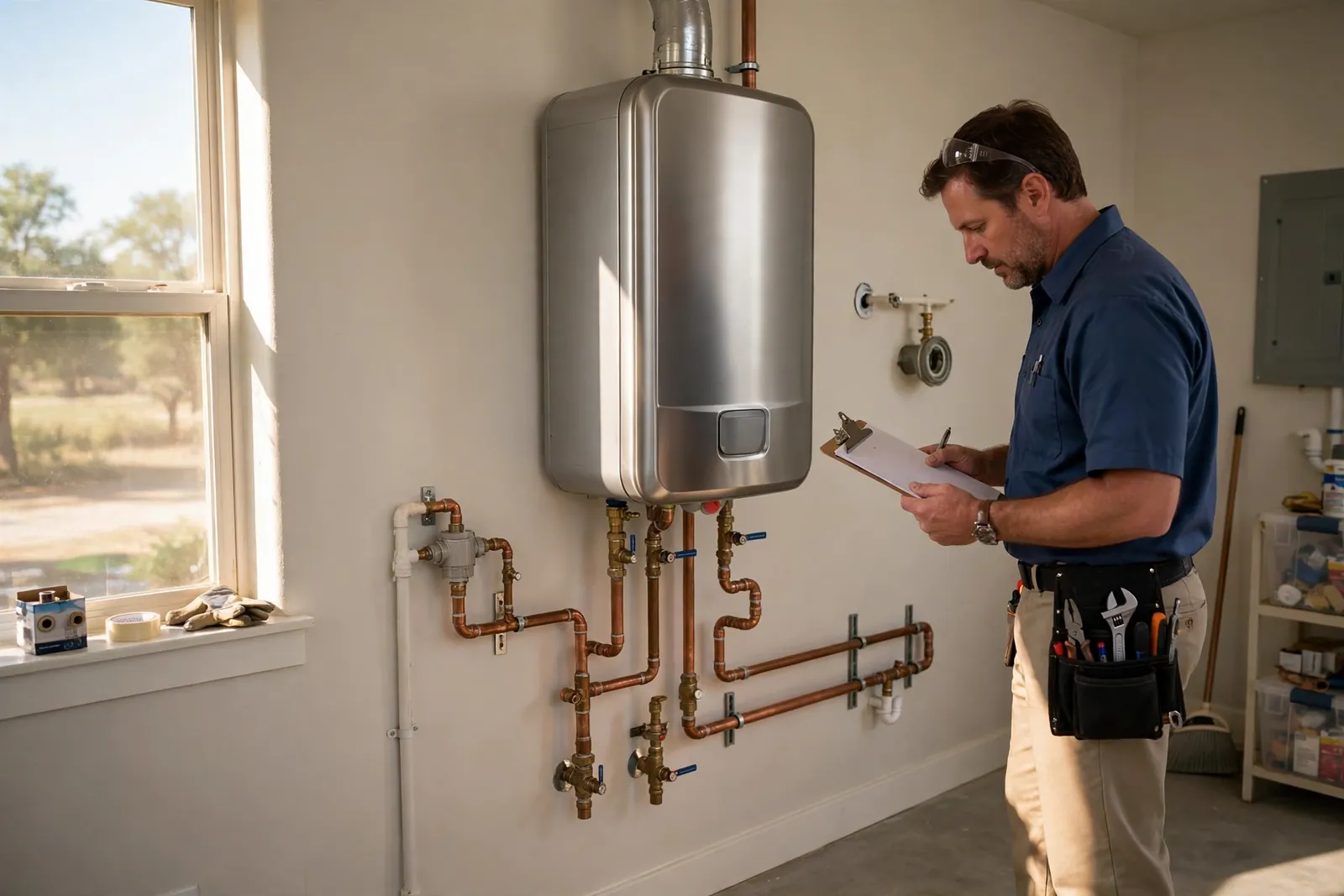 Lifespan Guide
How Long Do Tankless Water Heaters Last in Sugar Land, TX?
A tankless water heater that is descaled on schedule can serve a Sugar Land home for two decades. The lifespan is set by the water, the maintenance, and the parts — and the hard water here is the deciding factor.
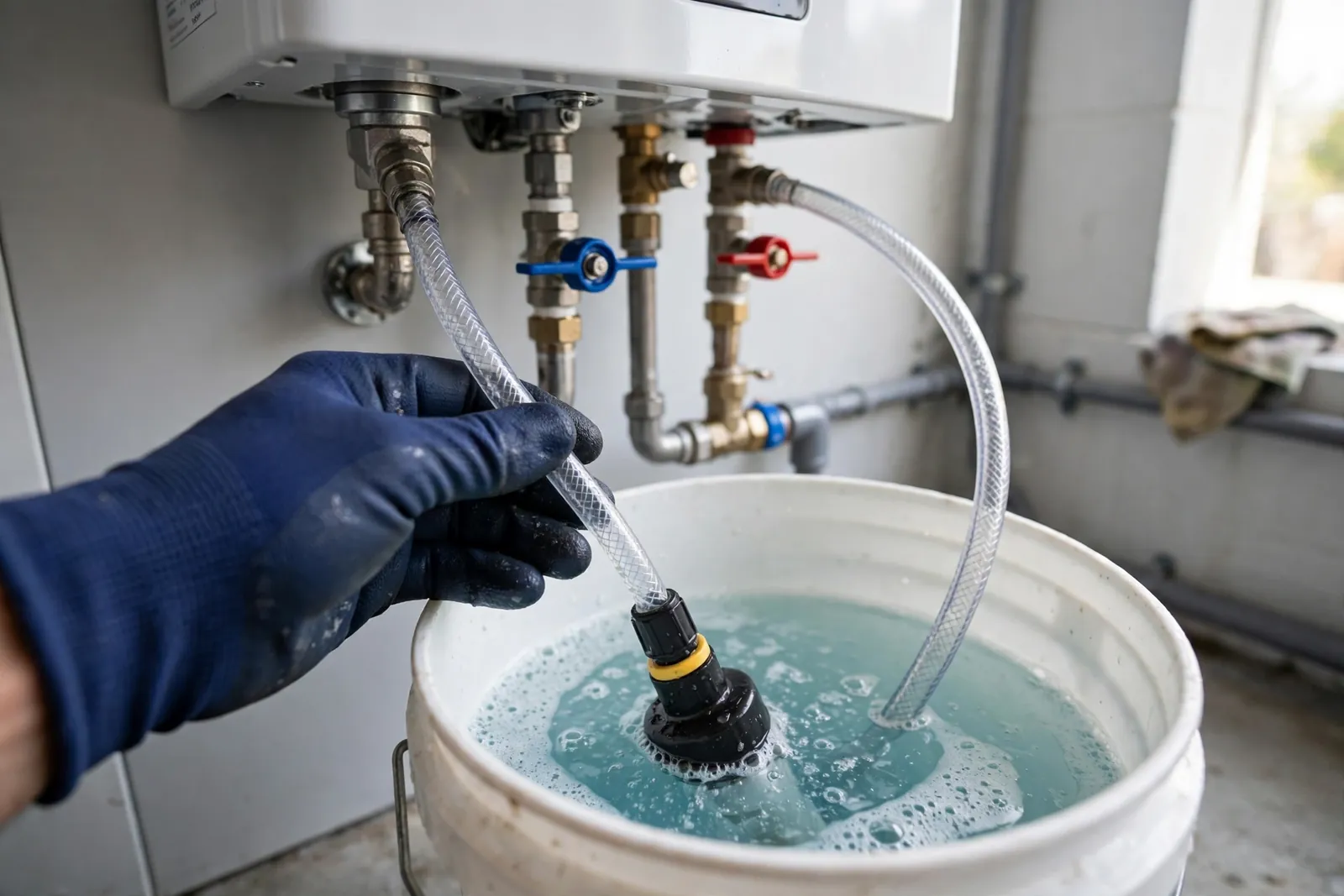 Maintenance Guide
How Often Should a Tankless Water Heater Be Flushed in Sugar Land, TX?
About once a year, in Sugar Land water. Houston-area water is hard, and the mineral load coats the heat exchanger a little more every time the unit fires. This guide explains the routine, the signs a flush is due, and what the visit covers.
Frequently asked questions
Questions people ask about this topic, answered plainly.
It depends on the home. A tankless unit heats water as it flows, so the hot water does not run out — but it needs a yearly descale in hard water, and it must be sized for the household peak. A tank unit is simpler, but the store can run out and the tank corrodes over time.
Yes. A tankless unit is wall-mounted and about the size of a suitcase, and it frees the floor space a tank occupied. A tank unit needs the floor space, the clearance, and the drain pan.
Yes, where it is sized for the home peak and the supply can deliver it — a gas line sized for the unit demand, or the electrical capacity for an electric unit. A second unit is sometimes the answer for the largest homes.
A yearly descale and flush of the heat exchanger, with the inlet filter cleaned at the same time. A tank unit needs a yearly flush and an anode check instead. Both are yearly routines, and both are skipped at a cost.
Yes, and the switch has four parts: the unit, the gas line or the electrical supply, the venting, and the water lines. The gas line is checked for the peak demand of the tankless burner, and upgraded where it cannot deliver.
It affects them differently. Scale coats a tankless heat exchanger and insulates it from the water, so the unit loses heat and flow. Scale settles in a tank and wears the anode rod, so the tank corrodes. Both need yearly maintenance in hard water.
The unit can heat a fixed flow rate by a fixed temperature rise, and two showers plus a washing machine can push the flow past it. It can also be scale narrowing the heat exchanger, or a gas line that starves the burner at peak. Flow and temperature are measured to tell them apart.
A tankless unit that is descaled on schedule commonly serves a home for about two decades — roughly twice the service life of a tank unit. The lifespan is set by the water, the maintenance, and the parts, and hard water is the deciding factor in Sugar Land.
Still have questions?
Call Now to reach a local tankless water heater professional — describe the water and the rooms it reached.
Call now for tankless water heater help
Tap Call Now to reach a local tankless water heater professional. Tell them the make of the unit if you know it, the symptoms, and any error code on the display.
Hours: Mon–Fri 7:00 AM–10:00 PM ET · Sat 8:00 AM–10:00 PM ET · Sun 7:00 AM–9:00 PM ET
Before you call
- Note the error code on the display, if one shows.
- Check whether other taps have hot water, and whether cold water runs normally.
- If the unit is leaking, shut off its water and gas or power where it is safe to do so.
- Take a photo of the display and the label on the unit.
- Note when the problem started and what changed just before it.