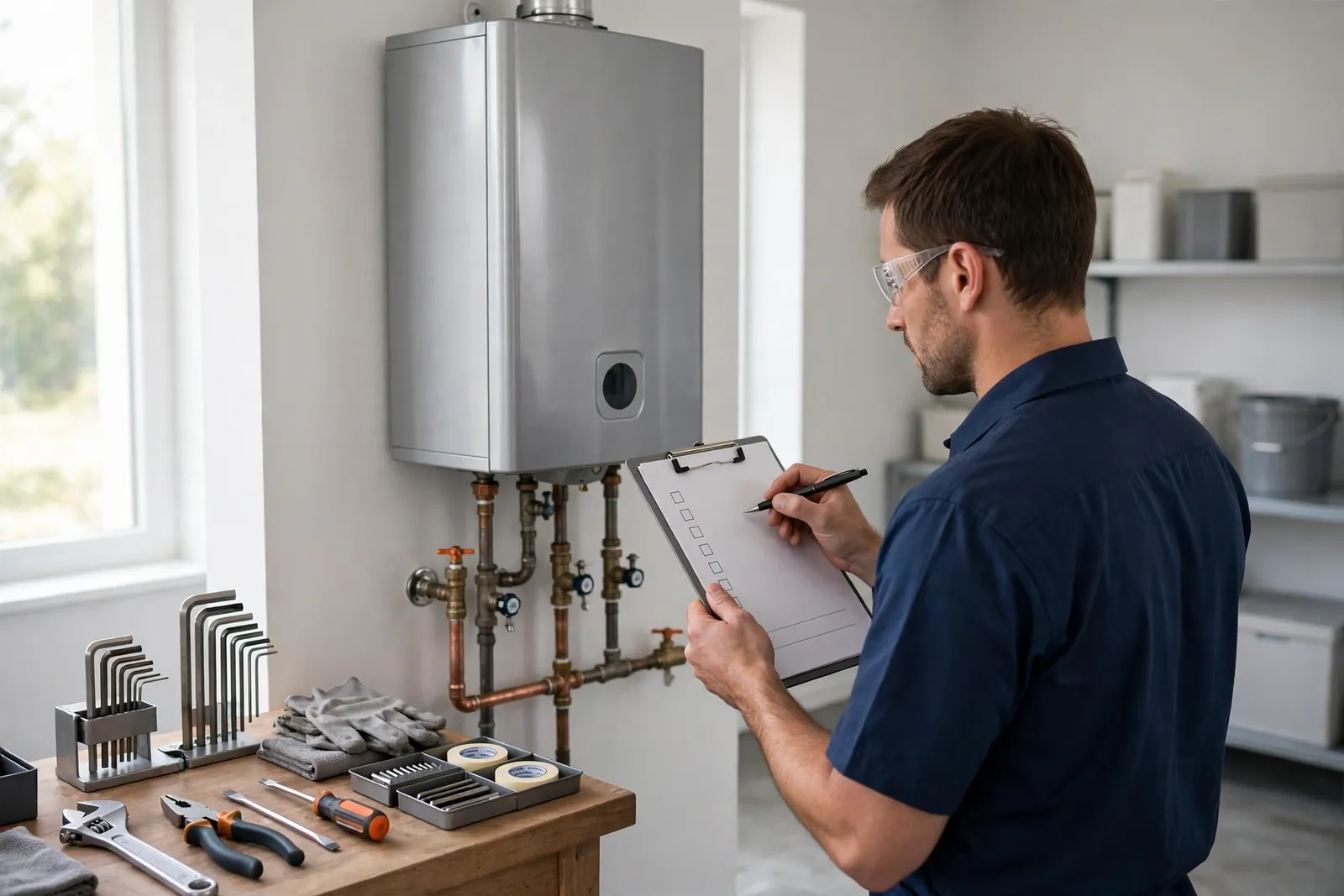
Tankless Water Heater Maintenance Checklist in Sugar Land, TX
The yearly routine, the autumn freeze check, and what to watch between visits. This checklist covers the descaling, the filter, the burner, the venting, and the record — everything a Sugar Land unit needs in a year.
Sugar Land Tankless Pros · 2026-11-17 · Maintenance Guide
The short version
Problem: The yearly routine is the descale and flush, the inlet-filter clean, and a check of the burner, venting, condensate drain and relief valve.
What to do: The autumn freeze check covers the internal heater, the drain-down steps, and the insulation on the water lines.
When to call: Keep the record: what was done, when, and what was found — it is what the maker care guidance asks for.
The yearly routine
The yearly routine is the centre of tankless maintenance, and it has four parts: the descale and flush, the inlet-filter clean, the burner and vent check, and the record. The flush dissolves the scale that hard water lays down on the heat exchanger, the filter clean removes the grit and scale flakes that starve the unit of water, the burner and vent check finds the wear before it becomes a failure, and the record is what the maker care guidance asks for.
The flush is a descale: a pump circulates a cleaning solution through the heat exchanger, dissolving the mineral layer, and the flush water is checked to see how much scale came out. A heavy load means the interval shortens next time. A light load means it stretches. The flow and temperature are checked afterwards, to prove the improvement.
The routine is scheduled, not left to a complaint. A household that waits for a symptom waits too long — the symptom means the scale is already thick enough to matter. A household that schedules the flush every year, at the same season, keeps the unit in the state it was made for.
The inlet filter
The inlet filter screen sits on the cold-water inlet and catches grit and debris before they reach the inside of the unit. In hard-water country it also catches scale flakes — the pieces of mineral that break off the heat exchanger and travel downstream. When the screen clogs, the unit starves for water and will not trigger, or will trigger late.
The filter is cleaned at every maintenance visit, and the flow is checked afterwards. A filter that clogs again quickly points to scale flakes coming off the heat exchanger — and to a flush. The filter is the simplest part of the routine, and the one most often skipped.
A household can check the filter between visits, where the unit maker guidance allows it — but the work involves the water supply and the unit, and the visit is the safer route where the unit has not been serviced in a while, or where the symptoms include error codes or a leak.
Burner, venting and condensate
On a gas unit, the burner is checked: the flame, the air, the igniter and the flame sensor. A fouled flame sensor is the classic ignition repair — the sensor is coated, it cannot prove the flame, and the unit shuts the gas off as a safety measure. On an electric unit, the elements are tested one by one, and the electrical connections are checked.
The venting is checked for blockage, corrosion and correct sizing, to the unit maker instructions and local code. A vent that was never sized correctly shows up as a venting code from the first cold snap, and the fix is the vent, not the unit. The condensate drain is checked for a clear, freeze-proof route — a drain that clogs or freezes is a unit that leaks.
The relief valve is tested, and the pressure is measured. A valve that weeps occasionally is doing its job. A valve that leaks constantly has either failed, or is responding to pressure trouble elsewhere. The pressure is measured, the valve is tested, and the house supply is checked.
The autumn freeze check
The autumn freeze check is the local part of the routine, and it is the one the 2021 freeze made plain. The internal heater is tested, because it works only while the unit has power. The drain-down steps are reviewed, so the household knows them before the cold snap. The insulation on the water lines is checked, and replaced where it has slipped or degraded.
The condensate drain is checked for a freeze-proof route, because a drain that freezes is a unit that leaks. The unit itself is checked for any leak or error code already present, because a unit that is already failing will not survive a hard cold snap well.
The autumn check is scheduled, not left to the first cold night. A household that checks in autumn finds the fault while the weather is still mild. A household that waits for the freeze finds it with water on the floor.
What to watch between visits
Watch the water. A shower a little less hot than it was, a tap that takes longer to warm up, temperature swings during a shower — those are the early signs of scale, and they are the signs to call about before the flow drops and the error codes start.
Watch the display. An error code that appears, and returns after a reset, is a fault that needs finding, not clearing. Write the code down, note what the unit does when a tap opens, and call with both.
Watch the floor. Water under the unit, damp on the wall behind it, or a wet patch that returns after mopping is a leak, and a leak is traced before it is repaired. Shut off the water at the isolation valves where it is safe to do so, and call.
The record
Every maintenance visit ends with a record: what was done, what was found, and when the next visit falls. The record is kept per unit, and it serves three purposes — the maintenance file, the maker care record, and the evidence if a leak has caused damage and a claim follows.
The record is also the basis for the interval. A heavy scale load shortens the descaling interval next time; a light one stretches it. The record is what the next visit builds on, and a unit with a record is a unit whose history is known, and whose faults are caught early.
Between visits: the homeowner checks
Between maintenance visits, a homeowner can check three things: the display, the floor, and the water. The display should be clear — an error code that appears, and returns after a reset, is a fault that needs finding, not clearing. The floor under the unit should be dry — water under the unit, or damp on the wall behind it, is a leak, and a leak is traced before it is repaired. The water should be hot and steady — a shower a little less hot than it was, or a tap that takes longer to warm up, is the early sign of scale.
The checks take two minutes, and they are the early warning the yearly visit cannot give. A household that checks the display, the floor and the water every month finds the fault while it is small. A household that waits for the yearly visit finds it when it has already done damage.
Write down what you find. The code, the date, the symptom — written down, they are the record the visit builds on. A unit whose history is known is a unit whose faults are caught early, and the record is the point of the maintenance as much as the flush.
Related: low water pressure problem · tankless water heater maintenance · tankless water heater help in Sugar Land
Related guides
 Maintenance Guide
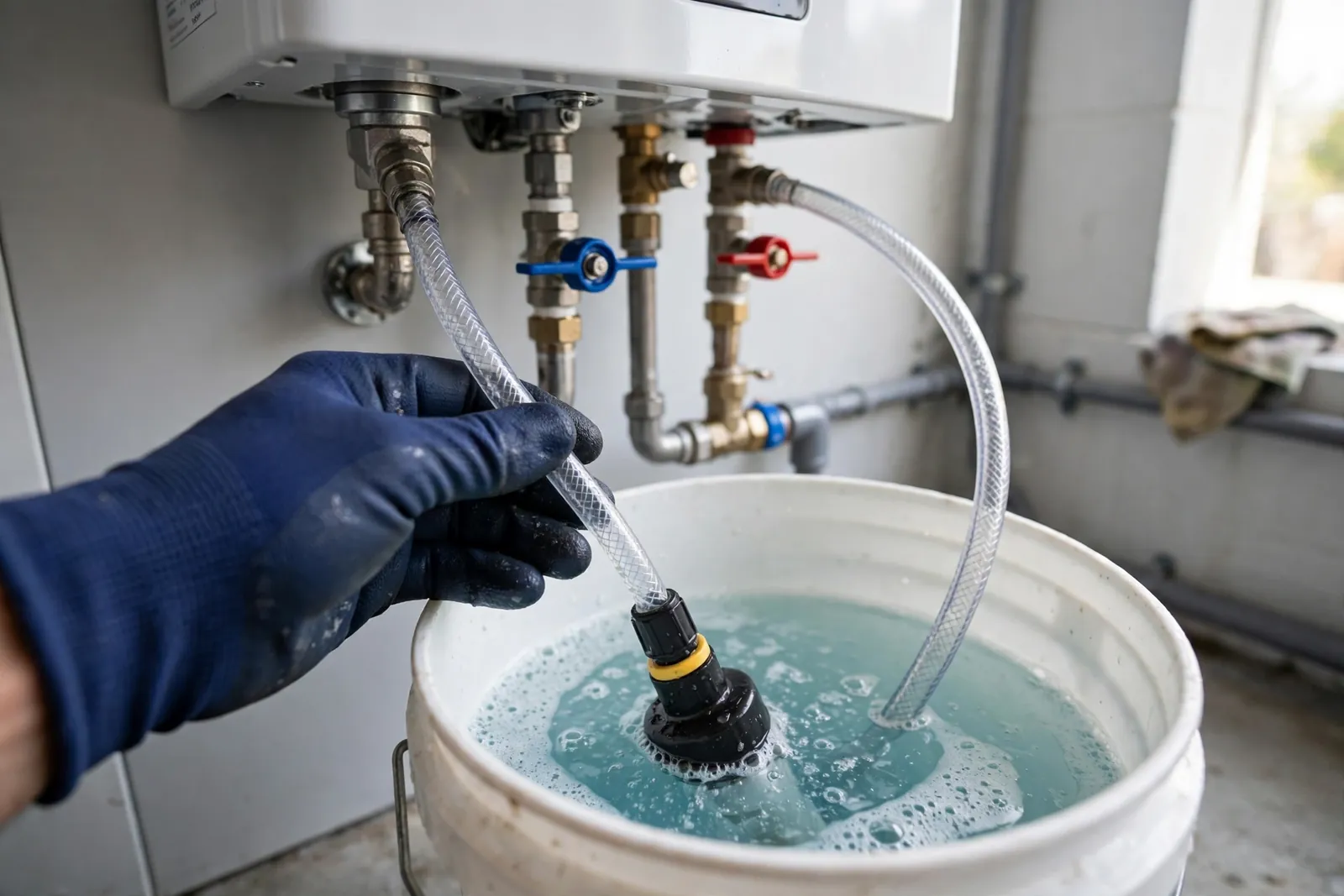
How Often Should a Tankless Water Heater Be Flushed in Sugar Land, TX?
About once a year, in Sugar Land water. Houston-area water is hard, and the mineral load coats the heat exchanger a little more every time the unit fires. This guide explains the routine, the signs a flush is due, and what the visit covers.
 Safety Guide
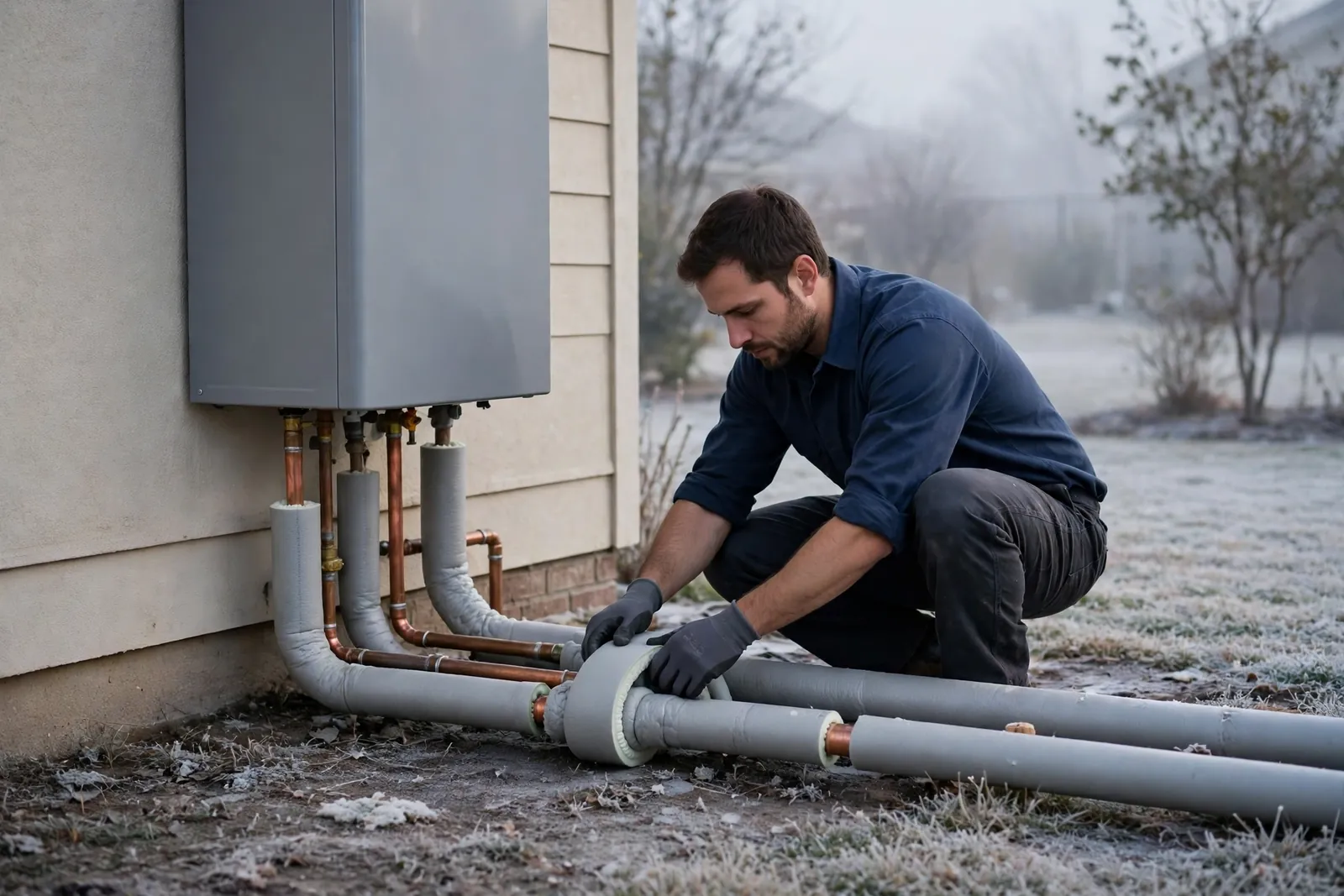
Tankless Water Heater Freeze Protection in Texas
The February 2021 freeze cracked tankless units across the Houston area. This guide explains what protects a unit, what to do before and during a hard cold snap, and what to check after one.
 Lifespan Guide
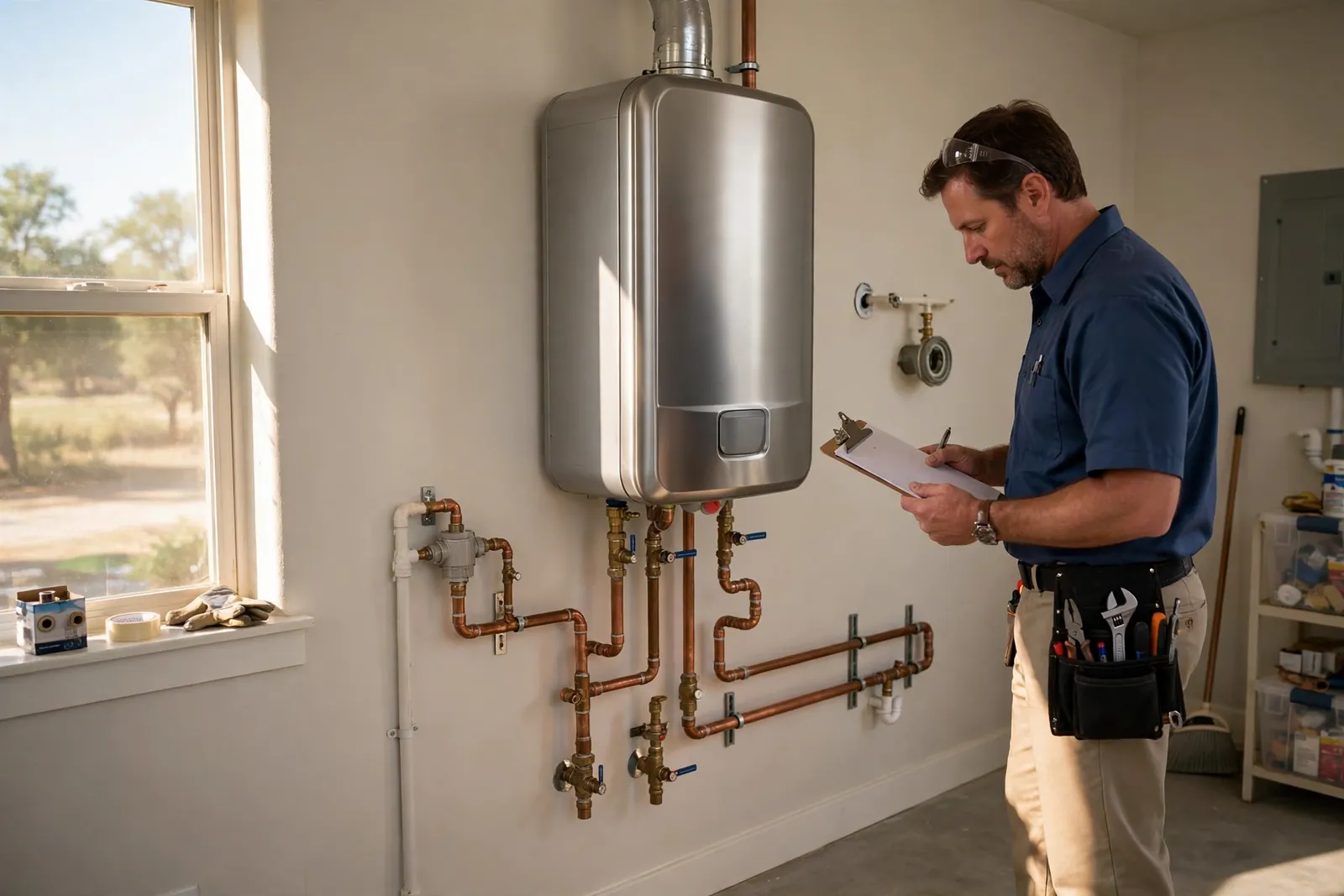
How Long Do Tankless Water Heaters Last in Sugar Land, TX?
A tankless water heater that is descaled on schedule can serve a Sugar Land home for two decades. The lifespan is set by the water, the maintenance, and the parts — and the hard water here is the deciding factor.
Frequently asked questions
Questions people ask about this topic, answered plainly.
The yearly routine: the descale and flush, the inlet-filter clean, the burner and vent check, the condensate drain check, the relief valve test, and the record. The autumn freeze check adds the internal heater test, the drain-down check, and the water-line insulation check.
About once a year in Sugar Land water: a descale and flush, an inlet-filter clean, a burner and vent check, and a freeze-protection check before winter. Commercial units are often serviced twice a year, because they run more hours.
The water: a shower a little less hot, a tap that takes longer to warm up, temperature swings. The display: an error code that returns after a reset. The floor: water under the unit, or damp on the wall behind it.
Yes. A softener removes the calcium and magnesium before they reach the unit, so scale forms far more slowly and the descaling interval stretches. The filter, burner, vent and freeze checks stay on the yearly routine.
The internal heater is tested, the drain-down steps are reviewed, the insulation on the water lines is checked, and the condensate drain is checked for a freeze-proof route. The check happens every autumn, before winter.
The steps are published in most unit maker manuals, but the work involves the gas or electrical supply, the venting and the heat exchanger. The visit is the safer route where the unit has not been serviced in a while, or where the symptoms include error codes or a leak.
It serves three purposes: the maintenance file, the maker care record, and the evidence if a leak has caused damage and a claim follows. It is also the basis for the interval — a heavy scale load shortens the next descaling interval, a light one stretches it.
Call with the age of the unit from the label and the symptoms, if any. The visit starts with the diagnosis — display, flow, supply, filter, scale — and the flush water will say how much scale came out, and whether the interval should shorten next time.
Still have questions?
Call Now to reach a local tankless water heater professional — describe the water and the rooms it reached.
Call now for tankless water heater help
Tap Call Now to reach a local tankless water heater professional. Tell them the make of the unit if you know it, the symptoms, and any error code on the display.
Hours: Mon–Fri 7:00 AM–10:00 PM ET · Sat 8:00 AM–10:00 PM ET · Sun 7:00 AM–9:00 PM ET
Before you call
- Note the error code on the display, if one shows.
- Check whether other taps have hot water, and whether cold water runs normally.
- If the unit is leaking, shut off its water and gas or power where it is safe to do so.
- Take a photo of the display and the label on the unit.
- Note when the problem started and what changed just before it.