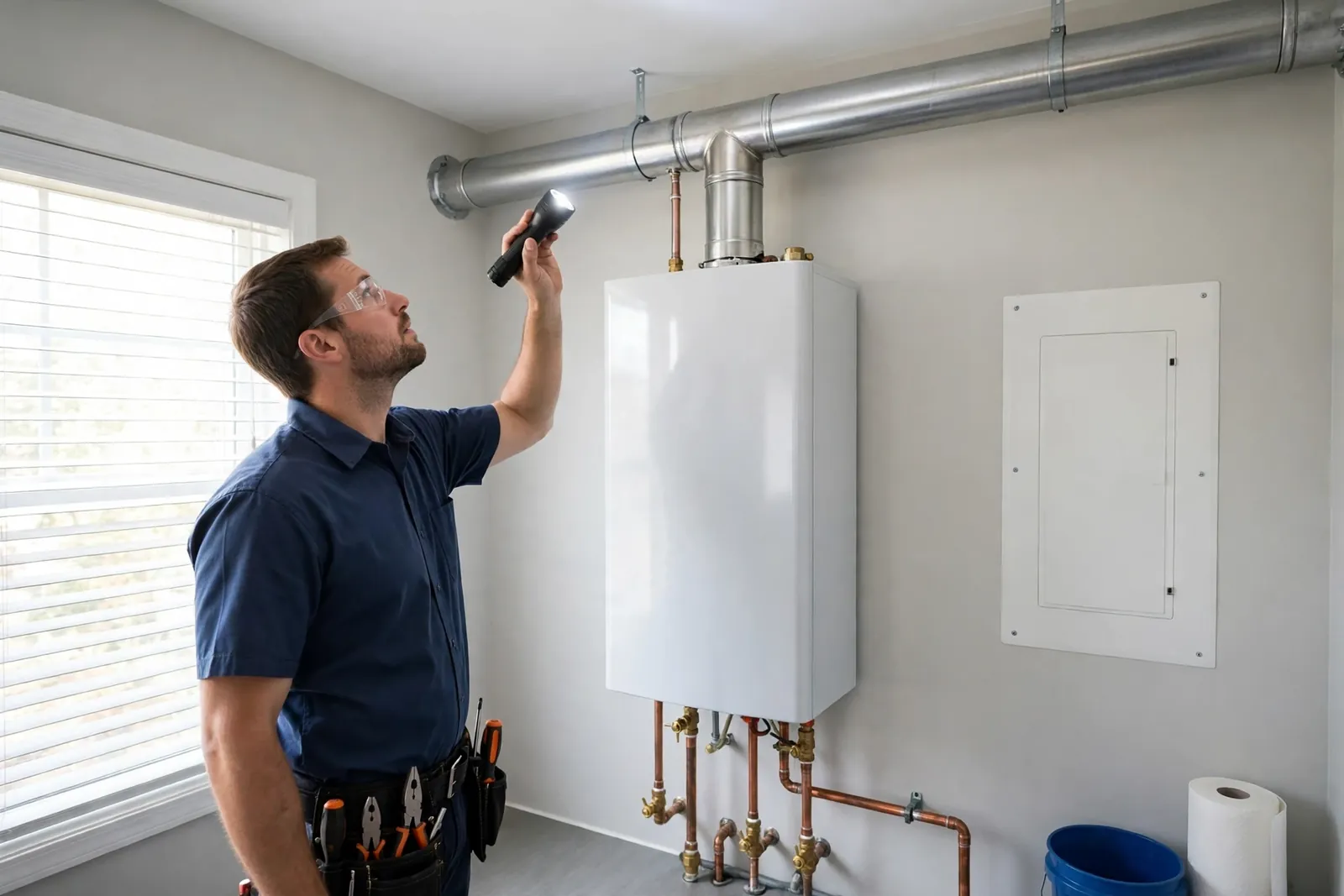
Tankless Water Heater Venting Repair in Sugar Land, TX
A gas tankless unit must carry its exhaust outside safely, and draw combustion air in. When the vent path fails, the safety sensors shut the unit down — and the repair starts with the flue, not the parts.
Need help with your tankless water heater?
Call Now to reach a local tankless water heater professional. Describe the unit, the symptoms, and any error code on the display.
Hours: Mon–Fri 7:00 AM–10:00 PM ET · Sat 8:00 AM–10:00 PM ET · Sun 7:00 AM–9:00 PM ET
What this service does
Venting is the part of a gas tankless installation that households never see and rarely think about — until it fails. A gas unit burns fuel, and burning fuel makes exhaust that must leave the house, and combustion air that must come in. The vent path carries the exhaust outside through a flue or a direct-vent pipe, and the air intake brings fresh air to the burner. When either one is wrong, the safety sensors trip the unit off, and the house has no hot water for a reason that has nothing to do with the burner itself.
The two kinds of gas unit vent differently, and the difference matters before any venting work begins. A condensing unit captures extra heat from its exhaust, so the exhaust is cool enough for plastic pipe — PVC or polypropylene — and the unit makes acidic condensate that drains away through a trap. A non-condensing unit vents hot exhaust through a metal flue and makes no condensate. The venting rules are different for each: the material, the slope, the terminations, the clearances from windows and doors, and the condensate path. The label on the unit says which kind it is.
Blocked venting is the most common venting fault. A flue can be blocked by a nest, by debris, by ice in a hard cold snap, or by corrosion that has narrowed it from the inside. A blocked vent trips the exhaust sensor and shuts the unit down — the unit is protecting the house from exhaust that has nowhere to go. The inspection looks at the whole path: the flue from the unit to the termination, the termination itself, and the clearances around it.
Corrosion is the slow venting fault, and it is the one that shows up on older installations. A metal flue corrodes from the inside, where hot exhaust and moisture meet the metal, and the corrosion narrows the flue and weakens it. A plastic vent on a condensing unit can be damaged by heat where the wrong material was used, or by a joint that was never sealed properly. The inspection looks for rust, staining, sagging and separated joints — and for the condensate drain, which is part of the venting system on a condensing unit.
Wrong sizing is the venting fault that dates from the installation. A vent that is too small for the unit chokes the exhaust; a vent that is too long, or has too many bends, does the same. A vent that terminates too close to a window, a door or an air intake can pull exhaust back into the house. These are installation faults, and they are found by measuring the vent against the unit maker instructions and local code — not by looking at the unit itself.
Before you call
- Note the error code on the display, if one shows.
- Check whether other taps have hot water, and whether cold water runs normally.
- If the unit is leaking, shut off its water and gas or power where it is safe to do so.
- Take a photo of the display and the label on the unit.
- Note when the problem started and what changed just before it.
How tankless venting works — exhaust out, air in
A gas tankless unit vents in one of two ways. A direct-vent unit draws combustion air from outside through one pipe and sends exhaust out through another, so the burner never uses air from inside the house. A non-direct-vent unit draws combustion air from the room it sits in and sends exhaust out through a flue. The direct-vent setup is the common one for modern installations, because it does not depend on the room having enough air — and because a unit in a tight closet or a packed garage can starve for air without it.
The vent path must have the right slope, so that condensate drains back to the unit trap on a condensing unit rather than pooling in the pipe. It must have the right terminations, with clearance from windows, doors and air intakes, so exhaust does not come back into the house. It must be the right material for the unit — plastic for condensing, metal for non-condensing — and the joints must be sealed. Each of these is a check on the inspection, and each one has a failure mode that shows up as a venting code or a unit that will not stay lit.
Combustion air is the other half of venting, and it is the half households block without knowing. A burner needs air to burn, and a unit in a tight closet, a garage packed with storage, or a utility room where the intake has been blocked by boxes will starve. A starved burner burns dirty, fouls the flame sensor, and trips the safety shutoff. The fix is often as simple as clearing the intake and the space around the unit — and the visit checks it before any part is ordered.
The condensate drain is part of the venting system on a condensing unit, and it is the part winter attacks. The drain carries acidic condensate away through a trap and a drain line, and when that line clogs — or freezes in a hard cold snap — the condensate backs up and the unit shuts down. The February 2021 freeze did exactly that across the Houston area. The drain needs a clear path and a freeze-proof route, and the autumn maintenance visit is the natural moment to check both.
What the service includes
Vent path inspection
The flue from the unit to the termination inspected for blockage, corrosion, sagging and separated joints.
Termination and clearance check
The vent termination checked for the right clearances from windows, doors and air intakes.
Combustion air check
The air intake and the space around the unit checked, so a starved burner is found before any part is ordered.
Condensate drain check
The trap and drain line checked for blockage and a freeze-proof route, on condensing units.
Vent repair or replacement
A blocked flue cleared, a joint resealed, or a corroded or wrongly sized vent replaced to the maker instructions and local code.
Testing and proving
The unit run and watched: exhaust leaving cleanly, burner steady, no venting code showing.
How the work runs
Call and describe the unit
The make if you know it, the symptoms, any venting code, and whether the unit is condensing or non-condensing.
Vent path inspection
The flue followed from the unit to the termination, looking for blockage, corrosion and separated joints.
Air and condensate checks
The combustion air intake cleared and checked; the condensate trap and drain line checked.
Measurement against code
The vent measured against the unit maker instructions and local code.
Repair or replacement
A blocked flue cleared, a joint resealed, or a corroded or wrongly sized vent replaced.
Test and prove
The unit run and watched: exhaust leaving cleanly, burner steady, no venting code showing.
Tools and methods used
Vent inspection by eye and hand
The flue is followed from the unit to the termination, looking for blockage, corrosion, sagging and separated joints.
Error-code reading
The display code is read first, because a venting code names the fault the unit detected.
Combustion inspection
The burner flame is watched for a clean, steady burn, and the flame sensor is checked for fouling.
Measurement against code
The vent is measured against the unit maker instructions and local code — material, slope, length, bends, clearances.
Drain inspection
The condensate trap and drain line are inspected for blockage and for a route that cannot freeze.
Venting faults and the codes they cause
Venting faults show up as codes, and the code family points to the vent. A venting code means the safety sensors detected a problem with the exhaust path — a blocked, corroded or wrongly sized vent, or an exhaust sensor reading out of range. The diagnosis follows the code to the vent: the flue from the unit to the termination, the termination itself, the clearances, and the condensate drain on a condensing unit.
Some venting faults show up without a code at all. A burner that burns unevenly, a flame that is yellow rather than blue, a unit that shuts down on cold mornings and works later in the day — each of these can trace back to the vent or the air intake. The inspection does not wait for a code: the vent path, the air intake and the condensate drain are checked on every gas visit, because a venting fault that is found early is a repair, and one that is found late is a safety problem.
When venting means a new vent, not a repair
Some venting faults are repairs: a blocked flue cleared, a separated joint resealed, a condensate drain unblocked, an air intake cleared. Some are replacements: a corroded metal flue that has narrowed from the inside, a plastic vent that was the wrong material for the unit, a vent route that was never right for the unit it serves. The inspection decides which one it is, by measuring the vent against the unit maker instructions and local code.
A new vent is a bigger job than a repair, and it is planned rather than improvised: the route, the material, the slope, the terminations and the clearances, all to the maker instructions and local code. The unit is not run again until the vent is right, because the vent is a safety system, not a convenience. The visit ends with the vent proven — the unit running, the exhaust leaving cleanly, and no code showing.
A gas unit that will not stay lit, shows a venting code, or shuts down on cold mornings
A tankless unit that cannot heat, or heats unevenly, leaves the house without reliable hot water — and the cause is rarely visible from the outside.
A vent path proven clear and correct, and a unit running cleanly with no code showing
The diagnosis names the cause — scale, flow, gas, venting or a failed part — before any work starts, and the fix is tested at the taps.
Problems this service solves
- A vent blocked by a nest, debris, ice or corrosion.
- A corroded metal flue that has narrowed from the inside.
- A plastic vent that was the wrong material for the unit.
- A vent that is too small, too long, or has too many bends.
- A vent terminating too close to a window, door or air intake.
- A condensate drain that has clogged or frozen and backs up.
- A combustion air intake blocked by storage or a closed closet.
- A venting code that returns after every reset.
Signs your tankless venting needs repair
- The display shows a venting error code.
- The unit shuts down on cold mornings and works later in the day.
- The burner flame looks yellow or uneven, or the unit smells of exhaust.
- There is rust, staining or sagging on the flue.
- The unit is in a tight closet or a packed garage with no clear air path.
- Water is leaking from the unit from a blocked condensate drain.
- The vent termination is close to a window, a door or an air intake.
- The unit was installed years ago and the vent has never been inspected.
Other tankless water heater services

Related problems
Industries that use this service
Single-Family Homes · Restaurants and Hospitality · Commercial Offices · All industries →
Frequently asked questions
Questions people ask about tankless water heater venting repair, answered plainly.
It means the safety sensors detected a problem with the exhaust path — a blocked, corroded or wrongly sized vent, or an exhaust sensor reading out of range. The vent path is inspected for blockage, corrosion and correct sizing, to the unit maker instructions and local code.
Cold mornings are when the unit works hardest and when a frozen condensate drain or a blocked vent shows up first. The condensate drain is checked for a freeze-proof route, and the vent path is inspected for blockage — including ice in a hard cold snap.
A condensing unit captures extra heat from its exhaust, so the exhaust is cool enough for plastic pipe, and the unit makes acidic condensate that drains away. A non-condensing unit vents hot exhaust through a metal flue and makes no condensate. The venting rules are different for each.
Yes — a blocked vent means exhaust has nowhere to go, and the unit shuts down for safety. If you smell exhaust or gas near the unit, leave the house and call from outside. Do not run a unit with a venting code until the vent has been checked.
The vent is measured against the unit maker instructions and local code — material, slope, length, bends and clearances. A vent that is too small, too long, or has too many bends chokes the exhaust, and the unit shows a venting code or will not stay lit.
A condensing gas unit makes acidic condensate that drains away through a trap and a drain line. When that drain clogs — or freezes in a hard cold snap — the condensate backs up and the unit shuts down. The drain is checked for blockage and a freeze-proof route.
A yellow or uneven flame usually means the burner is starved of air or fouled — a blocked combustion air intake, a dirty burner, or a venting fault. The air intake and the space around the unit are checked first, before any part is ordered.
Some venting faults are repairs: a blocked flue cleared, a separated joint resealed, a condensate drain unblocked, an air intake cleared. A corroded metal flue, a wrong-material plastic vent, or a vent route that was never right for the unit needs replacing, to the maker instructions and local code.
Every year, as part of the maintenance visit: the vent path for blockage and corrosion, the terminations and clearances, and the condensate drain. The autumn visit also covers the freeze protection before winter.
Yes — a gas unit needs combustion air, and a unit in a tight closet can starve for it. A direct-vent unit draws its air from outside through a pipe; a non-direct-vent unit draws it from the room. Either way, the intake and the space around the unit must be clear.
No hot water in your Sugar Land home?
Call Now to reach a local tankless water heater professional. Describe the unit, the symptoms, and any error code on the display.
Call now for tankless water heater help
Tap Call Now to reach a local tankless water heater professional. Tell them the make of the unit if you know it, the symptoms, and any error code on the display.
Hours: Mon–Fri 7:00 AM–10:00 PM ET · Sat 8:00 AM–10:00 PM ET · Sun 7:00 AM–9:00 PM ET
Before you call
- Note the error code on the display, if one shows.
- Check whether other taps have hot water, and whether cold water runs normally.
- If the unit is leaking, shut off its water and gas or power where it is safe to do so.
- Take a photo of the display and the label on the unit.
- Note when the problem started and what changed just before it.