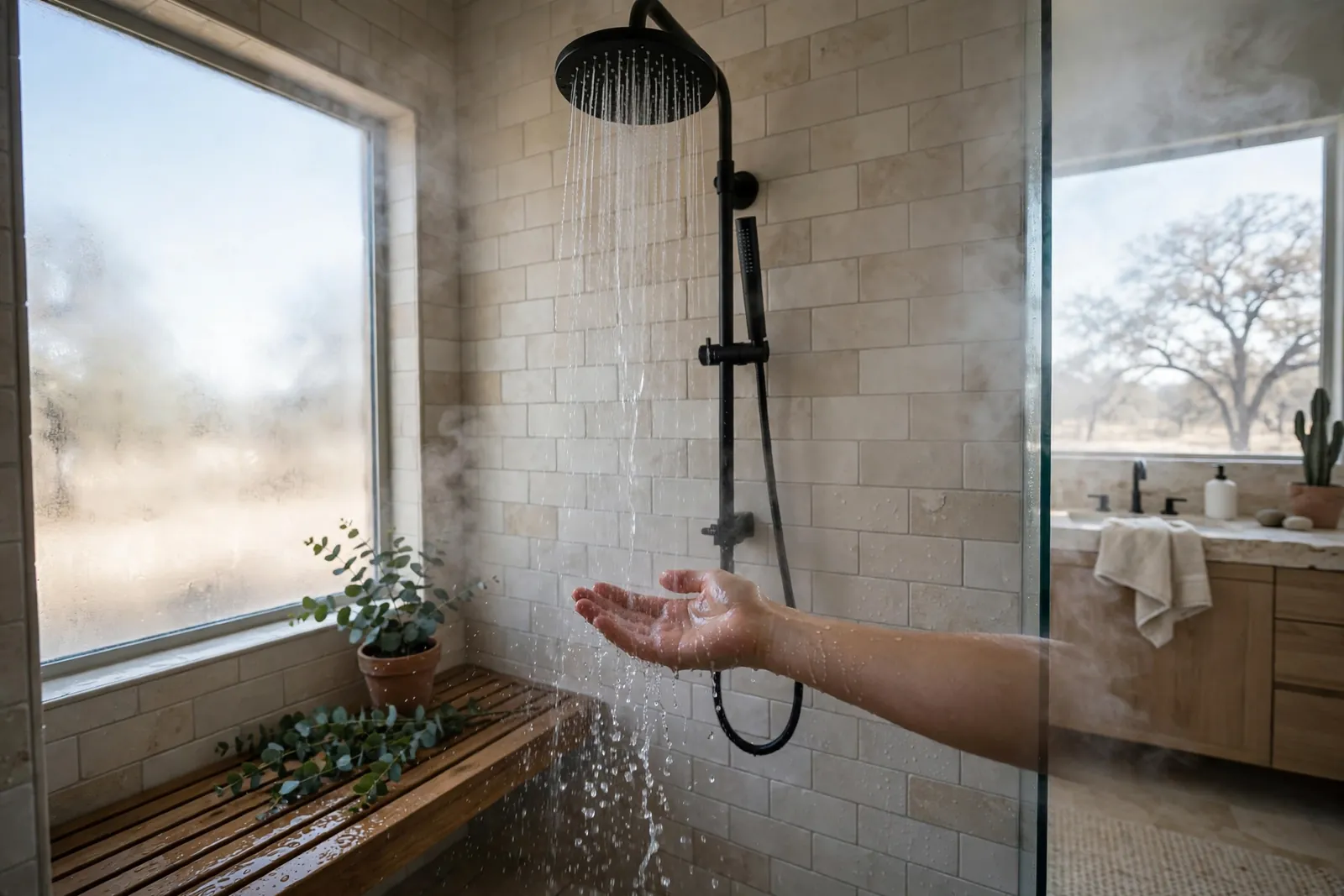
Cold Water Sandwich From a Tankless Water Heater in Sugar Land, TX
Hot, then cold, then hot again during a shower is the classic cold-water sandwich — and it is a flow-and-timing problem, not a broken unit. A recirculation setup is the usual answer where it happens every day.
Need help with your tankless water heater?
Call Now to reach a local tankless water heater professional. Describe the unit, the symptoms, and any error code on the display.
Hours: Mon–Fri 7:00 AM–10:00 PM ET · Sat 8:00 AM–10:00 PM ET · Sun 7:00 AM–9:00 PM ET
What the cold-water sandwich is
The cold-water sandwich is a tankless pattern with a plain description: the shower starts hot, turns cold for a few seconds, then turns hot again. It happens when the flow pauses — a tap closes, a shower pauses, a washing machine fills — and the unit stops firing. The water left in the line between the unit and the tap cools while the unit is off. When the tap opens again, that cooled water arrives first, then the unit fires and hot water follows. Hot, then cold, then hot — a sandwich with cold water in the middle.
The pattern shows up most in large homes, where the run from the unit to the farthest bathroom is long and the water in that run has time to cool. Sugar Land larger homes often have exactly that layout: a unit in the garage or on one end of the house, and a bathroom at the far end. The longer the run, the longer the cold middle of the sandwich.
The sandwich is not a fault, and that is the first thing to understand. The unit is working as designed: it heats water while it flows, and it stops when the flow stops. The cold water is the water that was already in the pipe, cooling while it waited. The fix is therefore not a part — it is a change in how the hot water is delivered, and the usual answer is recirculation.
Why it happens more in some homes
Distance is the first factor. A long pipe run from the unit to the tap holds more water, and that water has more time to cool between draws. A bathroom next to the unit barely shows the pattern; a bathroom at the far end of a large home shows it every day. The layout of the house decides how bad the sandwich is.
Habit is the second factor. A household that opens and closes taps often — a shower paused to soap, a tap opened and closed while washing — creates the pauses that make the sandwich. A household that runs one long, steady draw rarely sees it. The pattern follows the habits, not the unit.
The unit itself is the third factor, and it is about minimum flow. A tankless unit needs a minimum flow to stay firing, and a low-flow showerhead or a tap opened only a little can drop below it. The unit stops, the water in the line cools, and the sandwich follows. A unit with a lower minimum flow, or a small buffer, handles low-flow draws better — and the sizing conversation asks about the fixtures for exactly that reason.
Recirculation: the usual answer
A recirculation pump keeps hot water near the taps, so the wait is short and the sandwich is gone. The pump circulates hot water through the lines on a loop, so the water in the pipe is always hot when the tap opens. It can be a dedicated return line, run back to the unit, or a crossover setup at the farthest fixture, which uses the cold line as the return path.
The pump is sized with the unit, not added blindly afterwards, because it changes how the unit cycles. A pump that runs constantly can cause the unit to short-cycle all day, firing for a few seconds at a time. A pump on a timer, or on a demand switch, runs when the household needs it — the morning peak, the evening peak — and rests the rest of the day. The setup is planned, not improvised.
There is one more option, and it is the simplest: a small buffer tank. A buffer holds a small amount of hot water ready, so the tap draws hot water while the unit fires up. It is the answer where a pump is not practical, and where the sandwich happens at one tap rather than throughout the house. The choice between a pump and a buffer is made by the layout and the habits, not by the unit alone.
What to check before you call
Note where the sandwich happens — one tap or every tap — and when: at the start of a shower, in the middle, or when another tap opens. Note how long the run is from the unit to the tap, and whether the tap is a low-flow fixture. Note the error code on the display, if one shows, because a sandwich with an error code is a different problem from a sandwich without one.
A sandwich with an error code points to a fault — a sensor, a flow problem, or scale. A sandwich without a code, in a large home with a long run, points to the layout. The pattern, and the code, are what the visit needs.
What to do now
- Note where the sandwich happens — one tap or every tap.
- Note when it happens — start, middle, or when another tap opens.
- Note how far the tap is from the unit.
- Note whether the tap is a low-flow fixture.
- Note the error code on the display, if one shows.
- Note whether the pattern is worse in winter.
What causes it
Long pipe run
A long run from the unit to the farthest bathroom, holding water that cools between draws.
Paused flow
A tap opened and closed often, so the unit stops and the water in the line cools.
Low-flow fixtures
A low-flow showerhead dropping below the unit minimum flow, so the unit stops firing.
No recirculation
A home without a recirculation setup, so the water in the line cools between draws.
Oversized unit cycling
A unit that fires and stops in short bursts, leaving cooled water in the line.
Scale narrowing flow
Scale narrowing the heat exchanger, so the flow drops and the unit cycles.
Signs of this problem
- The shower goes hot, then cold, then hot again.
- The pattern happens at the farthest bathroom, not the nearest.
- The cold middle lasts a few seconds, then the water is hot again.
- The pattern happens when a tap opens and closes often.
- The pattern happens when another tap opens mid-shower.
- A low-flow showerhead makes it worse.
- The unit shows no error code while it happens.
- The pattern is worse in winter, when the water in the line cools faster.
Related service: Tankless Water Heater Repair
Related guide: gas vs electric guide
Related service: tankless water heater repair
Frequently asked questions
Questions people ask about cold water sandwich, answered plainly.
Hot, then cold, then hot again during a shower. The unit stops firing when the flow pauses, the water left in the line cools while the unit is off, and that cooled water arrives first when the tap opens again — then the unit fires and hot water follows.
Usually not. The unit is working as designed: it heats water while it flows, and it stops when the flow stops. The cold water is the water that was already in the pipe, cooling while it waited. The fix is a change in how the hot water is delivered, usually recirculation.
Usually, yes. A recirculation pump keeps hot water near the taps, so the wait is short and the sandwich is gone. It can be a dedicated return line or a crossover setup at the farthest fixture, and it is sized with the unit.
Distance. A long pipe run from the unit to the tap holds more water, and that water has more time to cool between draws. A bathroom next to the unit barely shows the pattern; a bathroom at the far end of a large home shows it every day.
Yes. A tankless unit needs a minimum flow to stay firing, and a low-flow showerhead can drop below it. The unit stops, the water in the line cools, and the sandwich follows.
A buffer tank holds a small amount of hot water ready, so the tap draws hot water while the unit fires up. It is the answer where a pump is not practical, and where the sandwich happens at one tap rather than throughout the house.
Winter incoming water is colder, and the water in the line cools faster between draws. A sandwich that is barely noticeable in summer can be plain in January, when the line water is coldest.
Yes, where it happens every day. The visit checks the layout, the fixtures and the unit, and the answer is usually a recirculation setup or a buffer — sized with the unit, not added blindly afterwards.
Dealing with this problem now?
Call Now to reach a local tankless water heater professional. Describe the unit, the symptoms, and any error code on the display.
Call now for tankless water heater help
Tap Call Now to reach a local tankless water heater professional. Tell them the make of the unit if you know it, the symptoms, and any error code on the display.
Hours: Mon–Fri 7:00 AM–10:00 PM ET · Sat 8:00 AM–10:00 PM ET · Sun 7:00 AM–9:00 PM ET
Before you call
- Note the error code on the display, if one shows.
- Check whether other taps have hot water, and whether cold water runs normally.
- If the unit is leaking, shut off its water and gas or power where it is safe to do so.
- Take a photo of the display and the label on the unit.
- Note when the problem started and what changed just before it.