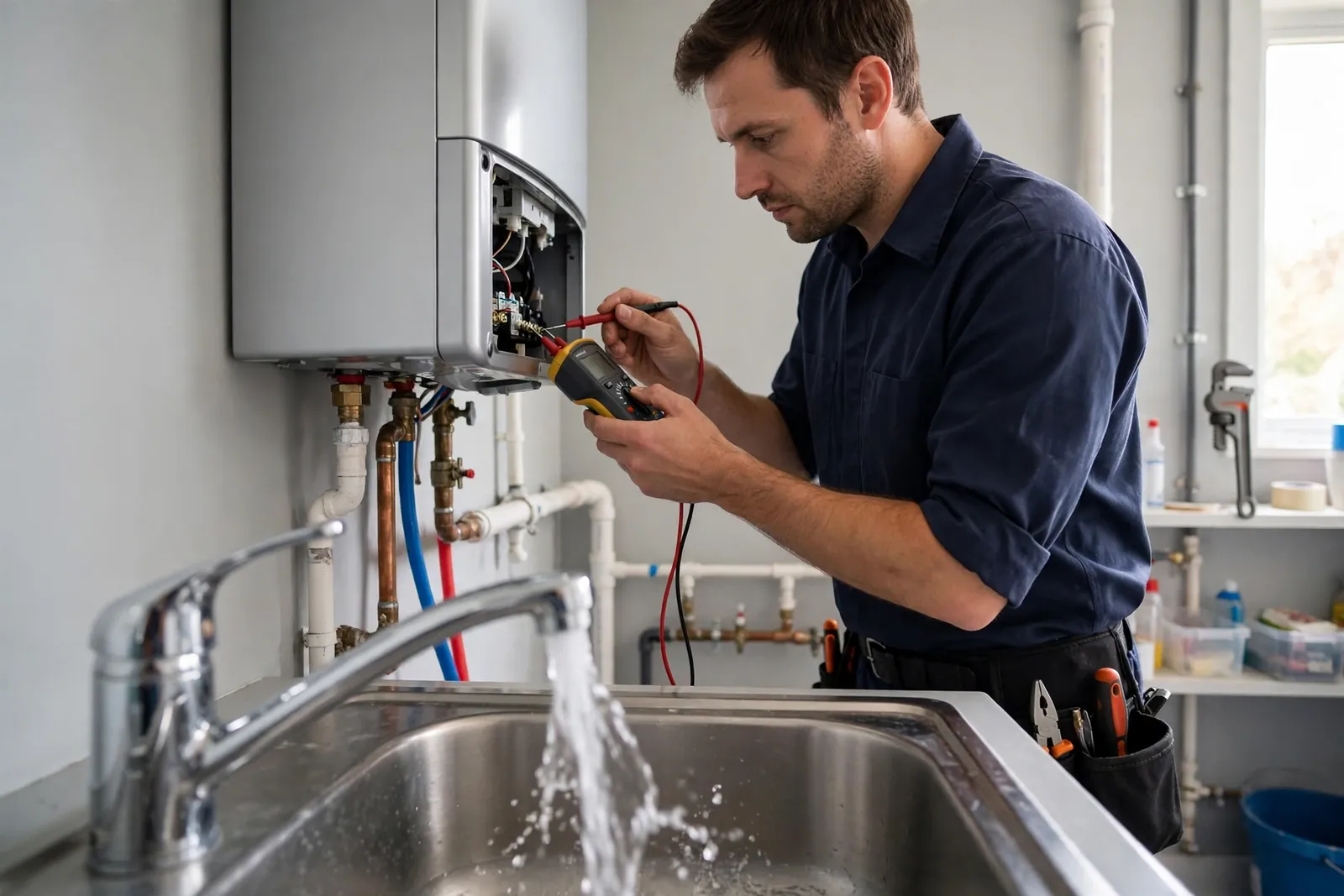
Why Is My Tankless Water Heater Not Heating in Sugar Land, TX?
A tankless unit that will not heat is a diagnosis job, and the diagnosis runs in order: display, flow, supply, filter, scale, and then the parts. This guide walks the order, and the causes behind each step.
Sugar Land Tankless Pros · 2026-11-17 · Repair Guide
The short version
Problem: Start with the display: an error code names the fault the unit detected.
What to do: The most common Sugar Land cause is scale, and the second is the inlet filter — both cheap to fix and expensive to ignore.
When to call: Do not keep resetting the unit: a code that returns is a fault that needs finding, not clearing.
The diagnosis, in order
A tankless unit that will not heat is a diagnosis job, and the diagnosis runs in order: display, flow, supply, filter, scale, and then the parts. The order matters, because each step rules out a cause before the next one is tried — and a diagnosis that jumps to the parts first is a diagnosis that replaces a sensor when the filter was clogged.
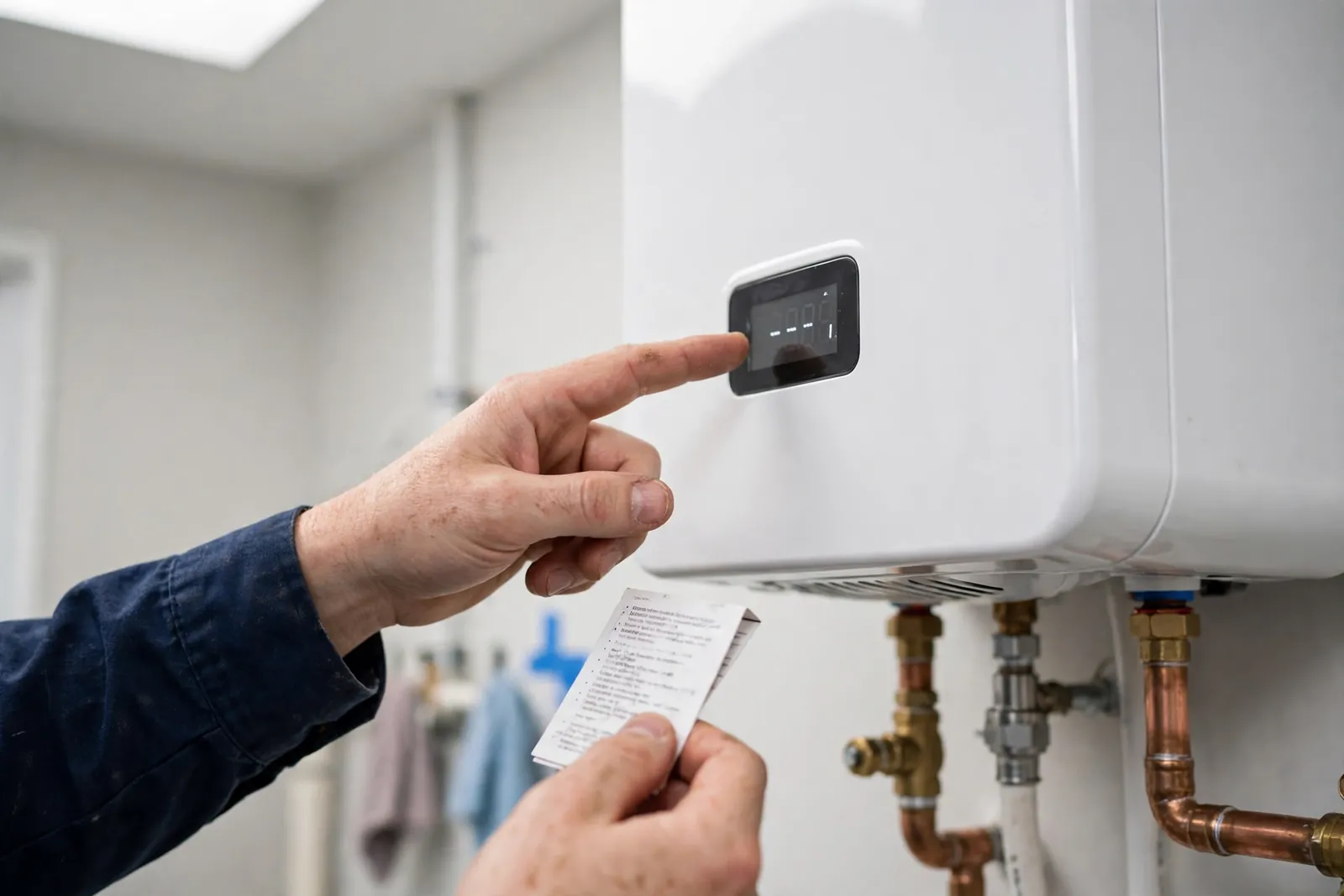
The display comes first, because the unit is already keeping a record. An error code names the fault the unit detected — ignition failure, overheating, a venting fault, a sensor out of range — and the code decides what the visit covers. No code at all is information too: a unit with a blank display has lost power, or its control board has failed. The code is written down before the unit is reset, because a reset clears the evidence.
Flow comes second. The flow sensor must detect enough water moving to trigger the burner or the elements, and if the flow is too low the unit stays silent. The inlet filter is pulled and looked at: a clogged screen is visible at a glance, and cleaning it sometimes ends the visit. Flow is measured at the taps, because numbers end arguments about how the water feels.
Supply: gas or power
Supply comes third: gas or power. A gas unit with no gas, a closed valve, or a line that cannot deliver the pressure under load will not light, or will light and die. The gas is checked at the unit, under load, because a line that delivers enough pressure at rest can starve the burner at peak — and a gas line sized for a tank unit is the classic version of that fault.
An electric unit with a tripped breaker, a failed element, or a panel that cannot carry the load will not heat, or will heat only partly. The breaker panel is checked, the elements are tested, and the voltage is measured at the unit. A breaker that trips every time the unit tries to heat is a load problem, not a unit problem — and the panel is the answer.
A supply fault that appears after other work — a renovation, a meter change, a panel upgrade — points to the work. A valve closed during the renovation, a breaker left off, a meter that cannot deliver the pressure under load. The history shapes the diagnosis, and the call asks for it.
Filter and scale
The inlet filter is the simplest cause and the most common after scale. The screen sits on the cold-water inlet and catches grit and debris before they reach the inside of the unit. In hard-water country it also catches scale flakes — the pieces of mineral that break off the heat exchanger and travel downstream. When the screen clogs, the unit starves for water and will not trigger. The screen is pulled, looked at, cleaned, and the flow is checked afterwards.
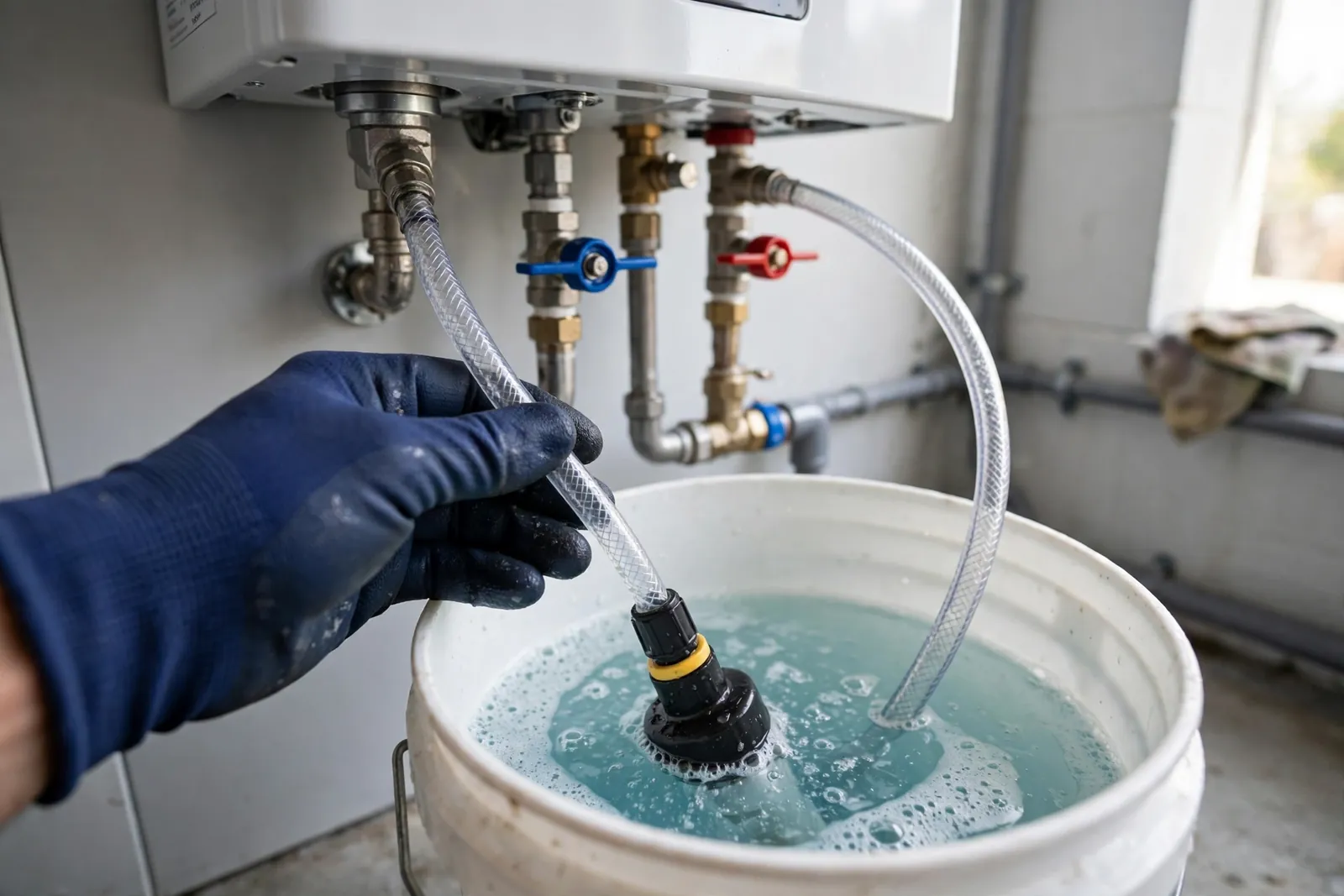
Scale is the Sugar Land cause. Hard water coats the heat exchanger a little more every time the unit fires, until the heat cannot get through and the unit trips its overheat protection. The symptoms arrive in order: a shower a little less hot, a tap that takes longer to warm up, temperature swings, then flow dropping and error codes on cold mornings. A descale dissolves the layer, and the flow and temperature are checked afterwards.
The flush water says how much scale came out, and whether the interval should shorten next time. A heavy load means the unit has been working against a thick layer, and the yearly routine has been skipped too long. A light load means the routine is working, and the interval can hold.
The parts that fail
A failed igniter or flame sensor is the classic gas-unit fault. The unit tries to light, the igniter sparks, the flame lights — and the flame sensor, coated in deposits, cannot prove the flame, so the unit shuts the gas off as a safety measure. The unit lights and dies within seconds, and the code names the ignition fault. The sensor is cleaned or replaced, and the unit lights and stays lit.
A failed flow sensor is the fault that hides most, because the unit does nothing at all. The water flows, but the sensor does not report it, so the burner or the elements never switch on. The sensor is tested against a known flow, and a sensor that reads wrong is replaced.
A failed element is the electric-unit version: the unit heats, but not enough, or one element has failed and the other carries the load alone. The elements are tested one by one, and a failed element is replaced. A control board that will not respond, or that throws codes for faults that are not there, is the last part in the chain — and it is replaced only after the sensors and the wiring are ruled out.
No heat at one tap, or every tap
No heat at one tap, with the rest hot, means the problem is at that tap — a fixture, a valve, or a mixing valve — rather than the unit. The unit is heating; the tap is not delivering. The fixture is checked first, because a diagnosis that starts at the unit when the fault is at the tap wastes the visit.
No heat at every tap means the unit is the problem, and the diagnosis starts at the display. Cold water running normally at the taps means the house supply is fine. Cold water weak or absent everywhere means the problem may be the house supply instead — and the unit is not the fault at all.
No heat that started suddenly, with no warning, points to supply, a sensor, or a part. No heat that followed a slow decline — lukewarm water, slow flow, error codes over months — points to scale. The history is the diagnosis, and the call asks for it.
What to do while you wait
Note the error code on the display, if one shows, and the make of the unit from the label. Check whether cold water runs normally, check the breaker panel, check the gas valve, and check whether other taps have hot water. Take a photo of the display and the label. If the unit is leaking, shut off its water and gas or power where it is safe to do so.
Do not keep resetting the unit. A reset clears the code, not the fault, and if the code returns the unit is still detecting the same problem. A unit that keeps shutting off is protecting itself from damage, and every cycle adds wear. Write the code down and call.
Related: no hot water problem · tankless water heater not heating · tankless water heater help in Sugar Land
Related guides
 Repair Guide
Tankless Water Heater Error Codes Explained in Sugar Land, TX
An error code is the unit telling you what it detected. This guide explains the code families — ignition, overheat, venting and sensor codes — what to check first, and which codes mean stop and call now.
 Maintenance Guide
How Often Should a Tankless Water Heater Be Flushed in Sugar Land, TX?
About once a year, in Sugar Land water. Houston-area water is hard, and the mineral load coats the heat exchanger a little more every time the unit fires. This guide explains the routine, the signs a flush is due, and what the visit covers.
 Maintenance Guide
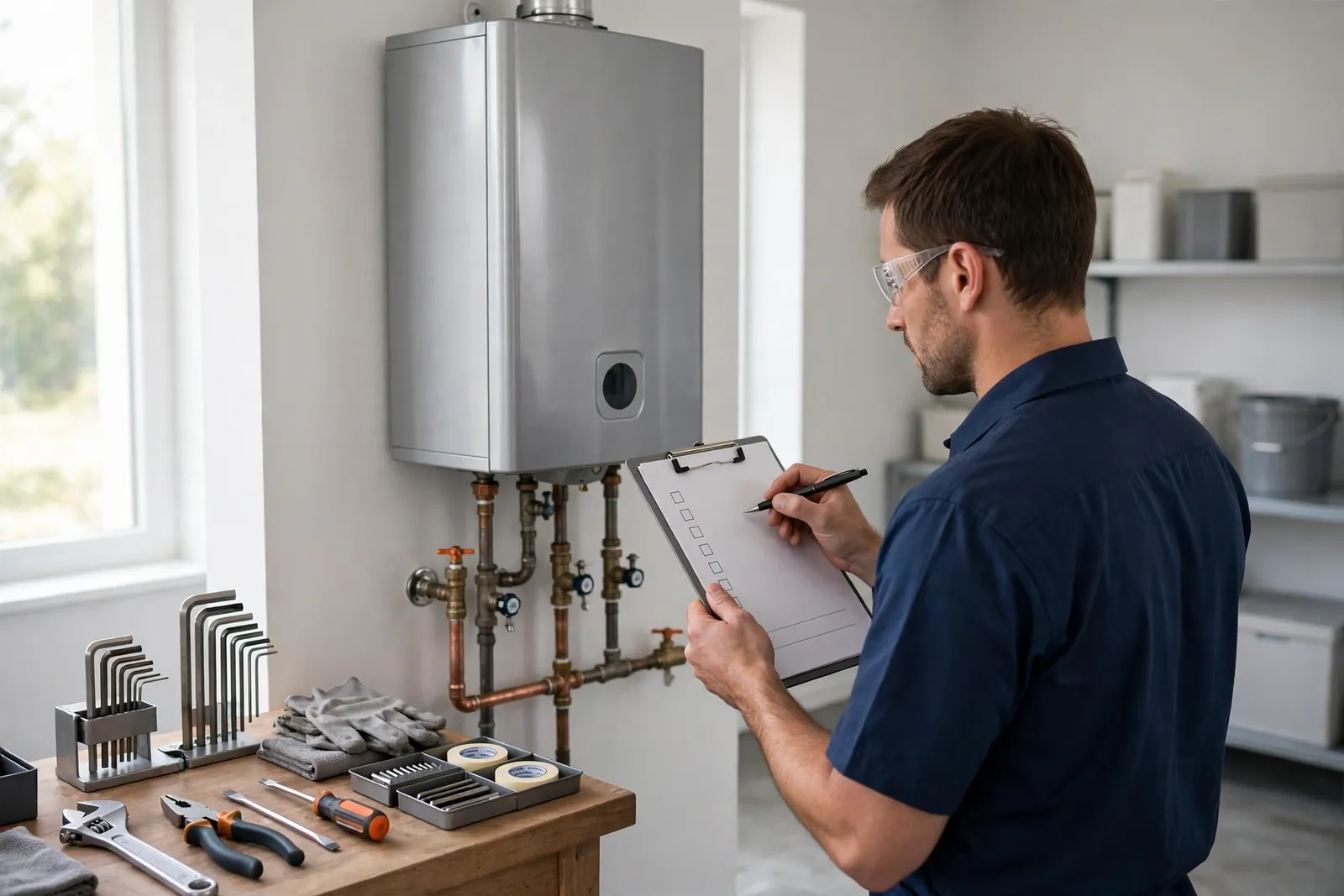
Tankless Water Heater Maintenance Checklist in Sugar Land, TX
The yearly routine, the autumn freeze check, and what to watch between visits. This checklist covers the descaling, the filter, the burner, the venting, and the record — everything a Sugar Land unit needs in a year.
Frequently asked questions
Questions people ask about this topic, answered plainly.
Start with the display: an error code names the fault the unit detected. Common causes are no gas or power, a tripped breaker, a closed valve, a clogged inlet filter, or a failed igniter or flow sensor. If the unit is leaking, shut off its water and gas or power where it is safe to do so, then call.
Note the error code, check whether cold water runs normally, check the breaker panel and the gas valve, and check whether other taps have hot water. Take a photo of the display and the label on the unit.
Often, yes — where scale is the cause. A descale dissolves the mineral layer insulating the heat exchanger, and the flow and temperature are checked afterwards. Where the heat exchanger is damaged beyond flushing, the conversation becomes a replacement.
No. Write the code down first, then reset once. If the code returns, the unit is still detecting the same problem, and repeated resets mask a fault that is getting worse.
Usually not. If one tap is cold and the rest are hot, the problem is at that tap rather than the unit. If every tap is cold, the unit is the problem and the call is urgent.
A blank display means the unit has lost power, or its control board has failed. Check the breaker panel and the power to the unit first. If power is reaching the unit and the display stays blank, the board is the likely fault.
Yes. A hard freeze can crack the heat exchanger, the water lines and the condensate drain. The February 2021 freeze did exactly that across the Houston area. A unit that stopped working after a cold night is checked for freeze damage first.
The diagnosis itself is fast — display, flow, supply, filter, scale, in order — and the fault is usually named on the visit. Whether the repair follows the same day depends on the fault and the part.
Still have questions?
Call Now to reach a local tankless water heater professional — describe the water and the rooms it reached.
Call now for tankless water heater help
Tap Call Now to reach a local tankless water heater professional. Tell them the make of the unit if you know it, the symptoms, and any error code on the display.
Hours: Mon–Fri 7:00 AM–10:00 PM ET · Sat 8:00 AM–10:00 PM ET · Sun 7:00 AM–9:00 PM ET
Before you call
- Note the error code on the display, if one shows.
- Check whether other taps have hot water, and whether cold water runs normally.
- If the unit is leaking, shut off its water and gas or power where it is safe to do so.
- Take a photo of the display and the label on the unit.
- Note when the problem started and what changed just before it.